07 Jan 2020 | 12:58 UTC — Dubai
US warns of Iranian maritime threats against its ships in Middle East

By Dania Saadi
Dubai — The US Maritime Administration has issued an advisory warning of the possibility of Iranian attacks on US ships in Middle Eastern waters after a US military strike in Baghdad on Friday killed atop Iranian commander, Qassem Soleimani, fueling tensions in the region and heightening concerns about disruption to oil supplies.
"The Iranian response to this action, if any, is unknown, but there remains the possibility of Iranian action against U.S. maritime interests in the region," said the department on its website.
"US commercial vessels are advised to exercise caution and coordinate vessel voyage planning for transits of the Persian Gulf, Strait of Hormuz, Gulf of Oman, North Arabian Sea, Gulf of Aden, and Red Sea with NCAGS (US Fifth Fleet Naval Cooperation and Guidance for Shipping) and follow NCAGS's recommendations and guidance whenever possible."
The US Fifth Fleet, which is based in Bahrain, polices the Strait of Hormuz and the other important waterways in the region.
Iranian has reiterated its threat to retaliate to the US strike after US President Donald Trumpvowed to hit 52 Iranian sites if Tehran strikes back.
Click here for full-size image

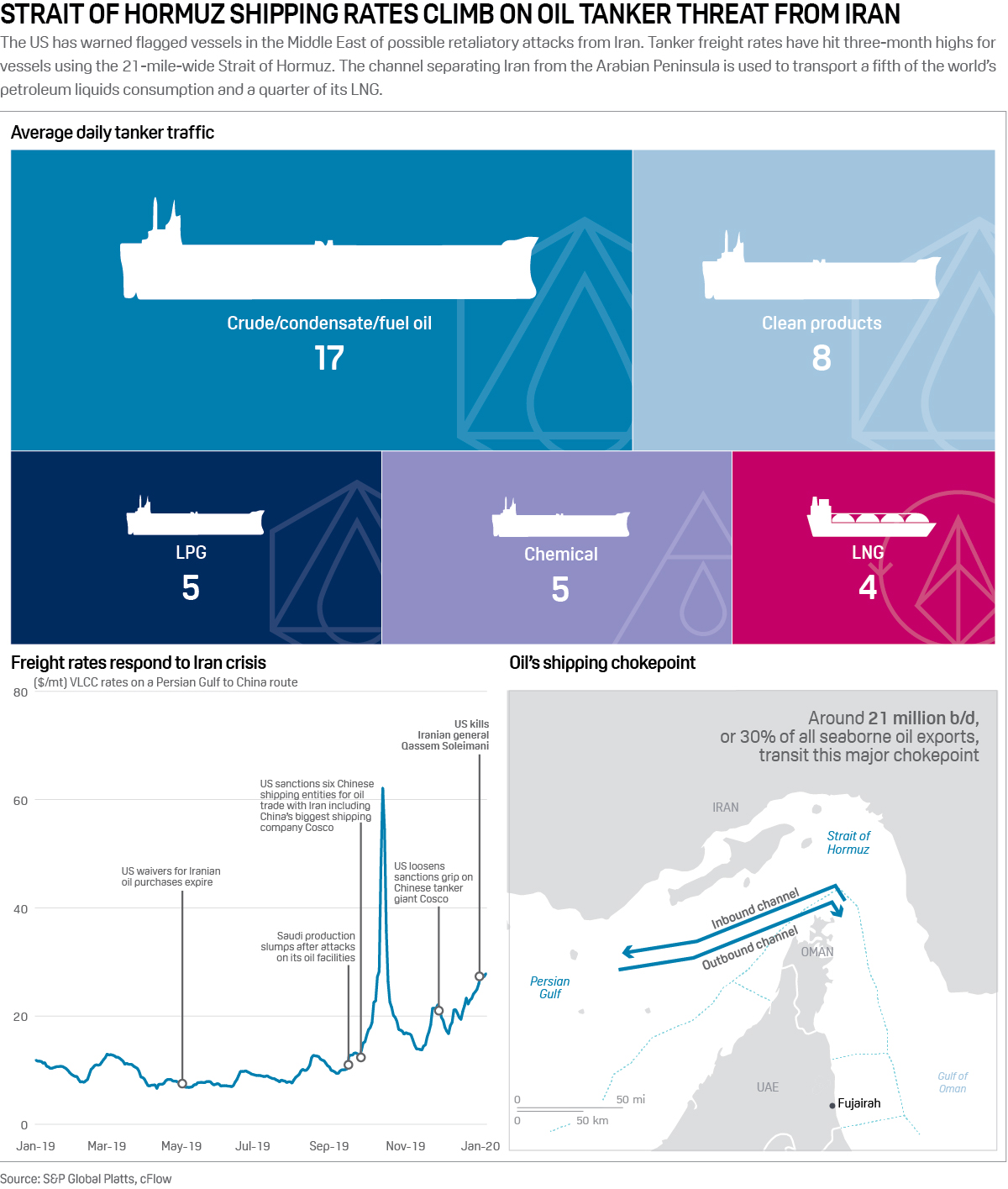
STRAIT OF HORMUZ
The US-Iran standoff has sent oil prices soaring to touch $70/b on Monday for the first time since September amid fears of the crisis disrupting oil supplies from the Middle East. Brent retreated on Tuesday, with prices falling 0.64% to $68.47/b at 11:19 AM GMT.
Daily oil flow through the Strait of Hormuz averaged 21 million b/d or the equivalent of about 21% of global petroleum liquids consumption in 2018, according to the US Energy Information Administration. The US Fifth Fleet is responsible for about 2.5 million square miles of area including the Arabian Gulf, Gulf of Oman, North Arabian Sea, Gulf of Aden, and the Red Sea, accordingto its website.
The policed area spans 20 countries and includes three critical choke points at the Strait of Hormuz, the Suez Canal and the Strait of Bab al Mandeb at the southern tip of Yemen.
"US Naval Forces Central Command (NAVCENT) has and will continue to provide advice to merchant shipping as appropriate regarding recommended security precautions in light of the heightened tensions and threats in the region," a US Fifth Fleet spokesperson said. "NAVCENT routinely advises the merchant shipping community on threats and risks to the unrestricted flow of commerce across the region through our Naval Cooperation and Guidance for Shipping (NCAGS) team."
UK REACTION
The UK is also beefing up security around the Strait of Hormuz, which Iran had in the past threatened to close in case of war in the region.
The UK has instructed preparations for HMS Montrose and HMS Defender to return to accompanying British ships in the Strait of Hormuz, UK Defense Secretary Ben Wallace said in a statement on Saturday.
Shipping companies, including owners and operators of tankers and LNG carriers, are on high alert following escalated tensions in the Middle East, with risks of freight rates rising sharply, higher war insurance premiums and other risk mitigation efforts being implemented.
Japan's Mitsui O.S.K. Lines, one of the country's largest ship-owners, issued a new safety advisory for its vessels transiting the Strait of Hormuz.
-- Dania Saadi, dania.el.saadi@spglobal.com
-- Edited by Jonathan Dart, jonathan.dart@spglobal.com