Refined Products, Chemicals, LPG, Naphtha
December 03, 2025
South Korea steps up support for petrochemical-refining integration initiatives

By Gawoon Vahn
HIGHLIGHTS
Hyundai Chemical, Lotte Chemical submit restructuring plans
Deadline for restructuring submissions set for Dec
Seoul promotes vertical integration to stabilize feedstock costs
Initiative tackles oversupply, Chinese competition and margin drops
In a decisive move to bolster the country's petrochemical industry, the South Korean government said it would conduct a comprehensive review of a restructuring plan submitted by three downstream companies seeking to integrate petrochemical facilities with refining complexes.
Seoul has set a deadline for the submission of restructuring plans by December, as part of its commitment to support the petrochemical sector, the Ministry of Trade, Industry and Energy said in an industry briefing report obtained by Platts, part of S&P Global Energy, on Dec. 1.
The government said it received a restructuring plan from petrochemical makers Hyundai Chemical and Lotte Chemical, as well as the country's third-biggest refiner, Hyundai Oilbank.
"This initiative aims to encourage petrochemical companies to actively engage in restructuring efforts that align with the government's vision for a more integrated and competitive industry," the MOTIE said in its industry briefing report.
Companies that submit their plans by the deadline will be eligible for government support, including financial incentives and resources designed to facilitate their transition to a more sustainable and efficient operational model, according to the report.
This initiative seeks to address critical challenges confronting the sector, including oversupply, increasing competition from Chinese producers and declining profit margins, according to the ministry.
The MOTIE said Lotte Chemical will divide its operations at the Daesan plant and subsequently merge with Hyundai Chemical, a joint venture between Hyundai Oilbank and Lotte Chemical.
"This merger aims to rationally adjust some of the NCC facilities and general petrochemical product facilities, which have been identified as contributing to structural excess within the petrochemical industry," the MOTIE said.
The ministry said the plan involves establishing an efficient operational system through vertical integration of refining and petrochemical processes. Additionally, Lotte Chemical aims to accelerate its transition toward a high-value, product-centered portfolio, which will strengthen its long-term profitability, according to the ministry.
Govt support
The urgency of this strategy has become increasingly apparent following the financial difficulties experienced by Yeochun NCC, or YNCC, the country's third-largest ethylene producer, which narrowly avoided default after securing a substantial loan from its shareholders, according to the government's official policy briefing statement.
The MOTIE said many South Korean petrochemical companies operate independently, without upstream integration, and rely heavily on imported naphtha as their primary feedstock.
"This dependency has left them vulnerable to fluctuating global prices and increasing competition from lower-cost products flooding the market, particularly from China, which has rapidly expanded its petrochemical capacity in recent years," the ministry said.
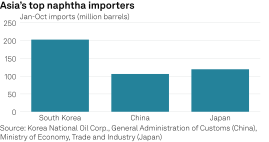
South Korea is Asia's biggest naphtha importer. The country purchased 202.65 million barrels of the light distillate in the first 10 months of 2025, a slight decrease from the 205.27 million barrels imported a year earlier, according to the latest data from state-run Korea National Oil Corp. issued on Nov. 27.
The MOTIE said it is promoting a strategy centered on "vertical integration" between the refining and petrochemical sectors. This approach seeks to enhance operational efficiency by allowing petrochemical companies to source feedstock naphtha directly from local refiners at reduced costs.
By integrating their operations, companies can better manage their supply chains, stabilize raw material costs and improve overall economic viability, the ministry said in its report.
This initiative is expected to enhance the economic viability of feedstock naphtha and LPG, providing much-needed relief to the petrochemical industry and boosting its competitiveness in the global market, an analyst at the Korea Chemical Industry Association in Seoul told Platts on Dec. 3.
Tax incentives
The Korea Customs Service announced a revision to the "Notice on the Handling of Duty Refunds for Raw Materials for Export" effective Nov. 28, aimed at improving the convenience of duty refunds for companies focused on exporting goods such as petrochemical products.
This update is designed to provide tangible support to struggling export sectors, particularly the petrochemical industry, which has been facing challenges due to global oversupply and stagnant demand, the KCS said in a statement seen by Platts on Dec. 1.
Under the new provisions, additional refunds will be allowed for raw materials that are consumed over a long period in the production of petrochemical exports, according to the KCS statement.

Editor: