Refined Products, Gasoline
November 10, 2025
SSE Brazil gasoline spot market share shifts amid more room for competition

HIGHLIGHTS
Gasoline spot prices rise amid refinery stoppages
Petrobras cuts prices, holds tender and caps rise
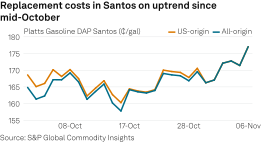
Replacement costs on the rise since mid-October
Spot gasoline negotiations in Brazil's South-Southeast region have seen a series of unusual events recently, leading to a general rise in price levels and a shift in market share among suppliers at the Santos and Paranagua ports, market participants have told Platts.
Spot market levels reportedly rose after the stoppage of private refiners Refit and SSOil on Sept. 26 and Oct. 24, respectively. The companies had been consistently selling at highly competitive levels in the regional market, according to regional market sources.
Platts heard general spot prices at the ports were at discounts as low as Real 230/cu m against Petrobras' EXA Paulinia and Araucaria refinery posted prices between Oct. 1 and Oct. 20. Levels were at a Real 130/cu m discount at the lowest Oct. 31, and have since risen further to levels between flat against those references and a Real 80/cu m discount.
Downstream sales, meanwhile, remained strong as the refineries' stoppages opened up a share of the market for other participants to grab.
"Gasoline supply and pricing competitiveness is more balanced now," said a trader at a medium-sized distributor.
Brazil's state-controlled Petrobras cut gasoline prices in all its trading locations Oct. 21, which helped hold down some of the market rise after the refinery stoppages. The company also held a tender in the region at a starting bid of a Real 200/cu m discount over their own posted prices Oct. 29, selling 130,000 cu m. The majority of volumes in the sale were traded at discounts of Real 75/cu m in the South and discounts of Real 130/cu m in the Southeast.
At the same time, an open arbitrage window between the first week of September and the fourth week of October led some participants to import higher volumes to the region. About 13,202 cu m of imported gasoline arrived at the port of Santos in October, along with 89,175 cu m in the port of Paranagua.
After the Petrobras price cut, some participants diverted their ships to other regions of the country. Others reportedly lost competitiveness in volumes that had already passed through customs and were stored in tanks, stopping them from currently selling at discounts against Petrobras in the regional spot market.
Participants also say replacement costs have risen in the past days, leading to more caution in spot sales.
"No one wants to use up all [the] inventory they have and then import more expensive volumes," said a trader at a regional distributor. "Our calculations show the current replacement cost is way above what the market is willing to pay."
Platts gasoline DAP Santos and Paranagua assessments have been on an uptrend since mid-October. Gasoline DAP Santos was assessed at $1.5779/gal Oct. 16, reaching $1.7403/gal Nov. 7.
In the coming months, participants say there could be a build-up in regional stocks in anticipation of a rise in state taxes mandated by Brazilian authorities this September, and expected to come into effect on January 2026.
"There could be a movement of importing more gasoline this December ahead of the tax change," said a South-Southeast trader at a major distributor.
Platts is launching Nov. 10 new FCA assessments for domestic gasoline markets in the Brazilian South/Southeast regions, with daily gasoline prices for Santos and Paranagua. They will track imports already passed through customs and available for domestic markets.
The assessments will be published both in Brazilian Real per cubic meter and US cents per gallon, and reflect prompt spot transactions between 300-2,000 cu m in volume, for delivery up to seven days forward from the date of publication.
Platts is part of S&P Global Energy.

Editor: