Crude Oil, Maritime & Shipping, Wet Freight
October 20, 2025
US, China port tariffs lend extra boost to VLCC freight rates
HIGHLIGHTS
UGC-China VLCCs at multi-year high
Volatility amid uncertainty over who is safe to trade
Fleet inefficiencies expected
VLCC freight rates have surged as the onset of US and China port tariffs, with accompanying extra costs and fleet inefficiencies, has added to robust demand for carriage from strong crude production.
The US and China each imposed high port fees on Oct. 14 on tonnage linked to the other's country. The US Trade Representative's Section 301 measures were published well in advance and attracted considerable industry comment. In contrast, China's measures arrived with little notice as Beijing issued its warning that it would retaliate only in late September.
Amid this, Platts, part of S&P Global Energy, assessed the rate to carry a 270,000 metric ton cargo of crude from the US Gulf Coast to China at $46.67/mt Oct. 17, its highest since Dec. 22 and 73% above its five-year average.
"The most exposed size class remains the VLCCs, given the fleet's involvement in China's crude imports. Operators and traders will be cautious about China-inbound voyages until the risks are mitigated," Kevin Zhao, a shipping analyst at Energy, said.
The scale of the potential impact is significant. China imported 10.1 million b/d of crude in 2024, according to data from S&P Global Commodities at Sea.
This is of particular interest for VLCCs; China is the single largest destination for this class, accounting for about 38% of VLCC trade on an export-volume basis in 2024, ship brokerage Gibson said in a note Oct. 17.
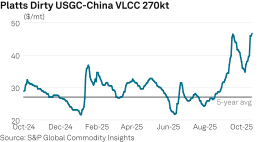
Uncertainty could fuel additional freight volatility
In the near term, the uncertainty over who is safe to trade into China could fuel additional freight volatility, analysts said.
China's special port fees apply to any ship with clear US links calling at Chinese ports: vessels owned or operated by US companies or individuals; vessels owned or operated by entities in which US companies, organizations, or individuals directly or indirectly hold 25% or more of the equity.
The 25% impact may prove "tricky" as it is hard to identify the impact among US-listed owners, Zhao said. It will be worth keeping an eye on all China-bound VLCC routes, he said.
Trade flows will inevitably be disrupted; with no advance warning, some tankers affected by the Chinese measures were likely already en route to China when the announcement was made, ship brokerage Gibson said in an Oct. 17 note. More ballast miles are expected as owners and charterers reshuffle tonnage, and the need for additional documentation checks could also lead to greater congestion in ports, the brokerage added.
Impact of a tight market
The VLCC market is already very tight, analysts noted. It has been supported by rising OPEC+ crude production, refinery maintenance, reduced direct crude burn for power generation in the Middle East, and a larger pull of Atlantic Basin crude eastward during September, Gibson said.
The recent discount of Brent to Dubai and WTI Midland to Murban encourages eastbound flows, while rising supply from Guyana, Brazil and the US has attracted modern VLCCs into long-haul trades, tightening vessel availability in other regions, such as the Persian Gulf.
The effects of this have already rippled beyond shipping. Medium-density crudes across the Atlantic basin, with the Angolan crudes in West Africa and Norway's Johan Sverdrup as notable examples, have been under significant pressure in recent pricing sessions as strong freight rates have made it even more difficult to place cargoes into a softer demand environment.
Platts assessed Angola's Hungo at a $2.95/b discount to Dated Brent Oct. 16, its lowest since April 2023, while Congolese grade Djeno hovered at its lowest since January 2024.
Seaborne exports from West Africa averaged 3.337 million b/d through Oct. 20, reflecting a 9% decline from the previous month after a peak of 3.662 million b/d in September, CAS data showed.
However, while the port tariffs loomed and other factors supported freight rates, volumes to China were strong, while opportunities remained unimpeded. Shipments from WAF to the Far East rose 40% in September to 1.196 million b/d, primarily driven by exports to China, which accounted for 1.133 million b/d.
The outlook is one of further strength in freight rates, Zhao said. "This incident, plus a tightening VLCC freight market, means I believe we are going to see a Q4 that outperforms the last one," he said.

Editor: