Crude Oil, Chemicals, Refined Products
October 20, 2025
INTERVIEW: Dangote founder aims to clone refinery to secure global lead

HIGHLIGHTS
Dangote aims to double refinery size to 1.4 million b/d
Company pursuing Middle Eastern partners, IPO within year
Upstream assets to begin production by end of October
When Aliko Dangote set out to build Africa's largest oil refinery in the swampland of southeast Lagos, it was treated as a unicorn project that could be the last of its kind.
Yet less than two years after launching the site in 2024, the Nigerian business mogul is seeking to double the size of the refinery with Middle Eastern funding, putting it on track to become the largest in the world.
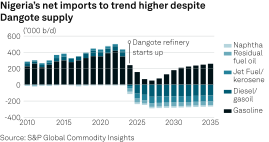
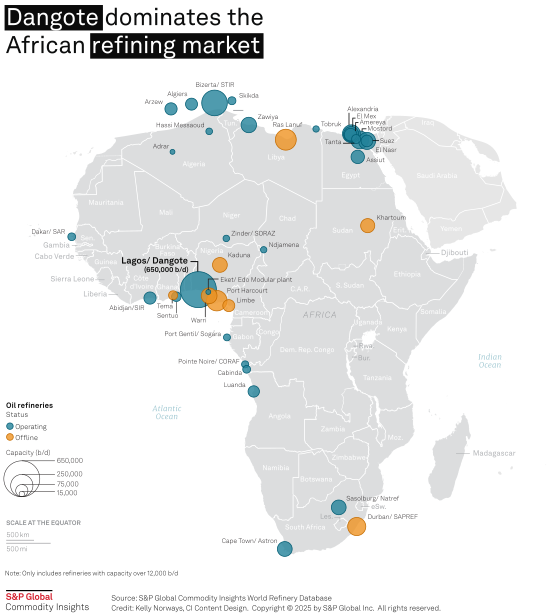
Today, the $20 billion refining and petrochemicals complex sits on 65 million cu m of dredged sand in Nigeria's Lekki Free Zone, boasting a custom-built port and the world's largest crude distillation unit. With the capacity to cater to 80% of Nigeria's fuel demand, the refinery quickly transformed the country into a net exporter of diesel and jet fuel, and supplies vast quantities of gasoline once imported from Europe.
Dangote, who made his name in the cement and sugar business, has often described the refinery development as a labor of love -- involving a decade of technical and political battles and a missed opportunity to buy Arsenal football club.
But the project is far from over, according to the 68-year old founder. In an exclusive interview with Platts on the refinery premises, he described his ambitions to develop African energy independence as a "herculean task."
"We have to build the refinery again, either here or somewhere else. But really, somewhere else is not possible because we'd have to go and spend so much building infrastructure, and we have the infrastructure already here," Dangote said.
In Nigeria alone, S&P Global Energy projects that net gasoline imports could more than double from 2026-27 to hit almost 200,000 b/d by 2030, underpinned by economic development and rapid population growth.
Expansion plan
In July, Dangote unveiled plans to expand the refinery from its current 650,000 b/d to 700,000 b/d by the end of the year. Now, the target is to reach 1.4 million b/d, with no specified date -- a scale that would surpass the world's largest 1.36 million b/d refinery in Jamnagar, India.
Engineers working at the Lekki complex say it was designed with room for growth, pointing out empty concrete plots capable of holding a second refining system. Now Nigeria's largest power producer, the Dangote Group already generates twice the electricity it consumes, insuring its operations against chronic shortages that plague the rest of the country.
Expanding could involve building a second refinery with the same configuration, one engineer said, potentially with the addition of a vacuum distillation unit to boost light ends yields. The company is also working on potential linear alkylbenzene and base oils projects, and aims to grow its annual polypropylene capacity from 1 million mt to 1.5 million mt in the next few years, Dangote said.
Costly refinery upgrades are not for the fainthearted in a saturated global market where margins are notoriously volatile. According to forecasts from the International Energy Agency, the world will already have 11.4 million b/d more refining capacity than it needs by 2030, concentrated mostly in China and India.
But Dangote rejects a model that leaves Africa dependent on imported fuel, and remains determined to disrupt a market shaped by economies of scale. He is not optimistic for state-backed African projects, and warns that the continent will "really be in trouble" without huge private investment.
"Most African governments will not have the capacity to build a refinery," Dangote said, calling smaller projects like Angola's new Cabinda facility "a drop in the ocean."
"In places where interest rates are 30%, some countries 20%, the cost of funding is high. And the infrastructure is zero," he said.
New funding streams
The Nigerian company's own maturing debt was recently seen as a key funding hurdle, before it secured a critical $4 billion financing agreement in August.
To expand the refinery and develop a new petrochemicals project in China, Dangote is actively considering a strategic partnership with Middle Eastern companies, the group president remarked. "Our business concept is going to change. Now instead of being 100% Dangote-owned, we'll have other partners," he said.
Within the next year, the refining business will list 5%-10% of its shares on the Nigerian stock exchange, he said, mirroring a playbook established by the group's cement and sugar businesses. "We don't want to keep more than 65%-70%," Dangote said, explaining that shares will be offered incrementally subject to investor appetite and market depth.
The door remains open for Nigerian National Petroleum Co. to boost its stake after the state oil company trimmed its interest to 7.2%, Dangote said, but not before its next phase of growth is well underway.
"I want to demonstrate what this refinery can do, then we can sit down and talk," Dangote said. A close aide, who was not authorized to speak publicly, said the company would exert caution before inviting additional participation from NNPC.
NNPC was not available for comment.
Stabilization journey
Bold expansion plans come amid ongoing efforts to stabilize the refinery after a series of short-term disruptions have made headlines in 2025.
The plant's main gasoline engine, the residue fluid catalytic cracker, recently went offline in September shortly after a three-week turnaround in August, fueling rampant speculation over future downtime.
Devakumar Edwin, a vice president at Dangote responsible for overseeing refinery operations, said the RFCC restarted around Oct. 7 and should soon be back at full capacity.
"We have resolved most, not all, but most of the problems. And I think we're looking for a window when we shut down for another month," Dangote said, in a rare comment on maintenance plans.
The month-long turnaround will involve shutting down the RFCC, but not the CDU and other secondary units. The entire refinery only requires a full turnaround every five years, Edwin said. Dangote said that the RFCC turnaround will be planned to avoid clashing with a seasonal demand peak towards the year-end, without providing dates.
The company recently highlighted employee sabotage as a potenital business risk, before its decision to fire 800 staff members sparked an acrimonious labor strike in September. After government-brokered remediation talks, the conglomerate has committed to find new employment for all dismissed workers, mostly outside the refining business.
"We don't have any worries with the unions," Dangote said, sharing that the reorganization was almost complete and deemed sufficient to abate recent tensions.
Crude sourcing deal
As the refinery grows, early challenges sourcing crude oil only risk becoming more acute. However, Dangote welcomed a breakthrough deal with NNPC for alleviating supply concerns.
Under a current "crude for naira" swap agreement, NNPC supplies Dangote with 14 crude oil cargoes, or sources the equivalent value of US dollars, in exchange for the same volume of gasoline and gasoil to be supplied in the domestic currency.
Dangote's upstream assets in the Niger Delta, Oil Mining Lease 71 and 72, could soon provide another supply injection, with production expected to start this month and reach up to 40,000 b/d.
Dangote remains interested in new upstream opportunities, which could add to an expanding asset base for the wider conglomerate. Recent investments include a major Namibian storage terminal, an Ethiopian fertilizer plant and a fleet of 4,000 CNG trucks, as well as a potential energy project in Senegal.
It is a rapidly expanding global portfolio for the Nigerian company, but Dangote insists the business isn't biting off more than it can chew. Diversifying into new markets is a priority, for example, while the company is comfortable continuing to outsource most of its trading operations to companies like Trafigura and Vitol.
"At the moment we don't want too many balls in the air, so I think that we should throw the ones we can handle," Dangote said, impressing the scale of the new expansion. "We have to tighten our belt and make sure that we know we are doing. It's a huge, huge undertaking," he said.

Editor: