Crude Oil, Maritime & Shipping
September 09, 2025
Crude tanker markets focus on Asian freight shifts, fleet renewal toward end-2025
By Thomas Washington and Sameer Mohindru
HIGHLIGHTS
Shorter voyages from Middle East to Asia may impact demand
India's stance on Russian oil imports crucial amid US pressure
OPEC+ supply hikes, aging fleet add to market complexity
Shorter distances for oil cargoes east of the Suez Canal and India's stomach to test US displeasure would be significant variables for the aging crude tanker fleet market in the coming months.
Chinese oil demand growth has slowed, although still a significant motive force for the freight market, driven by changes in the underlying economy, according to management at shipping company CMB.TECH while announcing second-quarter earnings Aug. 28.
Asia's refined products demand growth is expected to grow by 341,000 b/d year over year in the third quarter, down 78,000 b/d versus the August outlook, largely driven by moderating demand in China and South Korea, offsetting part of the growth forecast in Southeast Asia and South Asia, analysts at S&P Global Energy said in a September outlook.
As China's economy slows or its domestic refining capacity and storage are adjusted, its import patterns change, Fotios Katsoulas, a shipping analyst at Energy, said.
"This could mean a shift in where it sources its crude -- for example, moving away from longer-haul voyages from the Americas or West Africa and increasing imports from closer suppliers in the Middle East or Russia," Katsoulas said.
Other countries of India, Vietnam and Indonesia are still seeing robust economic growth and increasing energy needs, Katsoulas said.
"We could see a rise in intra-Asian trade flows, which typically involve shorter voyages."
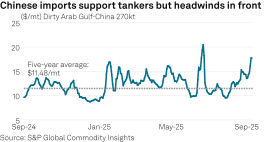
For now, the lower Chinese oil demand growth still offers support to freight markets. Platts, part of Energy, assessed the benchmark rate to carry a 270,000 metric ton cargo of crude from the Persian Gulf to China at $17.74/metric ton Sept. 9, up 100% from the start of the year and 55% above the five-year average.
India's Russian crude purchases
Russian seaborne deliveries of crude to China rose 12% month over month to 1.109 million b/d in August. China has proved an alternative to India, whose Russian imports fell 21% month over month to 1.3 million b/d, data from S&P Global Commodities at Sea showed.
Russian crude has provided New Delhi with plenty of discounted supply, but the value of Indian exports to the US far outweighs its imports from Russia.
"The balancing act is as much political as economic, with Prime Minister Narendra Modi seemingly portraying unity with Putin and China's Xi Jinping at a summit," analysts at ship brokerage Gibson said Sept. 5.
"The question remains: how long can India maintain this middle ground before Washington's pressure begins to bite," the Gibson analysts said. Whether Indian refiners bounce back in September or trade declines further will be closely watched, they added.
Complex OPEC+ impact
The tanker market in the second half of the year is likely to be defined by crude supply and the market's capacity to absorb this amid OPEC+ production increases, Frontline said in its first-half interim financial report.
Looking ahead, OPEC+ has reaffirmed its intention to boost production in August and September and conclude unwinding a 2.2 million b/d tranche of voluntary cuts, with monthly increases of almost 550,000 b/d.
So far, these reversals have only yielded modest increases in exports, Frontline CEO Lars Barstad said in a statement. That is due to compensation cuts and capacity constraints.
Nevertheless, at a Sept. 7 meeting, the group opted to begin winding down a further tranche of voluntary production cuts totaling 1.65 million b/d, with 137,000 b/d of quota hikes planned for October.
The increase in production and exports from OPEC+, particularly from the Middle East, could also contribute to shorter sailing distances, Energy Katsoulas said.
"Middle East crude often travels to nearby Asian markets, which are shorter hauls compared to voyages to Europe or the Americas," Katoulas said. This trend, if sustained, could exacerbate the impact of ships starting to return to Red Sea navigation, as seen earlier in the year, he added.
Bumpy timeline for tonnage
Industry body BIMCO forecast crude tankers' supply growth at 0.5% in 2025 and 1.5% in 2026. The Suezmax and VLCC segments are expected to drive this growth, although a slight reduction in the Aframax fleet is anticipated due to heightened recycling activity, BIMCO said.
Forecasts show the gap between oil supply and demand will be in favor of supply.
"So there will be more oil, more oil means more storage, more oil should mean also lower prices, which could be very supportive for our tanker markets," CMBT CEO Alex Saverys said on an earnings call.
The supply side of ships has shown a mixed story. In the short term, there are few ships coming to the market, but from H2 2026, more will appear, Saverys said.
While overall demand for oil might not be strong, demand for shipping is influenced by the available fleet, Katsoulas said. A range of shipping watchers have warned that an evolving sanctions landscape puts pressure on the availability of existing tonnage.
In any case, the fleet is likely to be elderly and by 2030, 40% of the VLCCs and 40% of existing Suezmaxes will be older than 20 years, Saverys said.
