Crude Oil, Refined Products, Fuel Oil, Gasoline, Jet Fuel
September 03, 2025
Angola inaugurates first refinery newbuild in 50 years

HIGHLIGHTS
Angola inaugurates second refinery in Cabinda
Refinery will eventually double national capacity
Government eyes two additional greenfield projects
Angola has taken a step closer to onshoring its fuel supply with the inauguration of its second refinery in Cabinda, the first of three developments aimed at transforming the country's downstream energy sector.
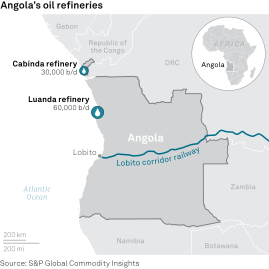
A Sept. 1 opening ceremony attended by Angola's president, João Lourenço, marked the launch of the long-awaited Cabinda facility, which will start operating with an initial capacity of 30,000 b/d and begin marketing products by the end of the year.
The refinery is the first to be constructed since Angola gained its independence from Portugal half a century ago, and promises to eventually double the country's refining capacity.
The first phase of the project will involve ramping up production on a single crude distillation unit, before another is streamed in 2026 and takes the refinery's capacity to 60,000 b/d. Ancillary work on the second CDU is mostly complete, Sonangol executives have said, sharing that further work will involve connecting the unit to existing infrastructure.
Early output from the Cabinda site will be slanted toward heavy products like fuel oil, with around a 45% yield; meanwhile, naphtha and other white products are expected to account for roughly 28% of output, Joaquim Kiteculo, CEO of Sonangol refining, told Platts in an interview earlier this year.
He estimated that the first CDU should take roughly three months to ramp up and will target a utilization rate of 90%-95 %.
Later in 2026, the state oil company will focus on maximizing yields of high-value products like gasoline, jet fuel and diesel, which will be made possible by the launch of a new reformer and residue fluid catalytic cracker.
The refinery was jointly developed by Sonangol and UK asset manager Gemcorp, which holds a 90% stake in the project.
A statement from Gemcorp called the project a "decisive step towards energy sovereignty and national competitiveness" for the African oil producer, which has historically sent its crude abroad to be refined in Asia and Europe.
Sonangol is expected to supply most of the crude for the Cabinda complex, but has reserved the right to source feedstock internationally, subject to refining economics.
Energy security drive
The refinery launch was welcomed as a key milestone among officials who have expressed growing unease with the country's dependence on imported fuel. In the last two decades, Angolan fuel consumption has more than doubled, while recent oil price volatility has made government fuel subsidies a major drag on the country's balance sheet.
Since 2023, the government has been pushing to phase out its fuel subsidies, but price hikes in July triggered a public outcry and deadly protests. The International Monetary Fund has called a planned subsidy phaseout by the end of 2025 imperative to save roughly 2.1% of expected GDP.
As a result, Angolan authorities have placed growing emphasis on refining capacity buildouts, which officials hope will also diversify the country's revenues and support job creation.
In July 2022, Sonangol previously tripled its gasoline output from its existing Luanda refinery, a 60,000 b/d facility located in the country's capital. Future expansion plans involve commissioning a new hydrodesulfurization unit and a RFCC unit, as well as building a steam cracker and adjoining biofuels facility.
Additionally, the national oil company hopes to progress two further greenfield projects, Lobito and Soyo, which could add some 300,000 b/d of refining capacity and transform the country into a net exporter.
The larger 200,000 b/d Lobito project is currently under construction, which is around 12% complete, but requires $4.8 billion to progress to its second phase, Sonangol's Kiteculo told Platts previously. Meanwhile, Soyo has been put on hold by funding challenges from its private developer, the US-led Quanten consortium, and is not expected online until at least 2028.
According to forecasts by S&P Global Energy analysts, Angola is likely to import roughly 130,000 b/d of refined products in 2025, rising to 145,00 b/d by the end of the decade. It recently exported almost all of its crude production, which has averaged around 1 million b/d, according to S&P Global Commodities at Sea data and official government figures.
