Crude Oil, Maritime & Shipping
June 13, 2025
Israel-Iran conflict triggers urgent shift in Asian crude trade strategies amid price surge
HIGHLIGHTS
Traders, refiners expect sour crude price complex, OSP uptrend
Japanese refiners see urgency for crude supply diversification
WTI Midland likely to become popular in Asia amid tensions
Israel, Iran unlikely to provoke major Asian military powers
Asian refiners and crude traders anticipate that the broader Middle Eastern sour crude price complex could become increasingly expensive in the upcoming trading cycles due to escalating tensions between Israel and Iran. However, they do not expect this conflict to significantly disrupt trade flows between the Middle East and Asia, as major regional crude importers actively seek US crude and alternative feedstock options.
Israeli forces launched attacks on Iranian targets, including Tehran, in the early hours of June 13. While it remains uncertain whether the recent conflict will directly disrupt various Persian Gulf sour crude flows to the massive East Asian market, traders and refinery sources from Singapore, Japan, South Korea, India, China, Thailand, and Taiwan anticipate that the price structures for Middle Eastern sour crude will likely trend sharply higher, which would negatively impact Asian end-users' cracking margins.
A senior Indian oil industry official noted that while there is no immediate threat to oil flows from the Middle East, the rising prices and shipping premiums are a more pressing concern.
Middle East crude prices have responded strongly to Israel's preemptive airstrikes. Platts, part of Energy, assessed sour crude benchmark front-month cash Dubai at $72.5/b on June 13, surging 5.7% from the previous day.
Platts assessed the spread between cash Dubai and same-month Dubai swap at $1.69/b, widening 14 cents/b day over day. The spread -- widely known as the Dubai market structure -- is considered a key component in the monthly official selling price calculations of major Middle Eastern producers.
In Japan, feedstock managers at major refiners, including ENEOS, indicated that the country's refining industry should have made more efforts to diversify crude supply sources, as Japan relies on Middle Eastern producers for over 90% of its crude needs.
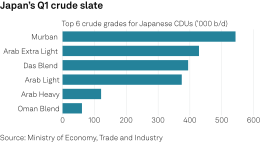
Japanese crude traders in Singapore and Tokyo agree that the latest conflict could lead to a significant shift in the Middle Eastern geopolitical landscape, creating urgency for Japan's refining industry to secure safe deliveries of sour crude while also exploring non-Persian Gulf options, particularly WTI Midland and West Texas Light.
"What a change [in the geopolitical situation and market outlook]!!! [We] might [need to] be buying [to secure] more Oman Blend and or Murban," a Japanese refinery trading source said.
A feedstock management source at ENEOS emphasized that US crude would be the best non-Middle Eastern option amid high geopolitical uncertainties, although they do not anticipate a complete disruption of Middle East-Asia trade flows. However, they expect freight costs for sour crude to rise significantly.
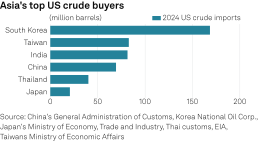
Major refiners in South Korea, the third-largest crude importer in Asia, have raised concerns about the economics of cracking Middle Eastern sour crude for the third and fourth quarters. They have started inquiries with suppliers such as Saudi Aramco and Abu Dhabi National Oil Company to ensure their term crude supplies remain unaffected by the latest geopolitical tensions.
Feedstock managers at two South Korean refiners and a state-run Thai refiner indicated that US and West African crude grades are likely to become popular non-Middle Eastern feedstock options if tensions lead to significant disruptions in sour crude flows to the Far East.
WTI Midland crude is expected to be in high demand due to supply security and refining economic factors, according to sources at South Korean and Thai refiners, who also highlighted that Middle Eastern sour crude OSPs could rise in the next trading cycle as the Platts Dubai market structure rebounds.
The Dubai market structure has significantly declined from its peak in the early first quarter, making Middle Eastern crude OSPs more reasonable in recent months. However, the market structure is poised to strengthen and significantly increase OSPs once again, trading and refinery LP Model strategists said.
In Taiwan, a refinery source described Israel's strike as "terrible" for the Middle East-East Asia crude trading market, prompting traders across the country to hold emergency meetings to reassess their procurement strategies for Middle Eastern crude.
Straits of Hormuz
Despite the anticipated rise in Middle Eastern crude prices, key buyers of Persian Gulf sour crudes express confidence that the Strait of Hormuz will remain open, thus not severely disrupting trade flows.
Both Iran and Israel are likely to refrain from actions that could compromise East Asia's neutrality. Historically, the Iran-Israel conflict has not caused significant supply disruptions in Asia. While Iran could retaliate against Israeli military actions, it is unlikely that tensions will escalate to a level that impacts oil supplies to the Far East, according to refinery sources and traders in Singapore, Thailand, South Korea, Taiwan, Japan, and China.
Escalating tensions could provoke military responses from East Asian nations. For example, if China faces major disruptions in oil imports, decisive actions are anticipated.
A crude procurement strategist from a Chinese state-owned oil company stated that while it cannot be completely ruled out that Iran might close the Strait of Hormuz, such a move would not benefit either side.
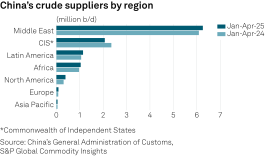
In addition to China, India, South Korea, and Japan are among the top ten military powers in the world, which is a significant factor in the current geopolitical context.
This military strength suggests that both Iran and Israel are likely aware that extreme actions disrupting crude oil trade flows to East Asia could provoke responses from these nations, thus maintaining a level of caution in their conflict to avoid involving major Asian military forces, according to traders and refinery feedstock managers throughout East Asia.
