Crude Oil, Refined Products, Maritime & Shipping, LPG
June 04, 2025
Shipping needs to adjust to persistent US-China trade strains: industry leaders

HIGHLIGHTS
'China-US rivalry will not go away': executive
'China has huge influence on shipping market': academic
'Change is part of shipping, so is adapting': executive
Trade tensions between the US and China will endure beyond the administration of US President Donald Trump, meaning shipping must navigate the uncertainty and not just wait for further clarity, market participants said at an industry event June 4.
Trump has issued, and in some cases then mitigated, a slew of tariffs on China and other US trade partners since he took office in January. These include a June 3 announcement of an increase in the tariff on steel and aluminum to 50% as of June 4, up from the 25% rate that came into effect on March 12.
This has rocked markets, and the volatile and changing nature of the announcements encouraged some industry stakeholders to take a wait-and-see mood. However, this is not an appropriate course of action for shipping, industry leaders said at a Marine Money forum during Nor-Shipping in Oslo on June 4.
"It does feel like we're [witnessing] geopolitics steroids right now, but this is tanker shipping," CFO of tanker firm International Seaways Jeff Pribor said. "If you go back 50 years, there's always going to be a factor, whether it's a crisis, [there's] always going to be something, and frankly, stop complaining about it."
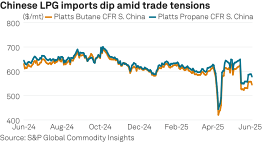
Commodities have been reacting. Platts, part of S&P Global Energy, assessed the rate to carry refrigerated propane to China on a CFR basis for 20-35 days ahead at $578/mt June 4 and its equivalent for butane at $545/mt. The vast majority of these deliveries come from the US, and the rates have dropped 8% and 12%, respectively, since Trump took office.
Total seaborne LPG exports from the US amounted to nearly 66 million mt in 2024, of which 7.2 million mt on ships owned or operated by Chinese companies, Energy data showed. 22% of US crude oil exports and imports and 19% of refined products were carried on Chinese-built tankers in 2024, when total international oil flows reached 12.3 million b/d, the data showed.
"China is one of the most, if not the most, important shipping nations, in terms of new building capacity, finance and shipping, and is a major cargo destination," Hing Chao, executive chairman of Wah Kwong Maritime Transport, said.
"China cannot be ignored, I think that is one fact, an aspect of reality that I think people have to accept," Chao said. "The other factor, reality, is that US-China tension will not go away; these two factors often work at loggerheads."
Port tariffs to stay
Besides the changing trade tariffs that have marked the start of the Trump Presidency, the US authorities have also introduced port service fees on ships owned or operated by China-linked entities and most ships built in China but owned or operated by non-Chinese entities.
However, these proceed from an investigation launched during Joe Biden's administration and originated from a trade union petition in March 2024. The port fees could well be here to stay, industry watchers said.
China dominates aspects of the shipping industry. While the US accounts for 0.1% of global shipbuilding, China produces more than the rest of the world put together, at 53.3%, Oystein Tunsjo, professor of international relations and head of Security in Asia program at the Norwegian Institute for Defence Studies in the Norwegian Defence University College, said.
"The primacy of the economy is being replaced with that of security as the world enters a new era, and globalization is being restructured, to make it less China-centric," Tunsjo said.
Keep going
"Geopolitical events do affect shipping companies' planning, but change is inevitable, be it potential risks around an invasion of Taiwan, production decisions by OPEC+ or US plans on how to treat Russia," Pribor said. As such, bearish headlines should not pause shipbuilding.
Freight rates declined in 2024, ending a strong period, and it is hard to judge where the industry is now in the cycle of freight rates, he added.
Prices have conveyed mixed signals. Platts assessed the rate to carry a 270,000 mt cargo of crude from the Persian Gulf to China at $9.73/mt June 4. It has declined more or less steadily from April 28, but the 2025 average to date has been $13.17/mt, against a five-year average of $11.33/mt.

Editor: