Refined Products, Crude Oil, Natural Gas
July 09, 2025
Mexico weighs its vast untapped unconventional oil and gas potential amid financial, regulatory hurdles

By Sheky Espejo
HIGHLIGHTS
Mexico looking to assess unconventional resources potential
Water scarcity could increase opposition to fracking
The Mexican government is cautiously exploring the possibility of tapping its vast unconventional resources, which account for roughly 60% of the country's potential oil and gas reserves. Mexico has tried this before without success, and experts say financial, regulatory, legal, environmental, and political hurdles make it unlikely the country or its state oil company will succeed this time — at least in the short term.
Former President Andrés Manuel López Obrador banned fracking "to protect the environment" and proposed enshrining the ban in law. But recently, at an event hosted by a top petroleum engineering school, Pemex CEO Víctor Padilla acknowledged the need to better understand Mexico's unconventional potential as conventional reserves decline.
"We want the opinion of those who really know," Padilla said. "We want to know what we have underground, the opportunities, how much it would cost, and what we could get."
The Burgos Basin in northern Mexico — a geological continuation of the prolific Eagle Ford in Texas — holds a significant share of the country's estimated 64 billion barrels of oil equivalent of unconventional resources, according to data from the energy ministry. Additional prospects lie in the Sabinas, Tampico-Misantla, and Veracruz basins.
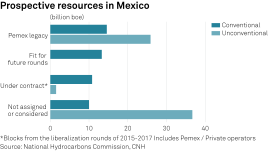
Untamed Potential
"The geological potential in Mexico is massive, and the country could develop the industry if the conditions were right—but right now, they aren't," said Jaime Chapa, head of oilfield services company Moreletii.
Chapa, a former Schlumberger and Halliburton fracking specialist, told Platts he helped implement the technology in more challenging settings like Argentina or Australia — where fields were remote — or Colombia, where violence was high. Platts is part of S&P Global Energy.
"And still we were able to deploy the technology and help our client increase production," Chapa said. "If you have the money, the industry will do it."
The Money Problem
But money is one of the main issues, experts say. Developing Mexico's unconventional reserves would require Pemex to partner with companies that have the necessary technology. But under the new legal framework, Pemex must hold a majority stake in every venture, said Leonardo Beltrán, non-resident fellow at the Institute of the Americas.
"As we all know, Pemex has outstanding debts, which makes it difficult to deploy the capital needed as a majority partner," Beltrán said.
Estimates place the required investment in the hundreds of billions of dollars. Pemex holds nearly $100 billion in financial debt, plus some $20 billion owed to suppliers. In 2024, Pemex reported a net loss of $31 billion.
Pemex's entire E&P budget for 2025 is $8.9 billion. According to Energy analysis, Pemex needs to almost triple its upstream investment in 2025 to advance the projects in its portfolio.
Legal Locks and Policy Shifts
Observers say Pemex's finances are just one hurdle. Transparency and stable rules around permitting and bidding are crucial to attracting capital, said Paul Sullivan, a fellow at the Windsor Energy Group.
"It would also help to have policies that are seen as stable in the long run. These are long-term investments. Companies don't like shifting policies mid-stream," Sullivan said.
Restoring independent regulators like CNH and CRE, dismantled under recent reforms, would also be essential.
"The rule of law on energy investments needs to be strengthened," Sullivan said.
These legal and financial constraints raise red flags for investors, experts say.
"Mexico's unconventional resources have huge geological potential, but lack of institutional, financial, and technical conditions limits development," said Ed Rodriguez of Flatstone Capital Markets LLC.
Without a shift in public policy, stronger regulation, infrastructure investment, and legal certainty, attracting investment will remain "a mirage," Rodriguez said.
The government must also find a way to address current restrictions on fracking, Beltrán said. Perhaps the new administration of President Claudia Sheinbaum could fit these projects under a different classification, like the "polos de bienestar" model, he suggested.
The Polos de Desarrollo para el Bienestar (Development centers for welfare) are industrial zones created by the Mexican government to stimulate economic growth, mainly in the underdeveloped southeast region of the country. To attract investment, the federal government offers incentives including tax breaks, customs benefits, and public infrastructure development.
"There needs to be a national conversation about fracking," Sullivan said, noting energy policy is interwoven with water, agriculture, public health, and sovereignty.
He warned that water scarcity could spark opposition to fracking in many regions with unconventional deposits.
If not addressed, water tensions could stifle energy and other investments, he said.
"One cannot have sustainable energy policies in the long run without also considering water, food, and other related policies and the nexus issues involved," Sullivan said.
Fracking typically requires 2 million–10 million gallons of water per well, he noted.
Unconventional development could help reduce the country's reliance on imported natural gas.
"Cheap US gas has created a false sense of security," said Sullivan. "But if there's a disruption, trade conflict, or infrastructure bottleneck, Mexico's dependence will become a vulnerability."
In February 2021, a US polar vortex disrupted gas production and pipeline flows, cutting exports to Mexico. The shock triggered power outages in northern states and exposed Mexico's reliance on US gas.
So far in 2025, US pipeline gas imports have averaged 6.43 Bcf/d, up from 6.07 Bcf/d in 2024, while domestic production has fallen to 2.53 Bcf/d from 2.62 Bcf/d, according to Energy data. Imports are expected to average 7 Bcf/d in 2025 and reach 8.3 Bcf/d by 2030.
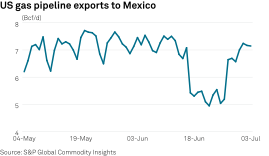

There are roughly 141 Tcf of gas in the unconventional deposits in Mexico, according to official data.
A Wasted Opportunity?
For Chapa, the missed opportunity in unconventional resources is hard to ignore.
"Mexico has everything it needs to succeed—skilled people, world-class resources, access to the best technology, and the will to make it happen," he said. "What's missing is leadership—the right people making the right decisions at the top."
While other countries move ahead under tougher conditions, Mexico hesitates, he added.
"It's frustrating to watch. We've got more advantages than many, but we're sitting on them while others are making it happen," Chapa said.
Countries like Guyana, Argentina, and Colombia are pushing ahead, while Mexico wastes a historic opportunity, he said.
"With everything we've got, we should be leading, not lagging."

Editor: