LNG, Natural Gas
February 20, 2025
Rising gas demand more likely than emergency order actions to boost production
By Jeremy Beaman and Corey Paul
HIGHLIGHTS
Rising LNG exports, power demand to drive gas growth
US under 'active threat' of price spikes: Trump EO
This story is part of a short series exploring supply, demand and price implications of US President Donald Trump's January national energy emergency declaration.
US President Donald Trump's declaration of a national energy emergency is unlikely to lure natural gas producers into raising near-term production levels, according to analysts.
But market forces could help achieve some of Trump's goals as rising LNG exports and the buildout of energy-thirsty data centers drive expectations that gas E&Ps are primed for growth in the coming years.
The emergency executive order asserted that the US is under "active threat" from high energy prices and that "inadequate development of domestic energy resources" leaves the country "vulnerable to hostile foreign actors and poses an imminent and growing threat to the United States' prosperity and national security."
It directed cabinet secretaries to identify and exercise emergency and other authorities to facilitate the production of more energy.
State of the market
Trump issued the emergency order at a time when benchmark prices were coming off historical lows, a fixture of the domestic market in 2024 that led producers to hold back some production. Those volumes have largely returned in conjunction with a rise in seasonal heating demand.
Over the last two decades, the US gas market has roughly doubled in size. In 2005, average daily dry gas production among the Lower 48 states was 48.4 Bcf/d, with total demand of about 60 Bcf/d, according to S&P Global Energy data. Last year, production was at 102.3 Bcf/d, down slightly from 2023 after producers pulled back due to weak prices, while total demand climbed to 108 Bcf/d, up 80% relative to 2005 levels.
Outside of some exceptional years, natural gas prices have generally trended cheaper over the last two decades, and the US recorded among the lowest prices of the century in 2024. In 2023 inflation-adjusted dollars, benchmark Henry Hub averaged $2.18/MMBtu last year, its lowest real-dollar average going back to at least 2005, Platts data showed.
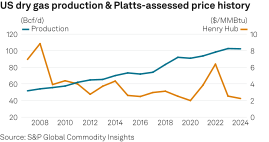
"Even with an improved outlook, [gas] producers have been resolute in not allowing near-term optimism to overshadow a familiar story; prices rise slightly, and producers expand budgets, only to see prices fall again," Energy upstream analysts said in a Q1 2025 gas supply outlook published Feb 13.
Garrett Golding, whose role as assistant vice president for energy programs at the Federal Reserve Bank of Dallas involves frequent engagement with oil and gas operators, said the sector is "still very much committed to capital discipline, to not just chasing production growth like they did 10 years ago."
"And that isn't going to change no matter who is in the White House or who is writing regulations," Golding said during a Feb. 6 event at the bank's Houston branch.
Leasing versus drilling
The Trump administration could most tangibly affect supply-side conditions by making more public lands available to producers, some industry observers said.
In an order after Trump's emergency declaration, Interior Secretary Doug Burgum directed assistant secretaries to draw up plans to lease more land for oil and gas production and to speed up the processing of applications for permits to drill.
But these actions would not necessarily yield more drilling activity, said Matthew Bernstein, Rystad Energy's vice president of upstream research.
"For permitting on federal lands, E&Ps there have quite robust permit inventories already, so while they may accumulate more at a faster pace, it is unlikely to translate into new drilling, which is a capital budgeting question," Bernstein said.
"For producers with assets primarily on federal lands, the speed at which permits are accumulated is not a consideration when budgeting," Bernstein said. "Basically, you can ease their regulatory processes, but you can't force them to drill."
Analysts at ClearView Energy Partners said the order "looks more likely to serve as a force multiplier for other objectives than a major catalyst in its own right."
Rising LNG exports
Independently of Trump's emergency order, US gas market fundamentals are expected to grow increasingly tighter as new LNG export capacity comes online in the coming years and draws producers to raise production.
The emergency declaration referenced the country's rising status as an exporter of global energy security in the form of LNG, although it was unclear how LNG fit into the broader order, which appeared aimed largely at lowering domestic prices and boosting production.
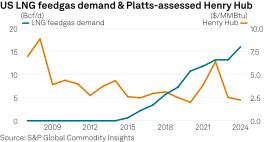
The US became the world's top LNG supplier in 2023, and its export capacity is already on track to double by the end of the decade.
Trump said he would if Europe and the US reached a deal. But Trump said he disagreed with the notion that LNG exports would lead to a runup in US gas prices.
"I think that the more you do, the lower the price is going to go," Trump said. "And what I'd like to see is rapid approvals."
That premise may be tested a year from now.
Production is expected "to play catch up" to feedgas demand rising about 6 Bcf/d between October 2024 and March 2026, according to Energy analysts' most recent short-term outlook for the North American gas market, issued in January.
Energy analysts identified the risk of a deep storage deficit developing in winter 2025-2026, leading to prices surging beyond $11/MMBtu in early 2026 before Henry Hub eases off as balances loosen on growing production.
Average Henry Hub prices are expected to increase from averaging below $3/MMBtu in 2024 to just over $4/MMBtu in 2025 and beyond $6/MMBtu in 2026.
Regional constraints
As a whole, the domestic gas market has supply sufficient to export higher volumes each year — including pipeline exports, 2024 levels were about 19.6 Bcf/d, up more than 80% over the last five years — but regional fundamentals can vary widely, with some areas such as West Texas having a surplus of gas and negative gas pricing.
The Northeast, a region singled out in Trump's order as evidence of an emergency, is generally the most constrained and prone to price spikes.
During peak demand conditions, which normally occur on the coldest days of winter, gas demand in New England soars beyond available supply. Members of the Federal Energy Regulatory Commission and the North American Electric Reliability Corporation frequently emphasize the reliability and affordability problems associated with the region's supply constraints, which are largely attributed to a lack of sufficient pipeline capacity.
On average, Northeast regional spot gas prices are below those of a decade ago, but they trend above those of other regions and are especially volatile during winter. Between 2005 and 2009, the average spot gas price in Appalachia was $7.33/MMBtu, according to Platts data. Over the last five years, the region averaged $2.84.
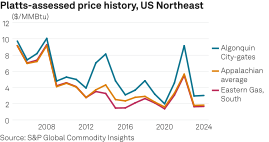
Should the White House find a way to invoke emergency powers to foster the buildout of pipelines in the area, where several major midstream projects have been stymied due to state and local opposition, that could offer an outlet to support rising production from the region.
As it stands, US producers would be taking on risk by raising production levels before the market asks for it, according to Bryce Erickson, managing director of advisory firm Mercer Capital.
"Every time — like 2022 — the price sort of goes up, it's amazing how much you can bring online pretty quickly," Erickson said in an interview. "And ... the opportunity can wane quickly."