Metals & Mining Theme, Ferrous
November 04, 2025
FEATURE: European steelmakers trade short-term pain for long-term gain in decarbonization

HIGHLIGHTS
European decarbonization projects face delays
Market headwinds hamper long-term green steel transition
Policy support builds up lower-emission steel market
The European steel industry is undergoing fundamental policy shifts aimed at supporting domestic companies, but steelmakers in the region have increasingly found themselves caught between the timelines of their own decarbonization commitments and an unfavorable market environment.
Most integrated mills are changing the way steel is produced by transitioning from the traditional high-emission blast furnace to the lower-emission electric arc furnace route, often with plans to establish low-emission metallics production with a direct reduced iron plant as well.
But there has been a marked increase in headlines this year about the feasibility and pace of the industry's shift toward lower-carbon steelmaking, with a flurry of announcements about project alterations and delays in decarbonization efforts across Europe's steelmakers.
In the latest such example, Swedish lower-carbon-emission steel startup Stegra said in October that it is seeking additional funding of Eur975 million.
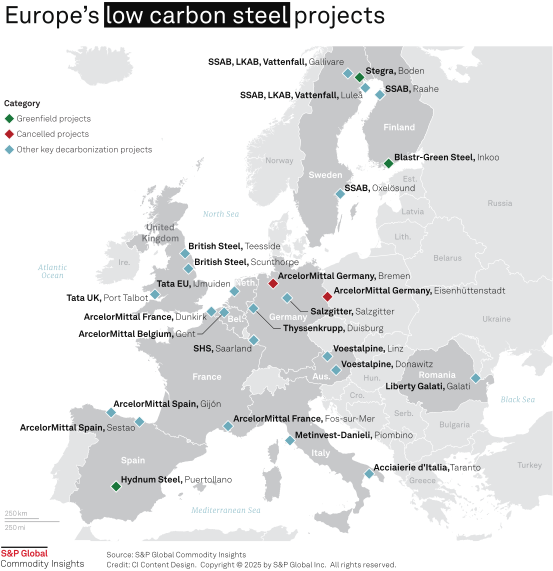
"Large-scale decarbonization projects are advancing at a slower pace than originally anticipated due to insufficient policy and market developments," an ArcelorMittal spokesperson told Platts, part of S&P Global Energy, in an email Oct. 30.
The German government had previously committed Eur1.3 billion to the DRI and EAF projects under the condition that construction commence by June 2025. The company told Platts it is now focusing on planning for the construction of only EAFs in Bremen and Eisenhuettenstadt. "But this requires stable framework conditions as outlined, on trade measures, energy costs and the development of lead markets for them to be economically viable," the spokesperson said.
German steel producer Salzgitter cited similar reasons in September for the delay of its own project targets, while German steelmaker Thyssenkrupp argued earlier this year that green hydrogen costs were higher than initially anticipated and put its green hydrogen tender on hold.
Market headwinds
"When you're in survival mode due to a difficult economic or market environment, you often stop thinking long-term and focus on the short term, because survival becomes the priority," Fernando Pessanha, chief strategy officer at Spanish start-up Hydnum Steel told Platts in an interview Oct. 14 when asked about recent developments in the industry. Hydnum Steel is a greenfield project that, once built, will offer low-emission flat steel to Iberian as well as other European customers via the EAF production route.
Pessanha said he also thinks that delays and hurdles have more to do with the overall economic environment the steel industry faces than a rethink on decarbonization within the industry.
GravitHy CEO Jose Noldin told Platts in an interview Oct. 16 that there are still plenty of positive movements in Europe, such as Austrian steelmaker Voestalpine breaking ground at its project in October and Sweden's SSAB project going ahead.
GravitHy is another start-up, which is currently planning a DRI plant in the south of France to serve lower-carbon DRI to steelmakers.
"Yes, some projects have been put on hold for better visibility of how to move next," Noldin said. "[But] decarbonization is the best opportunity we have had in the last 50 years."
The current problem surrounding project alterations appears to be more one for existing steelmakers, as they make the technical change from BF to EAF production amid market headwinds, rather than most startups.
Integrated steelmakers are simultaneously updating their technology while running their businesses.
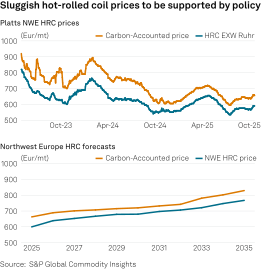
European domestic steel prices have struggled to gain significant upward momentum throughout 2025, largely due to sluggish demand from the automotive, mechanical engineering, and construction industries. According to Platts data, some modest gains started to materialize in early October, driven by higher offer prices from mills rather than market demand.
The lack of large-scale uptake of lower-carbon steel, which is already available but comes with a heavier price tag, despite offtake agreements for future production, has been one of the industry's challenges.
Platts assessed the premium for a European-produced carbon-accounted hot-rolled coil with emissions at or lower than 1/mt of CO2e per mt, the HRC CASP, at Eur65/mt Oct. 31, Eur10/mt down from its 2025 high in March. The all-in price for a carbon-accounted HRC stood at Eur675/mt ex-works Ruhr Oct. 31. The conventional -- "grey" -- HRC price was assessed at Eur610/mt EXW Ruhr the same day.
While the trade of lower carbon emission steel in 2025 has lacked liquidity, the expectation among market players is that recent policy changes in the EU proposing stricter import quotas, as well as the Carbon Border Adjustment Mechanism, set to come into definitive force in 2026, will put a levy on higher emission-intensive imports, as well as the so-called lead market, which will benefit European producers.
Energy analysts forecast that the premium will continue to persist beyond the 2030s, but it is expected to narrow next year as more low-carbon steel supply enters the market and low-carbon steel producers can price at parity with some high-emission blast furnace steel imports, which will incur a CBAM fee of around Eur50-70/mt.
'Teething problems'
Integrated steelmakers must lower their emissions as the phaseout of free CO2 allowances will begin in 2026, meaning that the more CO2 they emit, the more they will have to pay for production.
Simply put, steelmakers have little option but to lower emissions if they want to avoid production cost increases, which are already high due to high labor costs and energy prices. Austrian steelmaker Voestalpine said in October it currently pays Eur200 million per year for CO2 allowances and will be subject to paying an additional Eur1-2 billion during the phaseout to meet the growing demand for allowances. Voestalpine also called for an extension of allowances.
"I think it's a brownfield versus a greenfield problem," Evan Millard, principal analyst at Energy, said Oct. 24, when asked about the decarbonization pace. "I think they are teething problems more than anything else. We have a more positive outlook on this."
According to Energy analysts, stricter EU steel import quotas will boost utilization at EU mills, with the least carbon-intensive producers benefiting the most, if production exceeds their free carbon credit limits. The result could be higher utilization rates as domestic supply gaps emerge.
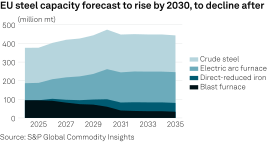
Total import quota volumes are expected to fall to around 18.35 million mt in 2026, about 45% lower than in 2025, capping import market share near 13% of EU demand, compared with 23-25% currently, according to Energy analysts.
Both ArcelorMittal and Salzgitter told Platts that the recent proposal on tighter quotas has been promising.
"The European Commission is finally correcting the errors in the trade protection system for steel," a Salzgitter spokesperson told Platts in an email Oct. 23. "We welcome the proposed design of the new instrument and are pleased that the 'Melt-and-Pour' rule is now being addressed -- without creating a bureaucratic monster," Salzgitter added.
The EC's "melt and pour" clause is a new requirement for steel imports to prove the country of origin by documenting where the steel was initially melted and poured, regardless of subsequent processing.
Sources close to the European Commission told Platts that, particularly the creation of a lead market, which will require public authorities to purchase lower-carbon steel made in the EU, should increase the uptake -- even if it comes with a premium. The concept of a lead market is part of the broader European Steel and Metals Action Plan, published in March 2025, which will be implemented through 2026. The SMAP also aims to raise the EU steel capacity utilisation rate to an 80-85% level, up from 67% in 2024.
The SMAP, CBAM, and reworked import quotas will all run concurrently next year.
Pessanha, as well as Noldin, said their choice of locations has been deliberate, adding that they see sufficient future demand for lower-emission steel in Europe.
According to Pessanha, future demand for his company's steel has already led to offtake agreements.
"Hydnum Steel closed more than 15 deals with major customers all over Europe for future purchase of our decarbonized steel," he said.
Noldin also said that GravitHy is close to signing an offtake agreement to supply the future upstream material it will produce. GravitHy expects to break ground in 2027, while Hydnum Steel is planning to start production in 2028.
"We have a great opportunity to keep production in Europe and do so in a redesigned, more competitive value chain," said Noldin. "But if we don't provide the conditions, we will make a different choice. Green steel will be made elsewhere," he added.

Editor: