Metals & Mining Theme, Maritime & Shipping, Non-Ferrous
October 27, 2025
INTERACTIVE: Americas' lithium market navigates slow progress amid opportunities
HIGHLIGHTS
Local cooperation depends on advances in refineries, Li-ion cell manufacturing
US, Canada lithium consumption to grow 40%, 74% annually through 2029
South America holds 30% of global lithium output
Regional collaboration in the Americas lithium sector is progressing slowly but steadily amid a challenging pricing environment.
The US and Canada continue to strive to secure essential minerals to boost their economic edge and reduce reliance on foreign sources, particularly from China, while resource-rich South American nations are expanding their market share through ever-increasing investment.
S&P Global Energy forecasts US lithium consumption will grow by an average of 40% per year between 2024 and 2029. Similarly, but on a smaller scale, Canada is expected to see a significant increase in lithium consumption, with an average annual increase of 74% forecast for the same period.
"The US government supports domestic mining heavily, though it does not support the whole battery industry," said Lukasz Bednarski, principal research analyst at S&P Global Energy. "It's a complex supply chain, so if we want to see cooperation between the northern and southern hemispheres, refiners and cathode material production facilities must be there," he added.
Due to limited lithium mining and refining in the region, the US is expected to remain reliant on imports to meet demand for lithium chemicals. The US imported roughly 15,465 metric tons of lithium carbonate in 2024, according to the US Department of Commerce. From January to July 2025, the US imported 12,031 mt of lithium carbonate, reflecting a 34% year-over-year increase.
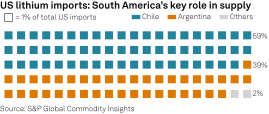
Most lithium carbonate used in the US is imported from Argentina and Chile. In 2024, Chile accounted for 59% of total imports, while Argentina contributed 39%. However, a significant portion of South American lithium is shipped to China for further production, as China dominates nearly all stages of the battery supply chain.
Limited US, Canadian production opens doors for partnership
For years, the US and Canada have aimed to increase the independence of their critical minerals supply chains, prioritizing the development of raw and refined lithium supplies. However, both countries account for only a small percentage of global lithium supply.
The only commercially producing lithium mine in the US is located in Silver Peak, Nevada, owned by Albemarle. The Silver Peak deposit produces approximately 5,000 mt of lithium carbonate equivalent annually, while US lithium consumption in 2024 was approximately 20,000 mt of LCE.
"One of the challenges is that most of the resources in the US are unconventional, such as geothermal mines. On one hand, it presents a great opportunity as they are large; on the other hand, it is difficult to extract lithium from them. From a technical and cost perspective, they are still in a black box," Bednarski said.
Lithium refining capacity in the region is also limited, with only two refineries in North Carolina producing lithium hydroxide at capacities of 15,000 mt and 5,000 mt, respectively.
Canada has strong prospects for lithium mining industry development due to its geological resources. Currently, it has two commercially producing mines in Manitoba and Quebec, and a refinery under construction.
In 2024, the US and Canada produced approximately 40,000 mt of LCE from their mines, compared to a global production of 1.28 million metric tons of LCE. As a result, the government and private sector are investing billions of dollars to strengthen the local supply chain, with many projects under development to increase domestic supply in the coming years.
In a scenario where demand for lithium intensifies in North America, regional proximity to South American nations presents certain advantages. Container shipments from South America to the US, for example, are generally faster than those to China, taking 20-30 days, compared to 35-45 days for shipments to China.
Cost is another significant differentiator. Market participants have noted that shipping costs from Argentina and Chile to China range from $3,000 to $5,000 per container, or approximately $150-$250/mt. In contrast, shipments to the US present a more economical option, around $90-$190/mt.
In terms of black mass recycling capacity, the US remains an emerging industry with insufficient refining capacity to process materials domestically. Most black mass generated in the country has reportedly been exported to South Korea for refining.
Black mass payables have remained stable globally so far this year, with US levels fluctuating between 69% and 72% for nickel and cobalt. Procurement activity has focused on higher-quality material containing at least 20% nickel.
Recyclers in the US expected demand for black mass exports to increase after China lifted its ban on the material on Aug. 1, 2025. Under the new policy, black mass that meets specific quality standards will be classified as non-waste and eligible for import. However, sources have said the standards are strict and much of the material produced domestically may not currently meet these tight requirements.
To address this gap, the US Department of Energy continues to support battery recycling efforts through funding programs as of October 2025, backing research, development, and demonstration projects aimed at scaling domestic recycling capabilities and reintegrating critical materials into the battery supply chain.
South America expands efforts to enhance participation
South America is actively investing and attracting investors to increase its participation in the lithium supply chain. The region accounts for 30% of total lithium output and holds half of the world's lithium reserves, according to the US Geological Survey.
This contribution is primarily driven by Chile, which leads with 21% of production from brine, followed by Argentina at 5% and Brazil at 4%. In contrast, Australia dominates the market with 37%, while the US accounts for less than 1%, according to Energy.
The region's importance is further confirmed by the presence of leading global producers. SQM, based in the Atacama region of Chile, has a capacity of 236,000 mt annually, representing 13% of global lithium raw materials. Additionally, Albemarle, with operations in Chile and the US, contributes an additional 13% to global supply, while Rio Tinto Lithium's operations in Argentina add 5%.
Currently, 13 lithium mining projects are in operation in the region: six in Argentina, three in Chile, three in Brazil, and one in Bolivia. Including projects still in development, the total number rises to 103 in the region.
Chile lags behind Argentina in the number of projects in early stages, with 17 projects, yet it remains the largest producer in the region. Argentina is expected to increase production more rapidly due to its openness to investors, with at least three projects under construction and 53 more underway.
Peru, Paraguay, and Mexico also have lithium potential in Latin America, although on a smaller scale and at different stages of exploration. Mexico and Paraguay are at earlier stages, and Peru has identified reserves.
Brazil plans to introduce a national policy aimed at developing its critical minerals sector in the second half of 2025 to expand its role in the electric vehicle supply chain. A key step is Bravo Motors' plan to open the country's first lithium-ion battery factory in the coming years. Currently, three companies are operational, and 16 lithium projects are listed as in development.
As of 2025, Brazil is one of the largest trading partners for the US in South America, with bilateral trade reaching approximately $80 billion in 2024. Still, Brazil was left with one of the highest tariffs imposed on certain exports to date, at 50%.
EV market set to grow despite shifts in direction
While the EV market remains subject to global uncertainty due to continued trade negotiations, plus the rising cost of living and an ever-changing environmental policy landscape, sales are expected to reach over 20 million units by the end of the year, a new record led by continued gains in China.
Nevertheless, several battery manufacturing projects have recently been suspended or canceled globally, underscoring the sector's significant challenges. Combined with ongoing volatility in raw material prices and persistent supply chain disruptions, a difficult investment environment was created, leading companies to reconsider or halt large-scale investment plans.
Although the US and South American lithium markets continue to grapple with low liquidity in spot trading, they remain intricately linked to Asian trends, each region navigating its unique dynamics and cost structures.
According to market participants, a collaborative approach to establishing regional pricing levels may be essential to ensure the sustainability and continuity of this supply chain.
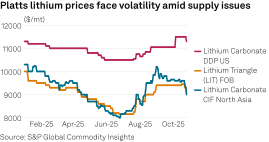
Platts, part of S&P Global Energy, assessed FOB Lithium Triangle price at $9,000/mt and Lithium Carbonate DDP US at $11,300 on Oct. 24, down 9% and stable, respectively, since the beginning of the year.

Editor: