Maritime & Shipping, Metals & Mining Theme, Containers, Ferrous
September 22, 2025
Looming China manufacturing slowdown threatens steel markets

HIGHLIGHTS
Manufacturing faces pressure amid slow domestic consumption
HRC output and inventories rise
China's manufacturing production and related steel demand remained healthy in August, supporting the flat steel market.
However, several China-based mills and trading sources said the seasonal demand recovery in September was too modest, and they were cautious about the growth momentum in manufacturing steel demand in the coming months.
Despite steel market inventories still rising, flat steel production has remained high so far in September, which could weigh on the steel market in October if no fresh policy stimulus is released this month or next, some of the sources added.
Manufacturing strong in August, challenges remain
China's manufacturing production index of steel consumption produced by Platts stood at 128 for August, up by 12 points from July and 10 points higher over the year. Platts is part of S&P Global Energy.
The production index is based on production data from China's National Bureau of Statistics for 18 steel-intensive manufactured goods, categorized into seven sectors and weighted according to their share of steel consumption. The monthly production average in 2018 is used as the baseline of 100.
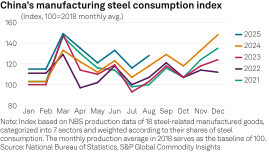
In August, the sectors of machinery, vehicles, home appliances, shipbuilding and power generation posted a year-over-year increase in production, while railway facilities and containers posted a year-over-year decrease, according to the data of the National Bureau of Statistics.
Steel demand from sectors of shipbuilding, new energy-related facilities and engineering machinery is likely to remain strong in the rest of 2025 and also 2026, according to some mill and trading sources.
"New shipbuilding orders have declined due to growing uncertainty in global economic growth, but as China has sufficient order backlogs, I expect steel demand in the shipbuilding sector to remain robust at least until 2028," said a mill source.
According to the China Association of the National Shipbuilding Industry, the shipbuilding completion in China will reach around 51 million deadweight tons in 2025, up by 5.9% from 2024.
China's shipbuilding order backlogs will remain above 230 million DWT by the end of 2025, higher than 209 million DWT by the end of 2024, the association said.
"Steel demand from engineering machinery has been on a healthy growth so far this year, and the strength is likely to sustain into next year. However, this is not due to any improvement in the construction industry; rather, in addition to the strong export market, the domestic engineering machinery market is currently in a replacement cycle of old equipment after three years of production decline, which has driven up the domestic purchases," said another mill source.
However, China's infrastructure investment was very weak in July and August, and if there is no further policy stimulus for the infrastructure sector, it could undermine the production growth in engineering machinery next year, the mill source added.
Some sources were more concerned about the automobile and home appliances sectors, saying domestic sales, particularly passenger cars, might see a significant year-over-year decline in the fourth quarter.
This would be in part due to exceptionally strong sales during the same period in 2024, which were fueled by government subsidies, and partly because these incentives have pulled future purchasing demand forward.
"The steel orders received by our company from the automobile and home appliances sectors have both dropped in September from levels in August and also a year ago," said the second mill source.
He noted that these manufacturers have reduced their steel order bookings for September, primarily for production scheduled in November, indicating a very cautious outlook regarding domestic consumption of cars and home appliances in the coming months.
The cautious attitude toward the domestic consumption outlook is actually reflected across the whole manufacturing sector as the fixed-asset investment in the sector was below a year-ago level in August for the second straight month, down by 1.3% year over year, slowing further from a 0.3% year-over-year decline in July, NBS data showed.
HRC market
"The outlook on manufacturing steel demand looks a bit dim, but currently most flat steel producers are still profitable, with the hot-rolled coil sales profit margins at around Yuan 50-100/mt ($7-$14/mt)," said a trading source.
The HRC margins have largely narrowed from the level of around Yuan 300/mt seen in early August, but they are still enough for mills to keep up their production at high levels, said the source.
According to NBS data, China's medium-thick HRC production was at 18.769 million mt in August, up 1.9% from July and 4.2% year over year.
Some market sources said HRC production continued upward in September. This, combined with tepid end-user demand recovery, has kept HRC market inventories on an upward trend.
The domestic HRC inventories at major spot markets monitored by China Iron & Steel Association totaled 1.93 million mt as of Sept. 10, up 9% from the start of August.
Some of the sources said steel market inventories usually start to retreat in early or mid-September as end-user demand recovers, but as of Sept. 18, HRC inventories remained on an uptrend.
"The steel demand outlook seems weak, but the domestic HRC prices have so far remained mostly stable, largely as the market is still anticipating the government to release more stimulus measures or strengthen steel production controls as part of efforts to combat involution," said another trading source.
The source said the government could sooner or later introduce more economic stimulus policies, but if any further stimulus measures cannot be implemented by October, the steel market may face downward pressure amid slow demand.
The Platts-assessed domestic HRC prices averaged Yuan 3,390/mt over Sept. 1-18, down 1.6% month over month but 10% higher year over year.

Editor: