Metals & Mining Theme, Ferrous
September 12, 2025
Weak China automobile sales outlook may hit cold-rolled coil steel market

HIGHLIGHTS
Domestic vehicle sales may decline in the coming months
Higher output, slow uptake seen pressuring CRC prices
A sluggish start to China's passenger vehicle retail sales in September, coupled with slower year-over-year growth reported in August, has contributed to a weaker outlook for sales in the remainder of the year, potentially putting pressure on the cold-rolled coil steel market.
CRC is widely used in vehicle production, and its prices could face downward pressure in October due to increased steel production and a potential slowdown in the domestic vehicle market, according to China-based steel market participants and analysts on Sept. 11.
This could also lead to a spillover effect on China's hot-rolled coil prices.
Slowing vehicle sales
Although China's domestic passenger vehicle retail sales increased in August compared with July, the pace of growth has noticeably slowed.
China's car sales in August increased 4.6% from a year earlier, but the year-over-year growth rate slowed from 6.3% in July and 18.1% in June, according to the China Passenger Car Association.
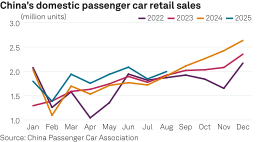
The CPCA projects domestic passenger vehicle retail sales to rise 6% year over year to 24.35 million units in 2025. However, industry sources say that this prediction is too optimistic due to anticipated weakness in the fourth quarter.
"Despite a rebound in domestic car retail sales in August, car sales declined rapidly in the first week of September," said an automobile market analyst. "Although car sales typically perform better in the middle to late part of each month, I believe that the weak car sales in early September may indicate a slowdown in momentum in the domestic car market."
A Chinese mill source said domestic vehicle sales could significantly decline year over year in the coming months, partly due to the exceptionally strong automobile sales during the same period of 2024, fueled by government subsidies.
Domestic passenger vehicle retail sales over September-December 2024 increased 11.2% year over year to 9.429 million, according to the CPCA.
"These incentives have pulled future car purchasing demand forward into late 2024 and the first half of 2025," the mill source said. "Our company's auto sheet orders are expected to decline in September from August."
Another mill source anticipates domestic vehicle sales in China to decline in the near term; however, China's plan to impose a purchase tax on electric vehicles starting in January 2026 could prompt some consumers to advance their purchases before the end of 2025.
Market participants indicated that consumer enthusiasm for switching from gasoline vehicles to new energy vehicles has reached its peak, resulting in a subdued growth outlook for China's domestic automobile market.
In August, retail sales of new energy vehicles accounted for 55% of total vehicle sales. Participants said achieving a substantial increase in the market share could prove challenging.
CRC market
Industry sources expect China's passenger car exports to remain robust in 2025 and 2026, potentially helping to partially offset the downward pressure facing the domestic market.
The CPCA estimates that passenger car exports in 2025 will increase 14% year over year to 5.46 million units.
However, with China's flat steel production continuing to rise, a slowdown in automotive steel demand could put pressure on flat steel markets, particularly CRC, in the coming months, according to industry sources.
The automobile sector accounts for about 15%-16% of China's total flat steel consumption, according to S&P Global Energy.
China's cold-rolled sheet output over January-July increased 8.6% year over year to 29.552 million mt, data from the National Bureau of Statistics showed.
Medium-thick HRC production during the same period increased 4.4% year over year to 132.435 million mt.
Some trading sources expect CRC and HRC output to remain stronger than a year earlier in August and September.
Amid rising production, the price spread between Chinese domestic CRC and HRC narrowed to Yuan 460/mt ($65/mt) on Sept. 9 from Yuan 530/mt of a year earlier and a recent peak of Yuan 700/mt in April, according to Platts data from S&P Global Energy. The typical production cost to roll HRC into CRC is around Yuan 400-500/mt.
