Metals & Mining Theme, Non-Ferrous
July 18, 2025
Stock draws, uncertain replacement options push US aluminum premium to a record

HIGHLIGHTS
Midwest Premium rises nearly 80% since the end of May
Importers face elevated risk bringing in new units with tariffs
The Platts US Aluminum Midwest Premium rose to a record high 68.25 cents/lb plus LME cash, delivered Midwest, July 18, as the market continues to search for viable replacement options amid evolving trade flow scenarios.
The currently assessed value is 0.25cent/lb higher than the previous record, which was reached June 6, six weeks ago.
US President Donald Trump signed an executive order June 3, doubling tariffs to 50% from 25% under Section 232 for aluminum imports into the US from all origins, effective June 4.
Since the doubling of the import duties, market participants have continually pointed to elevated replacement costs for new units as a bullish factor for Midwest Premium values, even with uncertain demand.
Still, fundamentals have been mixed, as consumers continue to ask for discounts from the Midwest Premium level, trader sources have said.
The currently assessed level, according to Platts data, is up 44.90 cents/lb or 192% from Jan. 2, and up 29.75 cents/lb or 77% from the May 30 assessed value of 38.5 cents/lb, just prior to the announcement of the increased import duties.
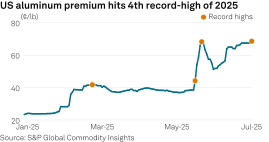
The most competitive bid, left open at the close in the Platts Market on Close assessment process July 18, was 68.20 cents/lb over the LME average July 25-Aug. 17, 100 mt, while the most competitive offer left open at the MOC close was 70.50 cents/lb over the LME average July 25-Aug. 15, 200 mt.
However, according to source feedback in June and July, premiums need to be higher to fully offset the tariffs. Indicative values were heard heard as high as 73 cents/lb during the week of July 14-18.
"Metal on the ground is tight," one trader source said. "We are seeing more requests for offers, and the [London Metal Exchange] price is increasing, so duty is going up."
Stock draw
Many current sales are being made using existing stocks in US warehouses. Consumers are reluctant to buy at record-high premiums, so discounts are being negotiated to entice buyers off the sidelines.
Inventories are being drawn at a rate of roughly 80,000 mt/month, according to a second trader, which will result in critically low levels by the late second half of 2025. At that point, the elevated premiums may become the new normal, with the US continually reliant on tariffed imports to fulfill domestic needs, according to market feedback.
Even with finite domestic inventories, importing countries are hesitant to send in new volumes with continually changing guidance around tariff rates, sources said. As of mid-July, the US will impose 30% tariffs on all imports from the EU and Mexico starting Aug. 1, a development that is expected to affect trade in key commodities, including steel, energy, and automotive products.
Canadian imports supply two-thirds of US primary aluminum consumption, according to the Aluminum Association. The US consumed 4.9 million mt of unwrought primary aluminum in 2024, with 3.6 million mt coming from imports, according to data from S&P Global Market Intelligence. Canada supplied the US with 2.7 million mt, or roughly 76%, of those inflows.
Other top importers of unwrought aluminum in 2024 included the United Arab Emirates, Argentina, Bahrain, Australia, India, and Qatar. The countries accounted for a combined 23% of imports, the data showed. No other country, aside from Canada, supplied the US with more than 350,000 mt of aluminum last year.
Copper and aluminum
With Trump also announcing 50% tariffs on copper July 8, import duty rates are now the same for both copper and aluminum. This shift in trade policy may result in some copper users substituting aluminum for certain applications, although, based on the replacement ratio required and the current respective costs for each metal, the substitution is not enticing for many players, sources have said.
"I think that would take some further development," a third trader said, regarding the feasibility of substitutions in the current spot market.
According to a Market Intelligence report, aluminum has only 60% the conductivity of copper, which means wires must be thicker to move the same amount of power. As a poorer conductor of heat, aluminum sometimes requires more insulation, but it can replace copper in applications such as overhead transmission lines, where weight is a major consideration, and in some cases, tubing.
The report said copper starts to face substitution pressure from aluminum when its price is about three and a half to four times that of aluminum.

Editor: