Metals & Mining Theme, Non-Ferrous, Ferrous
July 14, 2025
TRADE REVIEW: Slow stainless steel, battery demand to weigh on nickel prices in Q3
By Samantha Beh and Leah Chen
HIGHLIGHTS
Rainy season in the Philippines to tighten supply, hold up nickel ore prices
Disrupted supply, increased demand for cobalt support MHP payables
Nickel sulfate demand slows ahead of seasonal lull
This report is part of the S&P Global Energy Metals Trade Review series, where we dig through datasets and digest some of the key trends in iron ore, metallurgical coal, copper, alumina, cobalt, lithium, nickel and steel and scrap. We also explore what the next few months could bring, from supply and demand shifts to new arbitrages and quality spread fluctuations.
The nickel market is likely to continue facing a structural oversupply in the third quarter of 2025 despite hiccups in nickel ore and mixed hydroxide precipitate supply in the second quarter, which kept spot prices high.
The current oversupply is expected to persist in 2025 for the fourth consecutive year and likely last until 2031, according to the latest S&P Global Energy analyst report, which expects oversupply to reach 198,000 mt in 2025.
For Q3, pressure on nickel prices is likely to continue due to prevailing weak demand from stainless steel and battery markets -- the main consuming sectors of nickel.
China's nickel ore import slow amid rainy weather in the Philippines
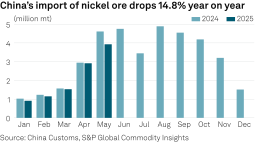
China's nickel ore and concentrate imports from the Philippines tallied at 10,431,707 mt year to date, down 946,100 mt or 8.32% year over year, according to China Customs, which market sources have attributed to lesser Philippine supply and their declining ore grades.
The Philippines remains the largest supplier to China, accounting for 91.8% of the total imports in May, according to China Customs. China's nickel ore imports totaled 3.93 million mt in May, down 14.8% year over year.
The nickel ore market is bracing for further supply tightness as the Philippines enters the rainy season from June through November. The tighter ore supply has supported nickel ore prices exported to China in Q2.
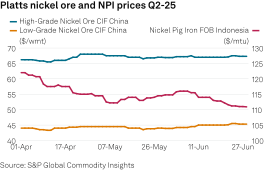
Platts, part of S&P Global Energy, assessed high-grade 1.6% Ni ore at an all-time high of $68/wmt April 24 on a CIF China basis since its launch Sept. 23, 2024. For low-grade 1.3% Ni ore, Platts assessed the latest price at $44.70/wmt on July 11, up $0.7/wmt from April 1.
Meanwhile, the Indonesian government's plans on July 2 to reduce the length of mining production quotas to one year from three years has impacted the nickel ore supply in the country. The measure was taken to tackle oversupply and nickel price volatility.
Weak stainless steel demand pressures NPI prices
The higher nickel ore prices also supported nickel pig iron prices in Q2, but NPI is facing increasing pressure from sluggish downstream stainless-steel demand moving into Q3.
Globally, 165 million mt of new steelmaking capacity is expected to come online between 2025 and 2027, according to the Organization for Economic Cooperation and Development. In contrast, steel demand is projected to grow by only 46 million mt over the same period.
This overcapacity in the longer term is likely to place added pressure on feedstock prices such as NPI.
Global economic uncertainties also placed pressure on nickel demand, which was already facing challenges due to production cuts in the stainless steel industry in the past quarter, accounting for two-thirds of global primary nickel demand, analysts at Energy shared.
"We have no trades done recently, but we are not willing to lower the prices anymore," a major stainless-steel producer said, highlighting sellers' reluctance to concede further discounts.
Platts assessed Indonesian NPI (10% Ni content) at $109.50/mtu FOB Indonesia on July 11, stable day over day.
Supply constraints support MHP
MHP supply had tightened due to reduced production in Q2, including an accident at a Chinese-funded nickel plant in Indonesia on March 28, although sources said production gradually resumed later in the quarter.
In May, China imported 142,744 mt of MHP, up 0.3% month over month and 10.1% year over year, Chinese customs data showed. Imports from Indonesia, as the largest supplier to China, increased 1.9% from April to 113,595 mt, representing 79.6% of total imports.
The ongoing cobalt export ban from the Democratic Republic of Congo also drove demand for MHP, which contains nickel and cobalt.
However, the market remained bearish, with buyers typically bidding at the low end of 80% payables amid weak downstream battery demand.
Throughout Q2, market participants said spot offers for MHP remained relatively stable at 85% payables for M-month delivery, while slightly lower payables of low-80s% payables were noted for forward months.
Platts assessed the MHP CIF North Asia basis LME nickel price at 85% payables July 11, up 2.7% payables since April 1. The all-in price, as calculated from the payables basis of the LME nickel price, was at $12,737/mt, down $472/mt since April 1.
Nickel sulfate price under pressure on weak NMC battery demand
Downstream, China's Contemporary Amperex Technology or CATL started development of the power battery industry chain in Indonesia through its $5.9 billion integrated nickel project on June 29.
The plant is expected to start operations by the end of 2026, with a capacity of about 15 GWh/year, targeting to produce batteries that can support 200,000 to 300,000 electric vehicles annually.
However, sources said the potential for the new energy sector to absorb part of the supply hinges on downstream demand. As China's demand for nickel-manganese-cobalt (NMC) batteries continues to decline in favor of nickel-free lithium-iron-phosphate (LFP) batteries, NMC battery sales only reached 44.5 GWh in April to May, according to China Automotive Battery Innovation Alliance. In contrast, LFP sales totaled 129.3 GWh in the same period.
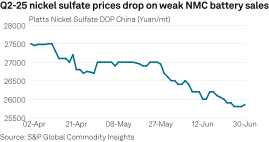
This shift in battery preference has implications for nickel sulfate prices, which in Q2 reflected a general downward trajectory. Prices started at Yuan 27,500/mt on April 1 and gradually decreased over the quarter due to weak downstream demand.
Chinese market participants expressed challenges in nickel sulfate sales as the market enters a traditional off-season, with support only coming from slowed MHP supply.
Platts assessed spot battery-grade nickel sulfate with a minimum 22% nickel content and maximum 100 ppb magnetic material at Yuan 25,750/mt ($3,603/mt) DDP China July 11, down Yuan 1,750/mt or 6.36% since the start of Q2.

Editor: