Metals & Mining Theme, Non-Ferrous
May 19, 2025
FEATURE: Tariff on Canada a roadblock for 'essential' supply to US aluminum sector, industry leaders say

HIGHLIGHTS
Affordable Canadian metal necessary to support growing US aluminum sector
Total US production capacity over 3.5 million mt short of meeting demand
Long-term tariff on Canada could lead to aluminum demand declining in the US
US tariffs on critical Canadian aluminum imports have been a roadblock to the US aluminum sector's ability to meet rising demand and achieve long-term growth, industry leaders say.
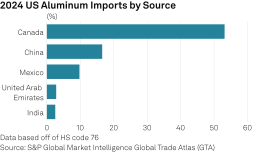
US President Donald Trump's March 12 order for a 25% tariff on all aluminum imports ended the US's duty-free access to Canadian aluminum. The US imported 60% of its overall primary aluminum demand from Canada in 2024, according to S&P Global Market Intelligence data. While Trump's tariffs were meant to stimulate domestic aluminum production, the US does not have nearly enough capacity to meet its own demand. And even with a May 16 announcement by the UAE that it is making progress in its plans to spend $4 billion building a smelter in Oklahoma, constructing new smelters takes about five years and can cost as much as $5 billion. In the meantime, while current demand remains healthy, the US industry is paying higher prices for tariffed metal from Canada, according to its representatives.
"The short version is the US industry needs more metal," Henry Gordinier, chair of the Aluminum Association, a trade group of US producers, said at an April 24 press roundtable. "Demand continues to look very strong, but if we are going to meet that demand here at home, that means we need an all-of-the-above approach in terms of metal supply."
"That means exploring ways to recycle more metal while potentially expanding primary aluminum production," he said. "All while recognizing that a great deal of our metal needs today are met by importing, especially from our partners in Canada."
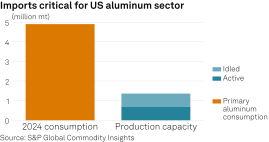
The US consumed 4.9 million mt of primary aluminum in 2024, with 4.2 million mt coming from imports, according to S&P Global Market Intelligence data. Canada supplied the US with 2.7 million mt.
And the US cannot make up the lost ground on its own. The US has four active aluminum smelters with a combined active production capacity of 700,000 mt annually. Idled production capacity, which has come offline over the last decade due to high energy costs, could add roughly 660,000 mt of additional annual production. The new Oklahoma smelter would add another 600,000 mt of annual capacity. Even taken all together, the US would have a supply gap of over 2.9 million mt.
"Building new smelters is one avenue [to meet demand], but it's not quick and it isn't cheap," Charles Johnson, CEO of the Aluminum Association, said at the roundtable. "Each new facility would require approximately $5 billion and five years to build, along with long-term annual power contracts for enough electricity to power Nashville or Boston for a year."
"And that's to build a single smelter. We would need to build about five new smelters to fill our existing estimated 4 million mt metal gap for primary aluminum, to say nothing of future metal needs as demand grows," Johnson added.
The association has emphasized that access to affordable electricity is a key issue for building new domestic smelters and keeping current infrastructure competitive. The trade group has been in talks with the Trump administration to discuss accessible power for the aluminum sector.
"In addition to talking tariffs, we continue to engage with the government to identify the roadblocks in America's electricity infrastructure and power rates that have prevented smelters from being economically competitive," William Oplinger, CEO of US-based aluminum giant Alcoa, said at the event. "In the meantime, for our industry to grow and continue investing, we need reliable, affordable metal and Canada plays an essential role in meeting that need."
When asked whether the Aluminum Association's stance on Canadian aluminum supply would make President Trump consider lowering tariffs on Canada, the White House remained firm on its current policy.
"President Trump has correctly identified the production of aluminum as critical to our national and economic security, with key uses in aviation, shipbuilding, electronics, and other military hardware," White House spokesman Kush Desai told Platts, part of S&P Global Energy. "The Trump administration is committed to restoring America's aluminum production capabilities with tariffs, tax cuts, deregulation, and American energy."
US tariffs on Canadian aluminum are costing Alcoa up to $425 million annually , Oplinger said during the company's first quarter earnings call on April 16. Alcoa has smelters in both the US and Canada, with much of its Canadian production shipped to US customers.
Of the four active US smelters, two are operated by Alcoa and two by Chicago-based Century Aluminum. In earnings calls for their Q1, neither company said they would increase production and restart idled capacity because of US tariffs.
"It's hard to make a restart decision based on a tariff that can change. We have seen the volatility of discussions around the tariffs over the last 60 days," Oplinger said on Alcoa's April 16 call. "We wouldn't necessarily make a decision to restart capacity simply based on tariffs just because they can change."
Jesse Gary, Century Aluminum's CEO, said in a Feb. 25 metals industry conference that Century was considering restarting up to 60,000 mt in idled production capacity at its Mount Holly, South Carolina, smelter.
However, the company did not mention production increases on its May 7 earnings call.
Century declined to comment to Platts, while Alcoa did not respond to a request for comment.
A long-term 25% tariff on Canadian aluminum could deteriorate US demand for aluminum by key end-users, Karen Norton, Energy principal aluminum analyst, said.
"If US tariffs stay at 25% on Canadian metal, it seems likely that domestic demand in the US will be affected negatively in key end-use sectors like construction, automotive and packaging," Norton said.
Industry experts have also noticed that a persistent Canadian tariff is likely to shift trade flows and keep aluminum prices elevated
"[A persistent Canadian tariff] is likely to require taking more metal from regions such as the Middle East that will command a higher premium, with higher prices expected to raise consumer costs and lower US competitiveness across key sectors," Norton said. "If consumers balk at these costs and there is no sign of the situation changing, then this may accelerate more concerted moves toward substitute materials, such as composites in autos and plastics in packaging."
The Platts spot 99.7% P1020 US Aluminum Transaction Premium was last assessed at 37.10 cents/lb plus LME cash, delivered Midwest, net-30-day payment terms, on May 15. This assessment, also known as the Midwest premium, has risen 58.9% since the beginning of the year.
"If consumers balk at these costs and there is no sign of the situation changing, then this may accelerate more concerted moves toward substitute materials, such as composites in autos and plastics in packaging."
Trump's first administration exempted Canadian aluminum imports from tariffs in 2019. The US aluminum sector has emphasized the importance of reinstating this exemption.
"In the US, we see significant opportunities to work together to recognize and consider the importance of Canadian metal to our economy, as was wisely done in 2019," Oplinger said at the April press event. "This would provide the certainty and metal supply our industry needs while we simultaneously pursue other avenues for increasing domestic production."

Editor: