Energy Transition, Natural Gas, Emissions, Renewables
December 25, 2024
Japan's FY 2040-41 energy supply, demand scenarios include boost in gas supply

HIGHLIGHTS
73% GHG cut-aligned scenarios expect big drop in fossil-fuel-based supply
Gas supply estimated at about 54 mil-74 mil mt in FY 2040-41: experts
FY 2040-41 thermal power share to drop to 30%-40% from about 70%
Japan's high-level Strategic Policy Committee disclosed Dec. 25 a set of energy supply and demand scenarios for fiscal year 2040-41 (April-March) aligning with a 73% greenhouse gas reduction target and a scenario with the slow introduction of decarbonization technologies with a boost in the primary energy supply of natural gas.
The FY 2040-41 energy supply and demand scenarios, part of the draft 7th Strategic Energy Plan, Japan's principal energy policy, were released by the Ministry of Economy, Trade and Industry's Strategic Policy Committee. The multiple scenarios that are part of the plan reflect the country's difficulty in drawing up the energy supply and demand outlook for about 15 years ahead.
The draft FY 2040-41 energy supply and demand scenarios, which align with the country's provisional target of a 73% cut in GHGs by FY 2040-41 from FY 2013-14, expects the country's final energy consumption volume to be about 260 million-270 million kiloliters in the fiscal year to March 2041, compared with 310 million kl in FY 2022-23.
Under the scenarios, the country's energy self-sufficiency is expected to improve to around 30%-40% in FY 2040-41 from 12.6% in FY 2022-23.
The FY 2040-41 primary energy supply under the 73% GHG cut-aligned scenarios is about 420 million-440 million kl, down from 470 million kl in FY 2022-23, led by significant drops in fossil-fuel-based primary energy supply, despite an increase in non-fossil fuel-based primary energy supply.
Under the 73% GHG cut-aligned scenarios, the primary energy supply of natural gas is at around 80 million-90 million kl, with petroleum at around 90 million-120 million kl and coal at about 40 million-50 million kl in FY 2040-41, compared with natural gas at 100 million kl, petroleum at 170 million kl, coal at 120 million kl in FY 2022-23.
In another scenario with slower-than-expected progress in introducing decarbonization technologies such as renewable energy, hydrogen, and carbon capture and storage (CCS), Japan expects primary energy supply of natural gas to be about 110 million kl, or 74 million mt in FY 2040-41, increasing from the FY 2022-23 level.
Mixed signals
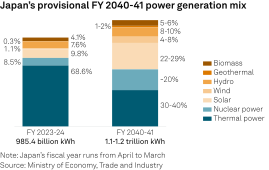
The natural gas in the primary energy supply of 74 million mt in FY 2040-41 underlined the country's need for a long-term and stable LNG supply. However, it could also send mixed signals to the industry as the country's proposed share of thermal power in Japan's power generation mix will plunge to 30%-40% in FY 2040-41 from 68.6% in FY 2023-24.
"[The slow technology advancement] scenario assumes that insufficient cost reductions in innovative technologies until FY 2040-41 enable only existing technologies to penetrate and expand, as well as a significant reduction of fossil energy sources as a total in the total primary supply, while at the same time an increase of LNG supply and total power generation [volumes]," said Hiroshi Hashimoto, senior fellow at the energy security unit of the Institute of Energy Economics, Japan.
"That means even a more important role of LNG in filling the gap of smaller supply of other energy sources," Hashimoto said. "This apparently encourages more proactive procurement activities."
Experts surveyed by S&P Global Commodity Insights estimate Japan's natural gas in primary energy supply to be in the 54 million-74 million mt range in FY 2040-41 based on their calculations of the country's primary energy supply of gas of about 54 million mt to 61 million mt under the 73% GHG cut-aligned scenarios for the fiscal year, as well as gas in primary energy supply standing about 66 million-67 million mt in FY 2022-23.
"As Japan's natural gas consumption volume is estimated to be about 54 million mt to 74 million mt over varied scenarios in FY 2040-41, as well as suggesting it to be increased or decreased from more or less than 67 million mt in FY 2022-23, which sends mixed signals in the prospective natural gas demand in the draft Strategic Energy Plan," said Takayuki Nogami, chief economist at Japan Organization for Metals and Energy Security.
"Amid uncertainty over the scale of LNG demand toward FY 2040-41, Japanese utilities would likely have to take a conservative approach toward LNG procurements for their businesses," Nogami said.
Given the range of natural gas supply in the primary energy mix, Takeo Kikkawa, president of the International University of Japan, said: "It will not serve as a basis for natural gas buyers for their procurement with a large range like this," adding that it is "meaningless."
Kikkawa, who was for many years previously involved in the formulation of the Strategic Energy Plan as a member of the METI's advisory committee, said that the slow technology advancement scenario might turn out to be the most likely scenario.
"As they have expressly written it, this might be a likely scenario in mind," Kikkawa said. "Conversely, this would mean that [Japan] would need to buy a considerable amount of natural gas; however, it is hard to read that way as the base scenario shows a decrease."
"The tone of hydrogen and ammonia has diminished [quantitatively], while the role of [synthetic] methane has relatively increased [qualitatively]" in the draft Strategic Energy Plan, Kikkawa added.
The 73% GHG cut-aligned scenarios expect Japan's hydrogen and its derivatives supply in the FY 2040-41 primary energy supply to be about 20 million kl. However, hydrogen and its derivatives supply is expected to drop to around 10 million kl in the FY 2040-41 scenario with slow technological advancement.
While synthetic methane does not specifically form part of the FY 2040-41 primary energy supply in the draft Strategic Energy Plan, it is placed among decarbonization solutions, which could gradually displace the use of natural gas as a result of technological advancement as a pathway even after achieving 2050 carbon neutrality.
Generation mix
The proposed share of thermal power in FY 2040-41 comes as Japan outlined in the draft Strategic Energy Plan that it will maximize the introduction of renewables as its main power source and seek a balance in its power generation mix for stable energy supply and decarbonization.
The proposal is based on a provisional FY 2040-41 outlook covering multiple scenarios, which suggest that Japan's electricity generation volume will reach 1.1 trillion-1.2 trillion kWh, up from around 985.4 billion kWh in FY 2023-24, driven by expected growth in power demand from digital transformation and green transformation.
The provisional FY 2040-41 power generation mix comprises renewables at about 40%-50%, thermal power at around 30%-40% and nuclear power at about 20%, compared with renewables at 22.9%, thermal power at 68.6% and nuclear power at 8.5% in FY 2023-24.
The provisional FY 2040-41 share of thermal power, however, does not include a breakdown of each power generation source, such as coal, LNG and oil, nor does it present an explicit share of hydrogen and ammonia in the proposed power generation mix.
The Strategic Policy Committee approved the draft 7th Strategic Energy Plan to be sent for a 30-day public comment expected to start by the end of the year, which will be followed by a cabinet approval for formulation.