LNG
November 04, 2025
Asian LNG reload exports rebound in 2025 amid regional storage surplus

By Shuocheng Ni
HIGHLIGHTS
Reload exports at 38 cargoes forJan-Oct vs 41 for full 2024
China emerges as top reloader this year with 15 shipments
Storage glut, weak import margins fuel Chinese re-export activity
The Asian LNG reload trade has recovered strongly in 2025, already reaching 38 cargoes as of the end of October compared to 41 shipments for the entire previous year, according to data from S&P Global Energy
It comes after cargoes reloaded for export had dropped in 2024 from 46 cargoes in 2023.
The origins of and destinations for the reload exports have changed significantly due to changing trade flows and the development of regional LNG reloading facilities.
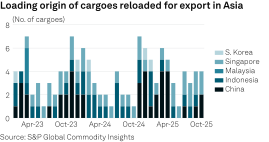
Reload activity rebounded in 2025 with spot international LNG prices being consistently higher than Chinese domestic prices, multiple sources noted.
The weighted average cost of pipeline gas contract prices in South China was around Yuan 2.8/cubic meter during winter, equivalent to around $10.65/MMBtu. Platts assessed the JKM December price at $11.117/MMBtu on Nov. 3.
Similarly, in 2023, the elevated LNG prices had created favorable conditions for long-term contract holders to sell in-the-money positions.
Conversely, in 2024, importers' contracted volumes were not significantly competitively priced relative to spot markets, reducing incentives for re-export activities. The price in the spot market even dropped lower than that of term contract in Q3, further discouraging reloading exports.
The expansion of storage facilities and increasing reload capabilities at receiving terminals in Northeast Asia has also contributed to the rebound in reloads in 2025 and is expected to continue doing so in the near future.
"Importers with excess storage facilities are trying to utilize their facilities during shoulder months," said a Singapore-based trader, adding that "considering the availability of storage infrastructure, reload trades will be a trend."
Changes in reload export origin and destinations
China has re-exported 15 cargoes so far this year as importers with bonded storage facilities increasingly seek to monetize excess inventories, and has overtaken Singapore to become the top reload exporter in 2025.
Abundant pipeline gas supplies and weak domestic demand have resulted in persistent price inversions where import costs exceed domestic market prices. This disparity has prompted importers with access to bonded storage facilities to actively pursue reload opportunities as a margin recovery strategy.
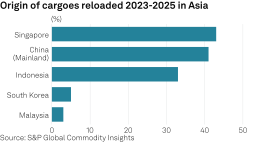
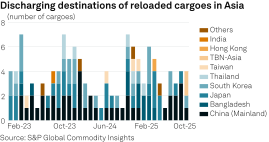
Notably, China serves dual roles in the current market structure, functioning both as a major source and destination for reload cargoes. China has exported 15 reload cargoes and imported 10 cargoes in 2025 till October.
Elsewhere, Indonesia's reload volumes have declined significantly in both 2024 and 2025, marking a notable shift from the country's historically important role in the trade. The Arun LNG terminal, traditionally a key reload hub, has seen reduced activity as regional supply patterns evolve.
Singapore continues to maintain its position as a crucial reload port, leveraging its strategic location and storage infrastructure.
"Although our primary target is to secure the supply to Singapore, we're also potentially open to reload exports when the utilization of the storage facilities is favorable in the future," said a trader at a Singapore gas procurement company.
Bangladesh has consistently attracted reload cargoes due to high credit premiums that make the market attractive for traders seeking to optimize margins. The country's credit risk profile has created pricing opportunities that reload operators have been able to capitalize effectively.
Japan and South Korea have emerged as important destinations for Chinese reload volumes, benefiting from the compressed regional price spreads making short-haul movements economically more viable.
Issues raised on reloads
However, traders raised concerns on reload exports regarding the flexibility of trading such cargoes due to restrictions of cabotage clauses.
Cabotage laws restrict such cargoes to be shipped back to the country where the cargoes had originally been re-exported from.
"If the cargoes are reloaded from China, the cargo automatically becomes JKT basis instead of JKTC, which reduces the flexibility," said a trader,indicating cabotage laws restrict cargoes' flexibility.
On the flip side, several end users have suggested that they did not see restrictions on importing reloaded cargoes as long as the cargo does not contain molecules loaded from sanctioned facilities.
"Sometimes reloaded cargoes are even more preferable due to [its availability in the] prompt; at least we have no issue taking Chinese reloads," said a Japanese importer.
Despite the concerns, market participants believe that the increase in reload exports will be an ongoing trend as Asian storage capacity ramps up, especially in China.
"Considering from 2026 the LNG [market] will experience an oversupply, importers will try to utilize the excess storage facilities during shoulder months," a Chinese trader commented.

Editor: