LNG, Maritime & Shipping
October 31, 2025
EU’s Russian LNG ban could tighten market as Yamal cargoes struggle to divert

By Matt Hoisch
HIGHLIGHTS
Most EU imports of Russian LNG from Yamal project: Energy
Shipping constraints set to limit Yamal utilization amid sanctions: analysts
EU expected to replace lost volumes, but restrictions add volatility
Shipping constraints may limit market participants' ability to completely redirect Russian LNG volumes to regions beyond Europe once a recently passed EU ban goes into effect, market watchers have warned.
Since the start of 2025, the EU has imported some 11.9 million metric ton (16.4 Bcm) of LNG from Russia, according to data from S&P Global Energy. Almost all of those cargoes -- roughly 11.7 million mt -- have come from Russia's Yamal LNG project. The primary importers have been France, Belgium, Spain and the Netherlands.
Under the EU's latest package of sanctions against Moscow, though, shipments of Russian LNG into the EU will be fully prohibited from Jan. 1, 2027.
The difficulty in redirecting all the cargoes stems from geography.
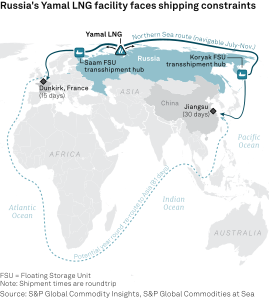
Yamal LNG's location on the northeastern part of Russia's Yamal Peninsula means rerouting those volumes to Asian markets becomes significantly more expensive when the Northern Sea Route is closed by ice, typically from around December to June.
"Europe has been the most economically viable market for Yamal LNG cargoes," said Irina Mironova, senior research analyst at the New Energy Advancement Hub. "Redirecting them to Asia will lengthen voyages and raise shipping costs, especially outside the Northern Sea Route navigation season, reducing profitability."
When the NSR closes off, ice-class carriers have to travel westward to transship cargoes onto more efficient, non-ice-class carriers. Shipping costs during these months can surpass $2/MMBtu to reach the Asia-Pacific region, according to a Energy analysis. This compares to about 50 cents/MMBtu to reach the Dunkirk terminal in France.
The longer voyages do not just raise costs; they also limit the volumes that can come to market as ships take more time to deliver a cargo and return for another.
"We anticipate the ban on Russian LNG in the EU markets to lead to lower utilization at Yamal LNG, due to shipping capacity constraints, limiting the overall supply availability," said Sara Pourghorbani, associate director of Global LNG Analysis with Energy.
Pricing effects
The scale of a potential supply reduction from Yamal and its impact on prices is uncertain. One market source with a major producer estimated the transit challenges could take some 10 million mt of LNG off the market from the facility in 2027.
"This would put some extra pressure onto the pricing in 2027," the source said.
At the same time, however, LNG supplies are expected to grow significantly in the coming years as new capacity comes online.
Energy has projected global LNG production will rise by nearly 80 million mt to surpass 510 million mt from 2025 through 2027, roughly 18% growth. An even larger increase is forecast by the end of 2030, when capacity is expected to reach nearly 630 million mt.
"The market is already moving into this oversupply mode," said Tatiana Mitrova, a fellow at Columbia University's Center on Global Energy Policy.
Demand growth also faces headwinds. Mitrova pointed, in particular, to China. It has cut LNG imports by some 9.5 million mt, or 17% year over year, over the first nine months of 2025.
"There will be some additional spare LNG capacity to serve Europe," Mitrova said. "I don't see this deficit gap."
Paweł Czyzak, interim Europe program director at the energy think tank Ember, agreed.
"Removing Russian LNG from the mix [in the EU] is unlikely to have an impact on prices, and certainly won't have any impact on security of supply," he said.
Still, even as the global LNG market heads to a period of ample production by the end of the decade, upside risk remains in the coming years as those new facilities come online. Project delays, geopolitical conflagrations, or a demand bump spurred by a particularly cold winter at a time when EU gas storage levels sit some 12 percentage points lower than last year remain concerns, according to the market source with a major producer.
"My sense is that 2026 and 2027 might still be volatile," the source said.
The EU's sanctions are on track to hold the global market in a tighter balance than it otherwise would have been, the market source explained. "It's another element of volatility in the market."
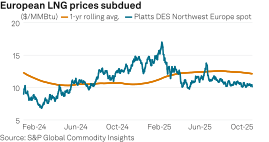
The EU's push to ban Russian LNG comes as European prices remained subdued. Platts, part of Energy, last assessed the DES Northwest Europe LNG marker at $10.126/MMBtu Oct. 30, down 2.93% day over day.
Legal uncertainty
Even as market participants try to anticipate the impact of the new sanctions, the full scope of the measures remains unclear to some of the players central to the EU's trade in Russian LNG.
TotalEnergies CEO Patrick Pouyanne said Oct. 30 that the company is seeking clarification around the restrictions as it assesses whether it will be able to declare force majeure on its contracted cargoes from Yamal or divert them.
"Our lawyers are working on it," Pouyanne said during the company's third-quarter earnings call. "It's a fresh regulation, so I don't have full clarity."
The French oil and gas company holds a 20% stake in Yamal LNG and is contracted to offtake 4 million mt/year from the 17.4 million mt/year project, according to data from Energy analysts.
"If there is no further ban [beyond prohibiting the import of Russian LNG into Europe], I cannot use the force majeure to cancel the contract," Pouyanne said. "If I don't have force majeure, I am committed to offtake some cargoes."
Other Yamal offtakers include China's CNPC (3 million mt/ year), Spain's Naturgy (2.5 million mt/ year), and Russia's Novatek (2.4 million mt/ year), according to the Energy analysis. Novatek also operates the project and holds a majority stake of 50.1%.

Editor: