Electric Power, LNG, Natural Gas
October 28, 2025
The enduring sway of Egypt’s fitful LNG demand
By Matt Hoisch and Sakshi Jalan
HIGHLIGHTS
Declining gas production has shifted Egypt to net LNG importer
Five FSRUs deployed in ‘unprecedented’ response: analyst
Despite recent exports, strong LNG demand expected to persist
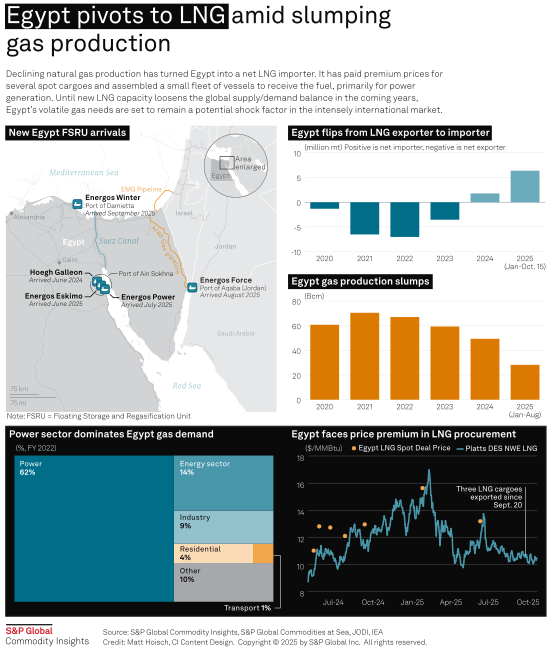
The late-September arrival of the Energos Winter floating storage and regasification unit at the port of Damietta on Egypt's northern coast carried a double significance. The vessel became the first FSRU to be stationed on the country's Mediterranean coast, opening an additional avenue for receiving LNG imports. It also brought the total number of LNG import vessels servicing the country -- a net exporter of the super-chilled fuel until recently -- to five.
"It is a massive reaction to the problem," said Charles Ellinas, CEO of consultancy Cyprus Natural Hydrocarbons Company.
In the past two years, Egypt's LNG trade balance has flipped. As recently as 2022, the country shipped out some 7 million mt of LNG more than it imported, according to data from S&P Global Energy. So far, in 2025, that surplus has moved to an almost equivalent deficit, with Egypt having brought in some 6.6 million mt more LNG than it has exported.
'Fuel for price volatility'
The key driver of the pivot has been a years-long decline in domestic gas production, particularly at Egypt's Zohr gas field, which accounts for about one third of the country's output, according to a recent analysis from Energy.
Zohr, which came online in late 2017, briefly reached its planned plateau production of some 90.6 million cu m/ day in early 2021, Energy data shows.
However, technical problems soon emerged and output fell. From 2021 to 2024, Zohr production saw a "huge" decline of some 30%, according to Carole Etienne, gas analyst at the International Energy Agency.
The slump hit Egypt's gas-reliant power sector, which faced shortfalls in 2024.
"The priority this year was to avoid this cut in electricity production," Etienne said.
That has required a major financial and infrastructural push, including an aggressive campaign of LNG purchases and the deployment of the five-strong fleet of FSRUs to receive the cargoes.
Egypt's position is significant to the international market less for the volumes it has sought than for its mode of procurement. Its imports so far in 2025 represent less than 2% of the nearly 440 million mt of global LNG production that Energy has forecast for the year. But, Etienne stressed, the spot nature of the country's demand adds pressure to price movements.
"This is something unprecedented," Etienne said. "It's fuel for price volatility."
Seasonal swings
Developments since the summer suggest Egypt's short-term gas needs have grown less acute.
The country has recently deferred some of the LNG cargoes it procured, according to market sources, and has even shipped out a small but steady flow of exports.
Since late September, three LNG cargoes have been exported from Egypt's Idku LNG terminal for Spain, Italy and Turkey, according to Egypt's Ministry of Petroleum and Mineral Resources, as well as data from Energy and S&P Global Commodities at Sea.
Over the medium term, Energy analysts project Egypt will export two cargoes per month until spring 2026.
The immediate easing of gas needs is not entirely surprising.
"There is a seasonal dimension," said Robert Mogielnicki, senior resident scholar at the Arab Gulf States Institute. Gas-for-power needs are higher in the hot summer months and ease as the weather cools.
That seasonality means few see the recent exports as a harbinger that Egypt will soon return to shipping LNG on the scale seen in the early 2020s.
"It is still expected to remain a strong LNG importer," Energy analyst Eric Yep wrote in a recent note.
Ellinas agreed. "Egypt is likely to need LNG imports for the rest of this decade," he said.
New LNG capacity is expected to loosen the global market in the coming years, with Energy projecting global production to grow by more than 50% relative to 2024 -- reaching about 630 million mt by 2030.
For now, though, swings in Egypt's gas needs are expected to remain a meaningful, if sporadic, influence on the market.
"Through 2025, Egypt's LNG import needs are likely to remain seasonally driven and policy sensitive," Etienne said. "If domestic output stabilizes, imports could decrease sooner than anticipated, but without investment in storage or greater system flexibility, volatility will persist in Egypt's gas balance and regional trade flows."

Editor: