LNG
September 23, 2025
Egypt’s Idku LNG terminal exports rare cargo amid ongoing import reliance
By Sakshi Jalan and Phoebe Davies
HIGHLIGHTS
Egypt's Idku LNG plant exports rare cargo to Europe
Cargo likely technical to keep plant operational amid imports
Egypt continues importing LNG to meet high domestic demand
The LNG carrier Minerva Amorgos, chartered by TotalEnergies, departed Egypt's Idku LNG terminal on Sept. 20 with a westbound cargo for Europe, according to Sept. 22 S&P Global Commodities at Sea data.
The loading marks a rare export from the facility, which has seen limited activity in recent years, especially since Egypt reverted to being a net importer starting in 2024.
The ship initially unloaded a Cameron-loaded cargo in Egypt at Ain Sokhna terminal via the FSRU Energos Power on Sept. 15. It then docked at Idku with a draft of 9.6 meters and left with a draft of 11.2 meters.
While the ship itself is 'for orders,' it is expected to deliver into France's Fos Cavou LNG terminal, according to the unloading program of the Port of Marseille, which expects the carrier at 9 pm local time on Sept. 23.
Idku, which has been operational since 2005, has two liquefaction trains with a combined capacity of 7.2 million mt/year, equivalent to around 120 cargoes. Yet exports have been sporadic: the last shipment before September was in April chartered by Shell, and the plant shipped out just four cargoes in all of 2024 -- two by Shell and two by TotalEnergies.
Market split on export motive
Some market participants said the loading may be more technical than commercial to keep the facility running.
"I think it is a technical cargo, there are one to two per year approximately," a Europe-based trader said. "This does not indicate Egypt will be exporting more anytime soon. Contractually, the terminal must remain operational, so even if they liquefy small truckload volumes over time, eventually it amounts to a cargo that they can export."
A second European trader said they expected the Idku terminal to still be producing a few cubic meters of LNG every day, so it made sense that it could export a full load, with either TotalEnergies or Shell taking it.
Egas and TotalEnergies didn't reply to the queries sent by Platts at the time of writing.
Mehrun Etebari, senior principal analyst at S&P Global Energy, added to the view, explaining that the export could help Egypt to meet some arrears.
"While technical reasons could be an explanation -- as they most likely were when the plant exported its first cargo in a year in April 2025 despite Egypt being a heavy LNG importer -- another possibility is that Egypt could be allowing sporadic LNG exports to help pay down arrears to international partners," Etebari said. "Shell and Petronas, whose investment drove critical new output additions from two phases at the West Delta Deep Marine gas project in the past year, are both partners in the liquefaction plant."
In 2016-18, a similar agreement allowed Shell to liquefy and export occasional cargoes even as Egypt imported LNG at far higher levels at Ain Sokhna, Etabari added.
However, some other market participants said Egypt could be re-exporting due to over procurement.
"The only reasonable explanation is because [Egypt doesn't] need it," a Mediterranean-based LNG trader said. "It was an imported cargo discharged in Idku and then reloaded as not needed."
Platts, part of Energy, assessed LNG DES East Mediterranean Marker for November delivery at $10.772/MMBtu on Sept. 22, at a 42-cent/MMBtu discount to November TTF hub futures price or a premium of 13 cents/MMBtu over the DES Northwest Europe.
A fourth trader said Egypt was pushing volumes back into the market, and should this trend continue, spreads between LNG and TTF could further widen in Europe.
"Egypt will sell it now and probably buy it back at a mega premium in summer... it's crazy," a fifth trader said.
Egypt has imported around 3.17 million mt of LNG in 46 cargoes so far in the third quarter, marking the strongest quarterly volume on record, according to Energy data.
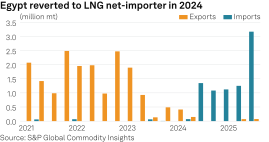
The country was on a procurement spree late in 2024 and early in 2025 to meet summer demand.
In June, Egypt had procured around 50 cargoes for 2025. In February, it signed $3 billion deals with Shell and TotalEnergies for 60 shipments, alongside a four-cargo tender and a 15-cargo strip awarded in the first quarter.
Nevertheless, market participants dismissed the idea of a wider export revival.
"Demand may ease now that the summer peak is over, but year-over-year demand will still be higher next year," a Northwest Europe-based trading analyst said, citing declining output from the Zohr field. "Exports are more about contractual obligations."
Some market participants also flagged delays in cargo discharging and questioned whether fuel switching or seasonal factors could explain the timing.
"It doesn't really make sense... there are delays at discharge right now," a second analyst said. "Maybe they'll switch fuels, maybe not."
For now, the Minerva Amorgos cargo stands out more as an exception than a shift in trend. Egypt's domestic consumption remains elevated, and with LNG demand projected at 8 MMt for full-year 2025 and 11 MMt in 2026 according to Energy analysts, imports are expected to dominate the balance sheet until late 2030s -- even as Idku's sporadic exports keep the plant technically operational.

Editor: