Electric Power, LNG, Natural Gas
September 15, 2025
INTERVIEW: Thailand seeks more LNG term contracts: permanent secretary

By Matt Hoisch
HIGHLIGHTS
Wants to convert ‘maybe 5 mil mt’ annual demand from spot to term: Sinsukprasert
EGAT in discussions with Cheniere for ‘maybe’ 1 million mt/year
Plans to announce Andaman Sea exploration bid round early 2026
Thailand is seeking to significantly boost the share of LNG it imports through term contracts as it contends with declining domestic gas production and increasing demand, the permanent secretary of the Thai Ministry of Energy told Platts during an interview at the Gastech conference in Milan.
Of the roughly 6 million mt of LNG imported into Thailand annually via spot trade, according to Prasert Sinsukprasert, the country wants to convert "maybe 5 million mt" to medium-term or long-term contracts.
It's "quite a lot," he said.
However, Sinsukprasert stressed, the government only directly controls the buying activities of publicly owned importers, such as Thailand's national oil and gas company, PTT, and its state-owned utility, Electricity Generating Authority of Thailand.
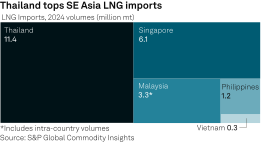
In 2024, Thailand was the largest LNG importer in Southeast Asia, bringing in some 11.4 million mt, according to Energy data.
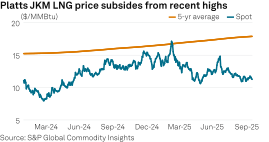
Russia's full-scale invasion of Ukraine fueled a surge in the JKM benchmark for spot LNG cargoes delivered to Northeast Asia to an all-time high of $84.762/MMBtu in March 2022. Prices have since subsided. Platts, part of S&P Global Energy, assessed the JKM price at $11.264/MMBtu Sept. 15.
The US is a major focus for Thailand amid its push to expand term contract trade. The government is interested in increasing US imports, including among Thailand's private buyers.
"We were hoping that all the shippers would look for US LNG, but it depends on the competitiveness of all these suppliers," Sinsukprasert said.
The US was Thailand's third-largest LNG trader partner in 2024, supplying some 2 million mt, according to Energy data. This put it behind Qatar and Australia, which provided about 2.3 million mt and 2.1 million mt respectively last year.
The permanent secretary said he's been speaking with US LNG producer Cheniere Energy and developers for the Alaska LNG project. "They're all very confident that they can give us a very good price," he said.
EGAT is in discussions with Cheniere to contract "maybe" 1 million mt/ year of LNG, Sinsukprasert said. He did not elaborate on the negotiation timeline. Cheniere declined to comment.
In June, Alaska LNG developer Glenfarne announced a preliminary, non-binding deal with PTT for 2 million mt/year of LNG from the project over a 20-year term.
Sinsukprasert would not say when PTT could sign a binding agreement for the US exports. "It will take some time -- I'm not sure when," he said. "We have to make sure that Alaska LNG will be feasible and commercially viable."
The discussions come after Thailand's Deputy Prime Minister Pichai Chunhavajira said in April that the country planned to negotiate with the US about the purchase of 1 million-1.5 million mt/year of LNG over the coming five years to replace some expiring existing contracts.
Sinsukprasert declined to comment on whether Thailand would import Russian LNG as it adjusts its trade commitments, citing the recent formation of a fresh cabinet under newly elected prime minister Anutin Charnvirakul, who was sworn in earlier this month.
"I have to talk to the Ministry of Foreign Affairs with the new cabinet to see what the direction of this new government is," he said.
'The more the merrier'
Thailand also seeks to expand the liberalization that has swept its gas market in recent years, Sinsukprasert said.
PTT was the country's only LNG importer from 2011, when Thailand began bringing in the superchilled fuel, until 2019, according to Energy analysis. Since then, a handful of other companies have attained import licenses.
Now, Sinsukprasert explained, the government wants more international players entering the market. "The more the merrier," he said.
Sinsukprasert said he expects this expanded access would materialize "in a couple of years," adding he would "push on the accelerator to ensure that it would happen very soon."
Thailand is also expanding LNG infrastructure in tandem with its effort to boost competition. Development is under way on the country's third onshore LNG import terminal, Map Ta Phut 3. Sinsukprasert said the terminal is expected to come online in 2029.
In its first phase, the 5 million mt/year terminal would bring Thailand's regasification capacity to 24 million mt/year, according to forecasts from Energy analysts.
Exploration and the longer term
As Thailand works to bolster its energy security, any significant boost to domestic gas production would have to come from new discoveries, according to Sinsukprasert.
He plans for the government to announce a new bid round in early 2026 for exploration and production licenses in the Andaman Sea.
Sinsukprasert underscored that increasing energy demand means gas will "play a very, very big role [in Thailand] even in the next 20 years."
"The data centers, the tech companies, they are all asking for clean and reliable energy," he said. "So, I am sure that gas will be around for quite some time."
Thailand will host the 2026 Gastech conference in Bangkok. Sinsukprasert said one aim at the major international gathering will be to highlight the growing role of Southeast Asian demand in LNG and gas markets.
