LNG, Natural Gas
July 17, 2025
Asia-Pacific LNG MOC activity jumps 86% YOY, drops 21% MOM amid geopolitical uncertainty

By Cindy Yeo
HIGHLIGHTS
Approximately 1.24 mil mt of LNG cargo traded during the cargo MOC
Osaka Gas marks debut trade on cargo MOC
Derivatives MOC sees 284 trades of 25 lots each, JKM time spread trades rise
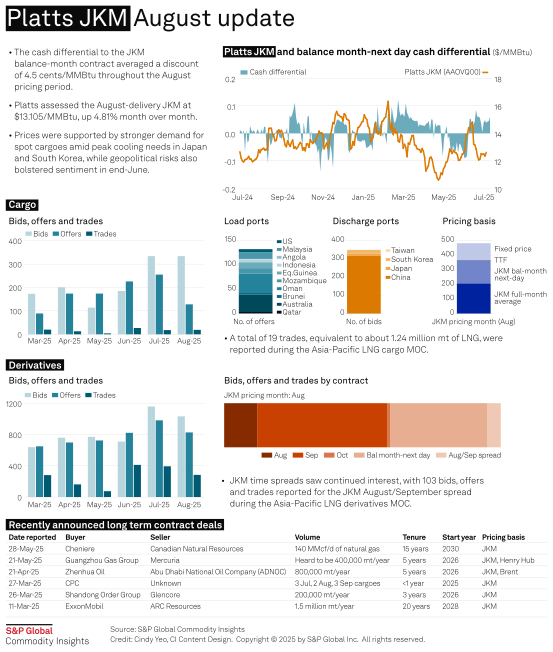
The Platts Market on Close assessment process for Asia's LNG physical market during the August pricing period recorded a sharp 86.43% increase year over year, but fell 20.76% month over month as the market contended with geopolitical uncertainty and the seasonal summer demand peak.
A total of 334 bids, 128 offers, and 19 trades were recorded for deliveries across H2 July, August, and September, involving 23 entities.
The majority of market activity centred around deliveries into the Japan-Korea-Taiwan-China region. In addition, three bids for deliveries into China, one bid for Japan, one offer for Thailand, and two offers for the broader JKT region were reported.
The 19 trades, amounting to approximately 1.24 million mt of LNG, saw Glencore emerge as the most active buyer, securing nine cargoes, followed by Vitol with seven. BP, TotalEnergies, and Uniper each purchased one cargo.
On the sell side, PetroChina led with five cargoes, followed by Vitol with three, and BP and Shell with two each. Osaka Gas, QatarEnergy Trading, TotalEnergies, Unipec, Socar, Chevron, and CNOOC each sold one cargo.
Notably, Osaka Gas made its debut trade on the MOC during the period, with delivery scheduled for H2 August -- highlighting a broader diversification of participants and growing end-user engagement in the pricing process.
Of the August delivery trades, 10 were priced against the September JKM contract, averaging a 9 cents/MMBtu premium.
Overall, 75.88% of market activity was indexed to floating prices, primarily tied to JKM full-month or balance-month next-day contracts, while three orders referenced the Dutch TTF index.
Specifically, JKM-linked bids and offers for August deliveries averaged 2.1 cents/MMBtu premium to the September JKM contract and parity against the JKM Balmo-ND contract.
Derivatives activity eases MOM, but up sharply YOY
The derivatives MOC saw 2,146 bids, offers and trades from 24 participants -- down 15.41% month over month, but up 38.81% year over year -- as traders responded to heightened volatility in the physical market driven by summer demand and geopolitical risk.
Close to half of all bids, offers and trades were reported for the September JKM contract at 46.97%, this was followed by the BalMo-ND contract at 35.23%.
A total of 284 trades of 25 lots each were reported for the August, September, BalMo-ND and August/September JKM contracts. This is equivalent to approximately 1.37 million mt of LNG.
Notably, the August/September JKM time spread attracted heightened interest, with a total of 11 trades recorded during the assessment period -- a sharp pickup in activity given that the JKM time spread had only traded once previously -- on June 6.
From June 16-July 15, LNG futures trading volumes cleared on financial exchanges reported 113,981 lots, equivalent to approximately 21.92 million mt, or 345 LNG cargoes.
Summer demand, geopolitics lift prices
Platts assessed the August JKM at $13.105/MMBtu, marking a 4.81% rise month over month and 6.36% year over year, underpinned by escalating geopolitical tensions and strong spot demand driven by elevated summer temperatures across Japan and South Korea.
Market sentiment was bolstered by geopolitical risks in late June as rising tensions between Iran and Israel triggered concerns over potential disruptions through the Strait of Hormuz, a critical route for Qatari LNG. Although no actual flow disruptions occurred, the event injected a risk premium into market pricing, according to market sources.
From January-June 2025, more than half of Qatari LNG exports were destined for the Pacific Basin, with China as the largest buyer importing 23.38% of total Qatari exports, according to S&P Global Energy data.
On the demand side, market sources noted that South Korean importers actively sought prompt cargoes, while Japanese buyers turned to swap strategies -- buying near-term and selling forward volumes -- to front-load inventories amid rising cooling needs.
Despite similar heat conditions, Chinese buyers remained largely on the sidelines, citing unfavourable spot prices. Southeast Asian demand was also muted as the region moved past its peak cooling season.
"The market is slightly soft this summer. There is a lack of buy tenders in the market," one trader said.
Meanwhile, the East-West arbitrage for US-sourced cargo to Asia remained mostly shut. Just six out of 128 offers indicated a US load port. Although some traders noted a pickup in arbitrage economics in the latter half of the assessment period, only those with long shipping positions were able to bring US cargoes eastward.
"I don't see a need for US cargoes to balance the market now," one trader said.

Editor: