Energy Transition, Carbon, Hydrogen
December 02, 2025
UK remains committed to low-carbon hydrogen after BP Teesside blow

HIGHLIGHTS
BP cancels 600-MW H2Teesside hydrogen plant project
'Material and significant changes in circumstances': BP
Demand uncertainty, rival project prompted BP's decision
The UK government said it remains committed to supporting low-carbon hydrogen production after BP cancelled its landmark project in Teesside, faced with a reduced demand outlook and competition from a rival data center project on the site.
The Department for Energy Security and Net Zero had been due to rule on a planning application for BP's 600-MW H2Teesside carbon capture-enabled hydrogen plant by Dec. 4, but the company withdrew the application on Dec. 1, citing "material and significant changes in circumstances."
BP's decision comes after the local council granted planning permission for an AI data center on the same site earlier in 2025, and a weaker demand picture for low-carbon hydrogen after some "major industrial consumers" scaled back or delayed decarbonization plans, it said in a letter to the UK planning inspectorate Dec. 1.
A DESNZ spokesperson told Platts, part of S&P Global Energy, that the decision was BP's and the government remained committed to hydrogen developments in the region.
"This is a decision taken by BP," the spokesperson said by email on Dec. 2. "We continue to provide a route for hydrogen projects in Teesside, including Tees Green Hydrogen, which is moving towards final investment decision, along with several other projects creating high-quality jobs for the region."
EDF's 7.5-MW Tees Green Hydrogen 1 pilot electrolyzer secured funding under the government's first electrolytic hydrogen allocation round, HAR1, with the expanded 100-MW phase 2 on the HAR2 shortlist.
Significant infrastructure project
Meanwhile, H2Teesside had been classified as a "nationally significant infrastructure project," and was subject to a development consent order decision by the Secretary of State, which would have overruled the local planning decision.
However, BP said the decision from the local council in favor of the AI data center, and the hydrogen demand uncertainty, had changed the calculus.
"In such changed circumstances, and in the absence of an alternative solution enabling co-existence, we are mindful that central and local government will need to consider competing priorities in a very different way than was the case when we submitted the DCO," BP said in its letter.
BP said the demand situation also increased project development risks.
"The hydrogen demand situation in Teesside has also deteriorated as some major industrial consumers have either scaled back operations or postponed decarbonization plans, significantly increasing the ... risk in developing the H2Teesside project," it said.
The company had previously said the permanent closure of Sabic's Olefins 6 steam cracker at Wilton, Teesside, did not affect the status of the project.
No fundamental shift
Industry association Hydrogen UK said the market fundamentals remained firm.
"BP's decision reflects a site-specific planning conflict rather than a shift in the fundamentals of the UK hydrogen market," Hydrogen UK CEO Clare Jackson said in an emailed statement Dec. 2.
"All credible pathways to net zero rely on significant volumes of CCUS-enabled hydrogen. If the UK does not develop these projects, we jeopardize reindustrialization efforts and risk losing jobs and investment."
H2Teesside would have been the largest low-carbon hydrogen production plant in the country, forming a central part of the UK's target of 10 GW of capacity in operation or construction by 2030.
Earlier in 2025, BP also scrapped plans to develop the 80-MW HyGreen hydrogen project at Teesside as part of its strategic pivot away from clean energy investments.
The HyGreen electrolyzer project failed to secure HAR1 funding, and BP subsequently slimmed down the list of hydrogen and carbon capture projects it was pursuing globally, focusing instead on upstream oil and gas investments.
The other blue hydrogen project to secure backing under the government's Track 1 carbon capture and storage cluster sequencing program -- Essar's 350-MW plant at Stanlow -- is also awaiting a final investment decision and grant agreement with the government.
No other blue hydrogen projects have received backing in the UK to date.
DESNZ awarded GBP2 billion ($2.6 billion) in support to 11 renewable hydrogen projects totaling 125 MW under HAR1 in 2023, at an average strike price of GBP241/MWh (around GBP9.50/kg).
It shortlisted 27 projects totaling 765 MW under HAR2, with results expected in the first quarter of 2026.
The UK government is also expected to publish an updated hydrogen strategy before the end of 2025.
Hydrogen UK's Jackson called on the government to stick to timelines on hydrogen policy, accelerate CCS infrastructure and give investors certainty.
CO2 infrastructure
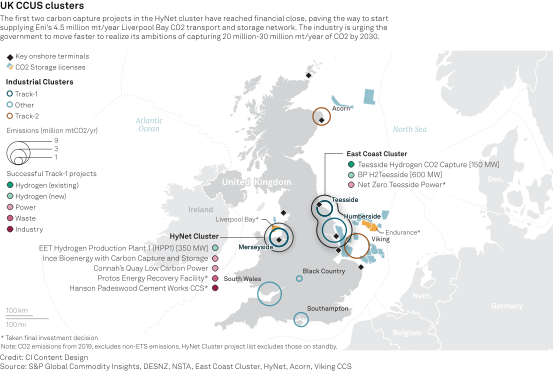
Earlier in November, the government said it would launch a new competitive selection process from early 2026 to identify carbon capture projects to connect to the 4-million-mtCO2/year East Coast Cluster around Teesside, with the CO2 transport and storage infrastructure already under construction.
On the emitter side, so far only Equinor and BP have reached FID on their joint 742-MW Net Zero Teesside Power project -- the country's first CCS-enabled gas-fired power plant -- with operations set to begin in 2028. The plant could capture and store up to 2 million mt/year, leaving 2 million mt/year of capacity available.
With the withdrawal of H2Teesside, just one other project remains in contract negotiations with the government -- BOC's Teesside hydrogen plant CCS retrofit.
BOC's project could capture over 200,000 mt/year, according to the Hydrogen Energy Association.

Editor: