


Energy Transition, Carbon, Emissions
October 31, 2025
INTERVIEW: Singapore carbon market to shape Article 6-aligned credit usage globally -- TNC

HIGHLIGHTS
Developing 5 nature-based carbon projects to be used in Singapore
Collaborates on new science on carbon leakage with Verra
EU coming back to carbon credits; voluntary incentive still missing
Singapore's carbon market and its aspiration to leverage the existing methodologies in the voluntary carbon market to nurture Article 6-aligned carbon credits will shape the market globally, Campbell Moore, Managing Director, Carbon Markets, The Nature Conservancy, told Platts, part of S&P Global Energy, in an exclusive interview Oct. 14.
The Nature Conservancy is a global environmental nonprofit that collaborates with stakeholders to protect vital ecosystems and biodiversity. TNC actively engages in nature-based carbon projects and is working on at least 19 Nature-based projects in 15 countries, Moore said.
"Singapore is obviously a global leader in Article 6.2. The technical group that will be evaluating the first Article 6.2 deals will shape the way other countries look at Article 6. Singapore is the first one interpreting regulations," Moore said.
Singapore has a carbon tax system that guides trade-dependent economies on tax pathways, with a comprehensive framework for implementing Article 6.2 market by allowing entities to use up to 5% international credits.
Moore emphasized that to boost Article 6, countries like Singapore should encourage others to act and suggested approaching Article 6.2 in an interoperable manner across nations to create a global market.
TNC working with Singapore government, Verra
Moore exclusively told Platts that TNC has already selected and started working on two of the five nature-based projects they will develop as an Article 6.2 accelerator for the Singapore market.
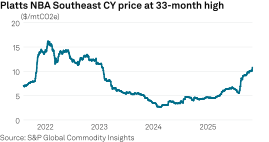
Platts assessed its Nature-Based Avoidance, Southeast Asia current year price, reflecting the most competitive, internationally fungible carbon credits issued by nature-based projects, at $10.80/mtCO2e on Oct. 30. The prices have more than doubled since the start of 2025, Platts data showed.
"The Singapore government is supporting TNC to develop five projects, at least all the way through feasibility. Those would all be intended to be used in Singapore. It's a 5-year grant. We're going to start with a project in Mongolia and Chile," Moore said.
Moore added these will be Grassland management projects, and the project in Chile is somewhat mature, while the one in Mongolia is at a very early stage.
Moore emphasized the role the Integrity Council for the Voluntary Market (ICVCM) can play in establishing this standardization of carbon markets across nations.
He noted it makes sense for ICVCM's rules to be adopted into government-regulated markets. However, he also added that ICVCM is not the solution, and governments need to come together.
Moore also highlighted that different markets and rules create gaps in the demand side and said, "Governments should think about creating commonality that drives global investors."
TNC and Verra, a leading global carbon registry, will soon announce the adoption of TNC's research on the carbon leakage from timber/forests, he said. "Verra asked us to help them build that into their rules. So, for all their improved forest management methodologies, they've asked us to take that new science and create a tool."
Europe coming back to the carbon way
Commenting on the European Commission's recent stance towards carbon offsets and its announcement of the withdrawal of the Green Claims Directive in June 2025, Moore said the EU is coming back to the possible usage of carbon credits at the commission level.
"They [EU] have signaled that international carbon credits are likely to play at least 3% in the ETS for the 2040 goals. And 3% of the EU is big. I think that's an appropriate approach," Moore said.
EC in July 2025 proposed to reduce net greenhouse gas emissions by 90% by 2040 compared to 1990 levels.
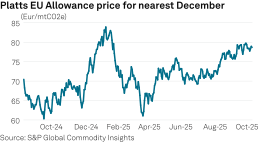
Platts assessed European Allowances for the December 2025 contract, a compliance credit which acts as a benchmark for other markets, at Eur78.66/mtCO2e on Oct. 30.
Under the EU's original plans, all emission cuts had to occur within its borders. Now, the EU will permit a limited share of high-quality international carbon credits, starting 2036.
However, Moore said companies need an incentive to act in the voluntary space, and that's missing at the moment. Moore praised Singapore's Coalition to Grow Carbon Markets, which aims to set shared principles on carbon credit use by COP30 to boost climate finance, and may include more countries going ahead.
NBS, co-benefits and removals
Nature-based solution carbon projects provide a variety of co-benefits, from promoting biodiversity and restoring ecosystems to supporting local communities.
"We need to unlock all the potential for natural climate solutions. Then, over time, we really do need tech-based approaches like direct air capture to become viable. Right now, they're not from a price and scalability perspective," Moore said.
The VCM market has seen a shift in demand toward NBS and CO2 removal methods, according to several Asia-based sources Platts spoke to and reflected through Platts assessments.
Platts Blue Carbon prices, a premium nature-based category, have increased 20% as of Oct. 30 since Dec. 31, 2024.
Moore also cited "Figure SPM.7" from the IPCC Sixth Assessment Report and said, "Nature now, machines later, the science and economics are very clear on that."
Moore emphasized the importance of investing in tech-based CO2 removal and hopes it proves effective, allowing for scaling up with a negative cost curve. However, he said the market needs to be realistic and realize that there is a significant untapped potential in nature-based solutions.

Editor: