Agriculture, Energy Transition, Maritime & Shipping, Biofuel, Renewables, Emissions
October 23, 2025
FEATURE: Fragmented systems could be expected after IMO NZF decision; FuelEU to benefit

By Chris To
HIGHLIGHTS
IMO Net Zero Framework 'dead' in current form
Time elapsing for FuelEU compliance deadline
Biofuels abatement could offset high costs for compliance
A "mushrooming" of regional maritime compliance systems could emerge as individual countries place more confidence in state-provided solutions to emissions and less in multilateral outlets, as a result of the International Maritime Organization's decision to adjourn the MEPC meeting for a year following an extraordinary meeting.
Faced with strong opposition from the US and other petro-states, 57 countries supported the motion to adjourn the discussions on the Net Zero Framework's adoption by a year; 49 voted no, while 21 abstained.
The outcome was a "systematic and coordinated effort" by those in opposition of the adoption to push for a delay, and could turn member states away from multilateral structures in favor of emerging individual compliance systems, according to Albrecht Grell, managing director of maritime analytics firm Oceanscore, who spoke to Platts in an interview.
"What we could witness is a number of countries ready to push forward with their own emissions trading systems," Grell said. "The UK ETS will be implemented in 2026 to cover domestic shipping, but could be extended to include voyages to/from the UK; the EU ETS could possibly lower vessels viable for compliance to above 400 gross tons, and there are possibilities in the likes of China, Turkey and the African Union. These regional schemes offer direct revenue options for governments, something that the IMO didn't provide."
IMO Net Zero Framework
Despite this, any future rollout of an altered IMO NZF would likely trigger a repositioning by these compliance systems, aligning themselves with a new framework, but with exceptions.
Attention has turned to the results of the Intersessional Working Group on the Reduction of Greenhouse Gas Emissions from Ships (ISWG-GHG-20) on guidelines developed for implementing any future NZF.
However, Grell was more emphatic on the current state of play, suggesting that the current structure that the industry has familiarized itself with is "dead".
"I don't think we'll see that net-zero framework come back, whether in two years or three years -- the question is now whether they will come up with something similar or not", he said.
Ultimately, any co-existing compliance systems, such as FuelEU, will not denote double counting should a global framework arise, but ambitions will have to be aligned to necessitate uniformity.
Focus on FuelEU
No larger compliance system than FuelEU, which now exists as the sole carbon-intensity framework in place, stands to benefit from the IMO's failure of implementation.
In a LinkedIn post, maritime decarbonization company Carbonleap stated: "Many shipping companies had delayed active participation in the FuelEU surplus market, hoping a global deal would reduce or replace the need for regional compliance. With the NZF vote deferred, those companies are now expected to engage more fully, both for compliance and commercial positioning."
The view is shared by Grell, who said that active participation in the FuelEU's compliance surplus market has increased heavily, with Asian shipowners in particular taking more concrete positions for compliance.
"More shipowners are finally getting to terms with clauses for charter parties, positioning themselves in pooling markets, and shipowners in Asia are now accelerating their engagement for those with exposure to FuelEU", Grell said.
Biofuel compliance potential
For shipowners, especially those subject to European regulations, the urgent issue of bunkering, compliance or penalty payments under FuelEU is pressing -- particularly when considering the only available drop-in fuel for markets: biofuels.
For shipowners choosing to pay penalties for using conventional fuels, the chart below -- factoring in spot EUA costs and FuelEU penalties per metric ton of fuel burned -- shows that the all-inclusive price of marine gasoil in Rotterdam is $922.54/mt, while 0.5% very low sulfur fuel oil costs $726.18/mt, based on September averages.
But Platts assessed B100 Used Cooking Oil Methyl Esther fob ARA prices at an average of $1,489.39/mt in the same period.
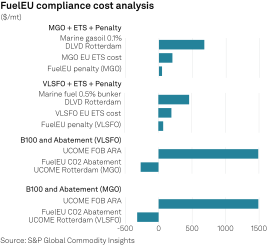
Abatement has been used as a method to price FuelEU compliance surplus in $/mtCO2e, allowing potential high-profit margins for those who bio-bunker accordingly. Biofuels only form part of the energy fuel mix, however, and concerns about demand outpacing supply have been raised by the International Council on Clean Transportation, with modeling showing that UCO will only meet 4.9% of maritime energy demand by 2030 due to limited supply.
As more players focus on compliance solutions, shipowners who are in deficit could face high offers for compliance in pooling markets, faced with shrinking supply, as no compliance generation is possible after Dec. 31 for the reporting period. "The surpluses are the result of supply and demand, but players could easily buy large volumes at cheaper prices and bank them, leaving only more expensive surpluses; it's better for shipowners to act and buy earlier to prevent the penalty," Grell said.
