Fertilizers, Chemicals, Energy Transition, Maritime & Shipping, Renewables, Emissions, Hydrogen
September 23, 2025
INTERVIEW: Fertiglobe eyeing Egypt green ammonia FID within 6 months
By James Burgess and Matt Hoisch
HIGHLIGHTS
Egypt plant could start production in 2027-2028
Cuts low-carbon projects to 3 from 4 on weaker demand
Optimizing plant to use more existing infrastructure
Fertiglobe plans to make a final investment decision on its 100-MW Egypt green ammonia project within the next six months, with production potentially starting in 2027 or slipping into 2028, CEO Ahmed el-Hoshy told Platts in an interview.
The company has consolidated its low-carbon ammonia portfolio from four projects to three as it adjusts supply to meet more constrained demand conditions, Hoshy said on the sidelines of the Gastech conference in Milan earlier in September.
The Ain Sokhna green ammonia facility is being optimized to leverage existing infrastructure at a site adjacent to three "world-scale" ammonia production lines, Hoshy said.
"What we're doing now is trying to optimize the design to utilize more of the existing infrastructure," Hoshy said.
The start of operations would depend on when the company orders some of the long-lead items for the facility, he said.
The CEO said the project will feed green hydrogen into the back end of two existing ammonia lines while sharing water treatment facilities and utilities to reduce capital expenditure. The FID has been pushed back from a previous indicated timeline of the first half of 2025.
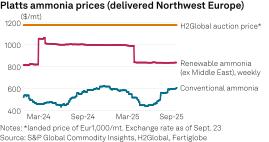
The company has secured cornerstone offtake under the pilot H2Global import auction to Germany for the 100-MW Ain Sokhna project, with a green ammonia purchase agreement running through 2033 at Eur1,000/metric ton ($1,180/mt).
The supply will start with a potential 19,500 mt in 2027, subject to production start date and supply availability from Fertiglobe's plant in Egypt, rising to a total of 397,000 mt cumulatively by 2033, for a maximum contract value of Eur397 million.
Platts, part of S&P Global Energy, assessed the cost of renewable ammonia delivered to Northwest Europe from the Middle East at $839/mt on Sept. 22, compared with conventional ammonia CFR Northwest Europe at $610/mt.
The supply to H2Global will account for the bulk of Fertiglobe's planned green ammonia production through to 2033, and it is not looking to market additional volumes at present, though Hoshy noted the company has options to sell additional volumes beyond the H2Global contract.
Project consolidation
Fertiglobe has shelved one of its carbon capture-enabled blue ammonia projects in the UAE citing the global market's early development stage, evolving regulatory frameworks and the need to manage capital costs tightly.
"We had four projects of low-carbon [ammonia], green and blue," Hoshy said. "Now it is three, and we're just consolidating efforts in that space."
Fertiglobe is proceeding with its 1 million mt/year Project Harvest plant in Al Ruwais Industrial City, Abu Dhabi, which is under construction and due to start up in 2027.
The company is also progressing the planned 1 million mt/year ExxonMobil Baytown project in Texas, US, he said, which is expected to come online in around four years.
Hoshy noted particular cost increases for blue ammonia projects, with higher capex requirements, particularly for construction and engineering.
"If my cash cost is $150/mt of ammonia for a grade, I can take some merchant risk," he said.
But for blue ammonia projects requiring billions of dollars in investment, "I'm going to take a bit more of the LNG approach, which is I need more offtake," he added.
The demand outlook for low-carbon ammonia has weakened, particularly in East Asian markets including Japan, South Korea and Singapore, he said.
"Definitely, demand is delayed," Hoshy said.
He also cited regulatory uncertainty around EU Renewable Fuel of Non-Biological Origin targets, with project developers and ammonia producers holding back from decisions in anticipation of conventional fossil fuel-derived products being accepted in the market for longer.
Hoshy noted that government funding promises of fixed amounts for low-carbon energy projects were now not going as far as previously envisaged, with production costs rising significantly from assumptions made just a few years ago.
Demand sectors
Fertiglobe still expects strong demand for low-carbon ammonia from energy-deficit markets such as in East Asia and Europe, and from hard-to-abate industries such as fertilizers and marine fuels.
The company is partnering with several others to place low-carbon ammonia in offtake markets such as Japan and South Korea. These include GS Energy, Mitsui, Marubeni and Mitsubishi.
And decarbonized power demand in Asia could be higher in the coming years than previously expected, Hoshy said.
Hoshy said ammonia remained a firm choice for decarbonizing the shipping sector, with previous enthusiasm for methanol waning amid a shortage of biogenic CO2 supplies to produce the product.
However, he said that with other drop-in fuels such as LNG competing in the space, the pace of uptake would be uncertain.
"The ESG pendulum swung the other way, so you have more time to make those decisions," Hoshy said.
The company expects strong demand prospects in Europe, where it is the largest urea marketer and a top-two ammonia distributor.
Hoshy said the EU's Carbon Border Adjustment Mechanism, which takes effect from 2026, would give a boost to low-carbon fertilizer projects.
Fertiglobe has been submitting carbon-intensity data to the EU for over a year in preparation for CBAM, he said.
The company's production sites in Algeria and Egypt are also well-placed to supply the market, with duty-free access to the EU compared with levies of around 6% on product from other sources such as the US.
Fertiglobe low-carbon ammonia projects
| Project | Location | Ammonia capacity (million mt/year) | Renewable/CCS-enabled | Electrolysis capacity (MW) | Status | Planned start date |
| Harvest | UAE | 1 | CCS | - | In construction | 2027 |
| Exxon Baytown | US | 1 | CCS | - | FID late 2025 | 2029 |
| Ain Sokhna | Egypt | <0.1 | Renewable | 100 | FID late 2025, early 2026 | 2027/28 |
| Canceled | ||||||
| Rabdan | UAE | 1 | CCS | - | canceled | could restart project in future |
Source: Fertiglobe, S&P Global Energy
