Fertilizers, Chemicals, Energy Transition, Electric Power, Renewables, Hydrogen
September 04, 2025
Low-priced Indian renewable ammonia auctions 'a meaningful signal': H2Global

HIGHLIGHTS
Local market factors back auction prices
Declining price trend in market reinforced
SECI, H2Global to meet for joint auctions
Low prices unveiled at India's renewable ammonia auctions have the potential to influence the global clean energy market, though they also bring to light the varying local factors that back price discovery, a spokesperson at the hydrogen derivative import scheme, H2Global Foundation said Sept. 3.
India concluded 13 auctions for an aggregated 724,000 mt/year of renewable ammonia for domestic fertilizer firms on Aug. 29 at a weighted average price of Rupees 53.27/kg ($605/mt). In contrast, Germany awarded the first renewable ammonia contract under H2Global at Eur1,000/mt ($1,088/mt) in 2024.
"At H2Global, we see this as a meaningful signal that large-scale projects under India's specific framework can clear at low prices," H2Global told Platts, part of S&P Global Energy.
"We believe it may influence expectations and negotiations elsewhere, especially for long-term offtake, and could encourage more aggressive bidding where similar conditions apply."
The lowest winning bid in the Indian tender was Rupees 49.75/kg, around $564.65/mt, by ACME Cleantech Solutions, to supply 100,000 mt/year of the environment-friendly fuel to Indian Farmers Fertilizer Cooperative.
The winning bidders will sign contracts with the auctioneer Solar Energy Corp. of India (SECI) and, after receiving the letter of acceptance, build their plants in 36 months to deliver to the fertilizer units that will substitute a part of their imports with Indian-made renewable ammonia.
No immediate global impact
The first Indian auctions of renewable ammonia are, however, unlikely to have an immediate impact on global market liquidity or the transparently traded benchmarks, owing to the unique Indian factors that back the prices, H2Global said.
"We do not see a one-to-one benchmark for EU-aligned Renewable Fuels of Non-Biological Origin (RFNBO) supply," the spokesperson said. This is because "India's rules; for example, 30-day temporal correlation, nationwide geographic correlation, power cost advantages and incentives, and reverse auction mechanics, materially shape the outcome."
Several Indian developers are winners of the government's renewable hydrogen subsidy under the National Green Hydrogen Mission's Rupees 197.44 billion ($2.24 billion) plan and enjoy other advantages such as power banking, waiver of interstate transmission charges and easier land access.
These local factors will make the Indian auctions incomparable with Europe's RFNBO-compliant auctions, where strict requirements of Additionality, Time Matching and Geographic Correlation mandate suppliers to create additional renewable capacity and use electricity with an hour of production with co-located renewable assets.
Reinforces declining trend
Yet, Indian auctions are signaling the declining trend in clean energy costs, H2Global said.
"Overall, we see India's auction as reinforcing the broader trend toward declining costs for clean ammonia and hydrogen globally, while the magnitude and timing of these effects will remain context dependent," the spokesperson said.
"We are also keen to see how price signals in our own ongoing H2Global auction compare once bids are in."
Hintco, the company overseeing the European H2Global renewable hydrogen import mechanism, has released tender documents for the vector-open lot for the second supply-side auction launched in February, with final bids anticipated by the first quarter of 2026.
H2Global is also working on regional auctions around the world and is working with Solar Energy Corp on a joint auction to help Europe procure renewable hydrogen/ammonia.
"We are having a meeting where we will discuss the RFNBO requirements," Sanjay Sharma, director at SECI told Platts, referring to upcoming meetings at the EU.
Price may fall in enabling markets
The H2Global spokesperson said there is scope for prices to come down over time, particularly in jurisdictions where comparable enabling conditions exist, such as low renewable power costs, grid fee exemptions, targeted support schemes, scalable project sizes and competitive reverse auctions.
"In such contexts, downward price pressure is more likely," the spokesperson said. "By contrast, in regions with stricter RFNBO correlation requirements, higher grid and logistics costs, or less supportive policy frameworks, the impact will be more limited; prices there may only partially converge and with a delay."
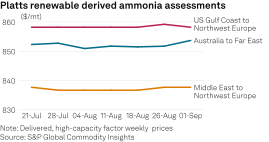
Platts last assessed Australia renewable-derived ammonia delivered into Far East Asia with high-capacity factors at $853.66/mt Sept. 1, down 0.6% from a month ago.
Middle East renewable-derived ammonia with a high-capacity factor delivered into Far East Asia was assessed at $820.66/mt Sept. 1, the same as a month ago.
