Agriculture, Energy Transition, Refined Products, Biofuel, Renewables, Jet Fuel
September 03, 2025
Shell abandons Rotterdam biofuels project after cost review
By Samyak Pandey and Thomas Washington
HIGHLIGHTS
Plans scrapped due to high costs and weak competitiveness
Project aimed to produce up to 820,000 mt/year of advanced biofuels
Despite setback, remains invested in hydrogen, carbon capture, low-carbon fuels
Shell has scrapped plans to complete its biofuels facility in Rotterdam, once billed as one of Europe's largest waste-to-fuel plants, citing high costs and weak competitiveness.
The decision announced on Sept. 3 follows a year-long suspension of construction, which began in 2022 but was paused in mid-2024 amid technical setbacks.
The project, located at Shell's Energy and Chemicals Park, was initially slated to produce up to 820,000 mt/year of advanced biofuels, about half of which would have been sustainable aviation fuel derived from waste oils and fats.
"As we evaluated market dynamics and the cost of completion, it became clear that the project would be insufficiently competitive to meet our customers' need for affordable, low-carbon products," said Machteld de Haan, Shell's president for downstream, renewables and energy solutions.
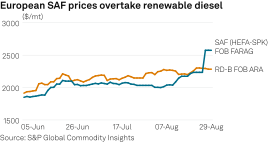
The move adds to a string of retrenchments in Shell's clean-energy portfolio. A company spokesperson told Platts, part of S&P Global Energy, that it does not have plans for any further reductions in the biofuels space.
In March 2023, the company canceled a planned SAF facility in Singapore's Bukom Island.
Last year, it also scaled back a key emissions target, now aiming to cut the carbon intensity of its energy sales by 15%-20% by 2030, compared with an earlier goal of 20%.
The Rotterdam plant would have been one of the largest SAF converters in Europe, at a time when airlines are under pressure to cut their climate footprint.
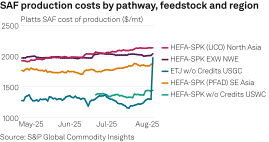
Aviation accounts for around 3% of global CO2 emissions, according to the International Energy Agency.
SAF is widely seen as critical for meeting net-zero goals, though critics argue that limited feedstock and high costs constrain its potential.
Despite the setback, Shell stressed its commitment to biofuels and the energy transition.
The company said it invested $8 billion in lower-carbon options, including hydrogen, carbon capture and low-carbon fuels, between 2023 and 2024.
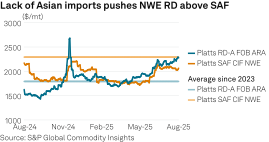
In 2024, Shell traded more than 10 billion liters of low-carbon fuels and became one of the world's largest suppliers of SAF, with nearly 20% of sales in North America and Europe.
The Netherlands continues to play a central role in Shell's energy transition portfolio.
The firm has invested Eur6.5 billion in the country over recent years, backing projects such as the Porthos CO2 storage venture and the 200 MW Holland Hydrogen 1 electrolyser under construction in Rotterdam.
Shell said impairments related to the Rotterdam project will be disclosed in its quarterly results.
Platts assessed the European SAF-Jet Fuel spread at $1,355.04/mt on Sept. 2, down $1.70/mt day over day.
