Agriculture, Maritime & Shipping, Crude Oil, Refined Products, Vegetable Oils
September 03, 2025
Russian crude, product exports rise in Aug as China steps up purchases
By Thomas Washington and Max Lin
HIGHLIGHTS
India tapers Russian crude imports amid threat of tariffs
Product exports to China surge
Ust-Luga drone attacks threaten export capacity
Russia's seaborne oil exports increased slightly in August, as a decrease in cargoes to India was blunted by a rise in deliveries to China, according to cargo-tracking data.
Russian-origin crude liftings from Russian ports reached 3.40 million b/d for the month, up slightly from 3.35 million b/d in July, but still below March-June levels, S&P Global Commodities at Sea data showed.
Deliveries to China rose 12% from July's level to 1.109 million b/d in August, while shipments to India fell 21% month over month to 1.30 million b/d.
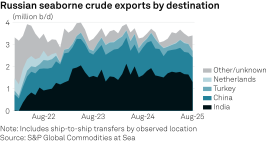
There has been much discussion about the impact of secondary sanctions by the US on India over its purchases of Russian oil, and oil market watchers have been trying to parse the impact of this on global oil supply.
Initial data suggest the pressure could lead to a moderate change in crude flows. On Aug. 27, the US announced 25% "secondary tariffs" on India to pressure the country to reduce its purchases of Russian oil.
However, trade with China remains ongoing, and India is expected to keep buying Russian crude despite the additional 25% tariffs, according to analysts. India may still taper its purchases enough to shift trade flows and potentially widen price discounts for Russian crude.
"India's government and refiners remain steadfast in the face of US pressure," analysts at HSBC Global Investment Research said in a note Sept. 1.
India's intention to continue buying Russian crude despite US pressure may appear counterproductive, looking purely at Delhi's economic interests. What India saved on discounted Russian crude was dwarfed by the value of Indian exports of goods to the US, so other factors, notably political ones, are at play, according to HSBC.
"Overall, for the market, it will likely drive Russian crude discounts higher and blends cheaper, being slightly bearish," Rachel Ziemba, a senior adviser for Horizon Engage, told Platts, part of S&P Global Energy.
Platts assessed Urals FOB Primorsk at $57.91/b on Sept. 2, an $11.53/b discount to Dated Brent. The discount has widened from $11.47/b on Aug. 27.
Ziemba said that, despite tough talk from the Indian government about continuing to buy Russian crude, businesses are likely to hedge and look for other supplies.
Regardless of how the situation unfolds, few believe that a peace deal between Russia and Ukraine is imminent. "Putin has shown no interest whatsoever in meeting with Zelensky," analysts at Global Risk Management said Sept. 2.
While there is little belief that Trump will impose new sanctions on Russia, GRM said the probability that existing sanctions will be enforced is increasing.
Products in the line of fire
Seaborne flows of Russian oil products in August rose 10% month over month to 2.31 million b/d, reversing a multimonth low. This recovery was largely driven by a significant rise in shipments of fuel oil and residues, which experienced month-over-month increases of 33% and 6%, respectively, according to CAS.
Exports of products to China surged 79% month over month to 291,733 b/d, deliveries to India rose 19% to 164,209 b/d and deliveries to Turkey increased 9% to 522,891 b/d.
This comes despite Russian product export capacity coming under pressure. Drone attacks over the last weekend in August on Russia's major Baltic export hub, Ust-Luga, damaged its gas processing facility and threatened exports, according to market sources and ship-tracking data.
A Ukrainian strike on the Ust-Luga terminal Aug. 24 set fire to the large Novatek facility on the Gulf of Finland, which is a significant outlet for fuel and residues used in the marine sector. The fire was later extinguished, but it failed to prevent structural damage.
According to CAS, Ust-Luga exports typically account for over half of all volumes from Russia's Baltic seaports.
Meanwhile, differentials for Russian-origin diesel and gasoil in West Africa have narrowed due to smaller discounts for Russian crude and lower Russian imports.
Russian gasoil/diesel exports remained stagnant in August at about 750,000 b/d, after declining by 4% to 754,000 b/d in July and failing to rebound in the same manner as fuel oil and vacuum gasoil exports. According to CAS, shipments to key markets decreased, with exports to Brazil dropping by 34% to 80,000 b/d and exports to Turkey, Russia's main gasoil market, falling by 6% to 288,000 b/d.
