Fertilizers, Chemicals, Energy Transition, Renewables, Hydrogen
July 15, 2025
INTERVIEW: Topsoe sees growing demand for solid oxide hydrogen production

HIGHLIGHTS
Offer 25%-30% efficiency gains over alkaline/PEM: CCO
SOEC and ammonia tech with dynamic operation capability
Q4 commercial start for 500-MW/year Denmark SOEC factory
Energy technology company Topsoe is eyeing growing demand for high-efficiency solid oxide electrolyzers for green hydrogen and ammonia production, as it starts to land major contracts for its technology, chief commercial officer Sundus Ramli told Platts in a recent interview.
The company produces solid oxide electrolyzers, along with other energy technologies such as ammonia and methanol plants, and is commissioning its 500 MW/year SOEC factory in Herning, Denmark, with the start of commercial operations targeted for the end of the year, reaching full capacity in 2026, Ramli said.
The company is targeting initial orders in the range of 50-100 MW, but is also in the running for a 700-MW order from Hive Energy for its planned Coega green hydrogen and ammonia plant in South Africa.
"We are probably one of the only companies that can deliver the full power-to-X value chain," she said.
Ramli pointed to efficiency gains for SOEC over typical alkaline and proton exchange membrane electrolysis hydrogen production of 25%-30%.
Platts, part of S&P Global Energy, assessed the cost of green hydrogen production via alkaline electrolysis in Spain, backed by renewable power purchase agreements, at an average of $9/kg in June.
The assessment reflects one possible pathway for producing EU Renewable Energy Directive-compliant green hydrogen.
"Developers, they want to be able to produce the lowest cost of hydrogen or ammonia," she said. "So for them, being able to buy 30% less electricity or build 30% less renewables, of course, impacts the cost of production massively."
Dynamic operation
Ramli said the technology could also be operated dynamically, and although SOECs are not as responsive to variable renewable input as PEM electrolysis, they can be configured so that the optimum number of units are running to match the renewable energy input profile, with others on hot standby.
"It is a misconception out there that it's not dynamic," she said.
Topsoe ammonia production technology was similarly responsive, with the ability to ramp production down to low levels and back up again.
"So putting those two together means that you can follow the renewal profile, which means you don't need storage."
The company's demonstration plant, which has been running for 5,000 hours, along with insurance offering to guard against non-performance or underperformance, give customers further confidence in the technology, Ramli added.
"That gives a lot of credibility in the market," she said. "That has been quite a game changer for us because suddenly, products become more bankable. The banks also can give a lower interest rate, so all in all, the project becomes cheaper."
Topsoe is also supplying the ammonia plant for the 2.2-GW Neom project in Saudi Arabia, Ramli said. The plant is due to start production in 2026.
Chinese competition
Ramli said Topsoe had been short-listed for the Coega project along with a Chinese alkaline electrolyzer producer to supply the project, for which a final investment decision is expected in 2026.
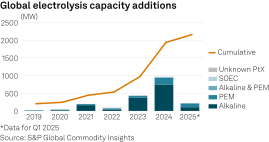
China is emerging as a leading supplier of alkaline electrolysis technology, and there are industry concerns that the sector could see a repeat of solar photovoltaic manufacturing, in which China has developed a dominant position.
However, Ramli sees competition with Chinese manufacturers as a good thing.
"China always does things really well," she said. "They're long-term planners. They have moved into becoming more and more of an electro-state. So they are very well positioned."
The Asian giant is developing large-scale renewable projects as part of its efforts to diversify energy supplies away from LNG and coal.
Ramli also said the global drive for energy security played into the push for renewables projects, with many countries bolstering green power and hydrogen efforts in an attempt to reduce reliance on expensive fossil fuels.
However, she acknowledged that the volatility in energy markets had increased risk in the nascent hydrogen sector.
"So who's going to take that risk? I think that's going to be tough, Ramli said. "But it should drive nations to do more to protect themselves."
Demand sectors
Ramli said the main demand for Topsoe's power-to-X technology was for integrated SOEC and ammonia projects, with interest also for methanol, e-sustainable aviation fuel and renewable methanol.
Within Europe, the Nordics and Iberia held the most promise, with access to plentiful low-cost renewable power.
And there was a growing interest in SOEC technology to produce hydrogen in the refining sector, she added.

Editor: