Energy Transition, Carbon, Emissions
July 07, 2025
Japan mulls barring international VCM credits before GX-ETS launch; move to be bullish for domestic credits

HIGHLIGHTS
JCM credit, J-credit supply insufficient to meet potential demand
Cap on carbon credit usage to drive direct emissions reductions
Participants seek more policy clarity to boost market confidence
Japan is considering to revoke the eligibility of international CO2 removal credits as the country's emissions trading system, GX-ETS, gears up for its mandatory emissions reporting phase in 2026, opting only to utilize credits from domestic programs such as the J-credit or the JCM, according to market participants.
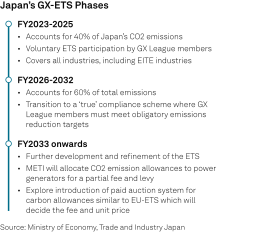
Following a governmental update to the Green Transformation Law May 28, the GX-ETS is set to transition from its voluntary trial phase to the obligatory first phase starting fiscal year 2026-27 (April-March), thereby mandating participation in the domestic ETS for facilities emitting more than 100,000 mt/year of CO2.
"Nothing is finalized, but we assume they will not accept any international voluntary carbon credits for now. I agree that J-credits [and] Joint Crediting Mechanism will not be enough, but it may take some time for the government to accept that," Tokyo-based Carbon EX COO Kageyama Takayuki told Platts, part of S&P Global Energy.
With uncertainty surrounding the eligible credits less than a year before the first phase, a Tokyo-based trader described the framework as it stands is "as clear as mud," notwithstanding the fact that there are other aspects that have yet to be clarified.
Insufficient supply of domestic credits
One main area of concern highlighted by various participants is whether the supply of credits issued from both the J-credit and JCM programs will be sufficient to match the expected demand, especially if carbon dioxide removal voluntary credits are ruled out.
Japan updated its Nationally Determined Contribution in October 2021, stating that it aims to reduce greenhouse gas emissions 60% to 570 million mtCO2e in FY 2035-36 and by 73% to 380 million mtCO2e in FY 2040-41, respectively, from its FY 2013-14 levels.
This is in line with the country's ambitious targets for the global 1.5 C goal and on a pathway toward net zero by 2050.
Several Tokyo-based traders have said interest in J-credits is picking up as FY 2026-27 approaches, with demand expected to reach 130 billion units by FY 2030-31.
Under the J-credit initiative, the government issues 1 million/year J-credits by certifying the amount of greenhouse gas emissions reduced or removed via sinks through efforts to introduce energy-saving devices and the management of forests.
Meanwhile, JCM is Japan's collaborative framework under Article 6 of the Paris Agreement that facilitates investments in global decarbonization projects and involves a shared responsibility for credit splits between Japan and partner countries.
With only 1 million J-credits being issued in addition to the uncertainty surrounding how JCM credits will be split between Japan and the host country, supply concerns are growing across the market.
The government aims for a cumulative supply of 100 million mtCO2e JCM credits by 2030, yet only 700,000 mtCO2e of such credits had been issued by June 2024, Platts reported July 2.
According to a key Tokyo-based stakeholder, the government may consider increasing yearly supply, but the verification process is tedious and cumbersome, as the J-credit program is being managed by four ministries.
"This has been the biggest bottleneck when it comes to timely and efficient decision-making [for the GX-ETS]," the stakeholder added.
The limited supply could also drive up prices for eligible credits, though participants have said the government will be setting a price ceiling.
Latest GX-ETS updates
Japan's Ministry of Economy, Trade and Industry held its first meeting of the Emissions Trading Scheme Subcommittee on July 2. The agenda was to assess the policy for a detailed framework of the GX-ETS.
In addition to the mandatory participation of 300-400 companies, another update includes a proposed cap on carbon credit usage, limiting it to 10% of actual emissions. This restriction applies to both J-credits and JCM credits, ensuring that companies focus primarily on direct emission reductions rather than relying excessively on offsets.
As for the allocation of free allowances, it will be guided by industry-specific benchmarks, which are currently being developed by dedicated working groups.
Participants have pushed the need for greater transparency and continued public engagement to ensure that the GX-ETS can further align and achieve Japan's climate targets, enabling covered entities to commit to their obligations as efficiently as possible.
The market will now look to a committee meeting set to be held in August to determine the price ceiling and floor for the ETS, on top of getting more feedback from consultations before finalizing the finer details by the end of 2025.

Editor: