Electric Power
October 21, 2025
Investors rush to capitalize on UK's booming battery storage market

HIGHLIGHTS
Investment wave in UK BESS driven by falling costs
Fixed-price tolling agreements unlock financing
Large batteries prioritized for economies of scale
Investors are flocking to the UK's battery storage market, with falling capital costs and the rise of fixed-price offtake structures driving a wave of dealmaking activity in 2025.
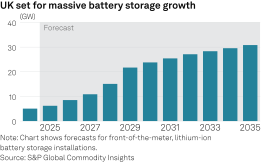
Already Europe's largest market for battery storage, Britain is on course to more than quadruple its installed base by 2030 from the roughly 5 GW in operation today.
The sector has received considerable financial backing this year, with companies raising debt from banks, selling equity stakes to institutional investors and divesting operating assets to recycle capital.
"We've seen extraordinary [capital expenditure] savings driven by heavy competition among Chinese [battery] suppliers, and that's ultimately boosting the [internal rates of return] for investors," Chris Elder, CEO of developer Fidra Energy, said during an interview with Platts, part of S&P Global Energy.
Elder said the cost of battery systems "roughly halved" during the procurement process for Fidra's 1.4-GW/3.1-GWh Thorpe Marsh project in Yorkshire, England.
The developer, which is backed by US investment giant EIG Global Energy Partners, secured more than GBP1 billion of equity and debt in September to fund Thorpe Marsh, one of the largest battery systems anywhere in Europe.
Several other large-scale UK batteries have attracted capital this year, with investors enticed by a rising tide of offtake agreements offering fixed-price revenue.
Most recently, Danish pension fund AIP Management bought a stake in a 700-MW portfolio of three sites from Swiss-headquartered developer BW ESS, before acquiring a 50% interest in the 500-MW/1-GWh Coalburn 2 battery project from fund manager Copenhagen Infrastructure Partners.
"We don't have an infinite balance sheet," Erik Stromso, CEO of BW ESS, said during an interview. "Working with partners like AIP allows us to recycle some of [our] capital and to put it to work in other projects that we have coming through our pipeline, both in the UK but also internationally."
Unlocking fixed revenues
The growing use of floor and tolling agreements has unlocked a new source of fixed revenue for storage projects and enabled capital to invest, according to industry players.
Floors provide battery operators with a minimum price for their electricity, while tolls involve giving trading control of the battery to an offtaker in return for a fixed payment.
"There's a lot of risk-averse capital that's been sat on the sidelines, whether it be pension funds or other investors, that aren't looking to shoot out the lights, but are just looking for steady returns, and having those bankable offtake agreements in the background is really helpful," Peter Kavanagh, CEO of developer Harmony Energy, said in an interview.
Harmony is in the market to raise GBP350 million in equity for the expansion of its European portfolio, and Kavanagh said tolls and floors are helping "drive capital" into batteries.
Tolls in particular have become more popular amid rising battery spreads in the UK, allowing developers to tap into the banking market for finance.
"Having an alternative revenue structure in the market beyond floors, I think, has been helpful," Louise Dalton, partner in the energy and climate practice at law firm CMS, said in an interview. "We've seen a lot of bank interest on the tolling side, and I think that is attractive to a certain class of investors."
The low cost of battery equipment allows developers to secure tolls at lower fixed prices, which in turn enables them to put greater levels of debt into projects, according to Elder.
The Fidra CEO added, however, that while there is appetite today from offtakers for long-term tolling, the market is not unlimited, and only a certain number of companies have the balance sheet capability to do deals.
"You may see that market decline a little bit, particularly as spreads come off, but it will be cyclical," Elder said.
For Stromso of BW ESS, the key is getting the right mix of contracted and merchant revenues.
BW ESS aims to contract about half of the 700-MW portfolio in the AIP transaction, which already includes a seven-year tolling agreement secured last year with Shell Energy Europe for the 100-MW/330-MWh Bramley project.
Stromso sees offtake appetite from energy companies, utilities and hyperscalers, many of whom are coming to the realization that their portfolios are "short on flex."
"Our ability to provide that is something that complements our contracting strategy quite nicely," Stromso said. "And by doing that, it also frees up capacity for us to go and then build more projects without contract coverage."
Scalability in focus
With tens of gigawatts of UK batteries in the pipeline -- far outstripping the needs of the country's electricity system -- financiers are tasked with picking the right horses to back.
Beyond contracted revenues, industry players emphasized the importance of having a quality sponsor with a strong track record of development.
Many investors are also prioritizing larger projects, which have become more prevalent in the UK as the cost of batteries falls, with developers seeking to benefit from economies of scale.
Projects bigger than 500 MW are more attractive not only to investors but also to battery suppliers and the contractors who build the projects, according to Elder.
Fidra secured an equity investment for Thorpe Marsh from the National Wealth Fund, the UK government's policy bank, which also this year provided funding for another UK battery platform, Eelpower Energy.
"That scale is important for them ... as an investor," Elder said about the 1.4-GW Thorpe Marsh project. "I think that helped us in terms of making the case for their investment."
Not everyone is chasing mega-projects, however. The largest site in Harmony's development pipeline is 400 MW.
"We've not gone above that," Kavanagh said. "I think personally, I would feel very uncomfortable at 1 GW because it's a lot in a single location. If there's a change in network policy, you're very, very exposed in one location, so I'm skeptical about how many at that size will get built."
There is also a question about how many batteries of that scale the UK power system actually needs. With about 5 GW installed and many projects under construction, the journey to the government's target of 23-27 GW of battery storage by 2030 may not be a long one.
At the same time, ongoing grid reforms are set to also "put a stop" to the increase in scale, according to Pradeep Jayakumar, technical director for battery storage and hybrids at consultancy Natural Power.
With large grid connections becoming increasingly scarce, Jayakumar expects standalone batteries to level out at the 100-MW to 200-MW mark, and for developers to increasingly favor colocation opportunities where grid capacity already exists.
"Anytime you install a brand-new wind farm or a solar plant, or an existing operational plant has to be upgraded, you will now think to store as well," the adviser said in an interview. "You won't see any more individual big ones. I think that's reached its end. You'll see big colocated assets."

Editor: