Electric Power, Natural Gas, Nuclear
October 14, 2025
Data center grid-power demand to rise 22% in 2025, nearly triple by 2030
By Garrett Hering and Susan Dlin
HIGHLIGHTS
Data-center power demand will rise to 134.4 GW in 2030
Virginia's data-center power demand up 30% year over year
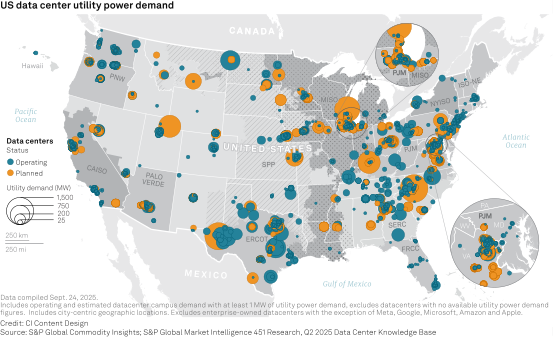
Data centers proliferating across the US will require 22% more grid power by the end of 2025 than they did one year earlier and will need nearly three times as much in 2030, according to the most recent forecast from 451 Research, part of S&P Global.
Utility power provided to hyperscale, leased and crypto-mining data centers will rise by roughly 11.3 GW in 2025 to 61.8 GW, 451 Research said in its updated Datacenter Services & Infrastructure Market Monitor & Forecast, released in September.
In 2026, US data center demand will rise to 75.8 GW for IT equipment, cooling, lighting and other uses, and further expand to 108 GW in 2028 and 134.4 GW in 2030, according to the outlook. That does not include enterprise-owned data centers outside of hyperscale tech giants such as Amazon.com, Apple, Google, Meta Platform and Microsoft Corp.
The data center boom is driving the robust load-growth estimates of many electric utilities, largely fueled by the emergence of AI. But much uncertainty surrounds the precise pace of power demand from data centers, the grid resources needed to cover that demand and the capabilities of large-scale onsite power alternatives.

In September, for instance, American Electric Power Company subsidiary Ohio Power Company provided the Public Utilities Commission of Ohio with an update on its data center pipeline that showed interconnection requests for 36 sites totaling 13 GW of load. That was down from over 30 GW previously.
The reduction followed the commission's order in July directing Ohio Power, known as AEP Ohio, to file new tariffs specific to data centers. Large data center customers connecting to the grid in AEP Ohio's service area will be responsible for at least 85% of the energy they are subscribed to use, regardless of actual usage, according to the order.
Ohio is among several states seeking to protect households and other utility customers from grid infrastructure costs linked to data centers.
The order aligned with the commission's approval of a settlement between AEP Ohio, agency staff, the Ohio Consumers' Counsel and others to shield non-data center customers from costs related to underused investments to serve the data-center industry.
New data-center tariff
The new data-center tariff is "culling duplicative or speculative requests," analysts at Jefferies said in an Oct. 6 note, noting that the tariff-driven attrition should "tighten AEP's load signal while lowering stranded cost risk."
AEP's near-term narrative of rising demand, however, remains intact, the analysts said.
Utility executives in July forecast a $16 billion increase to AEP's capital plan, pushing its forthcoming five-year plan update to $70 billion, partly to meet firm data-center demand across its 11-state service territory.
To model its forecast, the utility relies on financial commitments such as electric service agreements and letters of agreement, AEP Executive Vice President and CFO Trevor Mihalik told analysts and investors on an earnings call.
AEP cited customer commitments for 24 GW of new demand by 2030, including 18 GW from data centers, compared to 190 GW of incremental demand in its raw interconnection queue. That volume of load would be five times the utility's current system size.

451 Research forecasts Virginia's data-center demand for grid power will reach roughly 12.1 GW in 2025, up from 9.3 GW in 2024, made up of leased and hyperscale facilities. In Texas, utility power demand from data centers will hit about 9.7 GW in 2025, rising from less than 8 GW in 2024, led by crypto-mining and leased projects.
Oregon is expected to see over 4 GW of data-center demand by the end of this year, up from 3.5 GW in 2024, according to the outlook. For Arizona, Georgia, Ohio, California, Illinois and Iowa, state-level data-center demand is forecast between 3.2 GW and 2.3 GW.
Stefanie Williams, a senior analyst at 451 Research, pointed to rising interconnection requests in several states, including Georgia.
"Ample land, reasonable power costs, dense fiber and demand from hyperscalers continues to drive growth in the state," Williams said. "Additionally, we see significant growth in Ohio, particularly around Columbus, where data center operators have clustered for years."
Insufficient grid supply
Data-center operators also continue to explore emerging markets, including in Idaho, Louisiana, Oklahoma and smaller cities in West Texas, according to the 451 Research analyst.
"This is largely driven by the search for stranded power and alternative energy generation opportunities," Williams said.
Given grid limitations and the desire for rapid power solutions, suppliers of various on-site power systems are vying for a share of data-center demand.
Jefferies analysts noted AEP's contract for 100 MW of fuel cells from Bloom Energy Corp., with an option to increase to 1 GW, among the utility's "bridge solutions" to serve data centers while grid upgrades are completed.
"Data centers will increasingly require on-site systems as their power demands outpace the capacity of the grid," S&P Global Energy analysts said in a July report.
Among the options are existing conventional assets, such as retired nuclear assets, as well as new natural gas-fired generation, battery storage, renewables and various hybrid combinations, according to the report.
But idle or available power plants are in short supply, the analysts added.
"Consequently, clean energy technologies will become increasingly important, often in conjunction with natural gas generation or supplementing an insufficient grid supply."

Editor: