Energy Transition, Carbon, Emissions
October 09, 2025
Natural carbon capture removal credit prices hit 2025 low on supply glut

HIGHLIGHTS
Credit issuances rise 94% month over month
Carbon credit prices fall 10% as issuances soar
Supply outpaces demand amid limited corporate buying
The Platts Natural Carbon Capture credit price fell to a new 2025 low as a 94% month-over-month surge in September credit issuances outpaced corporate demand.
Platts, part of S&P Global Energy, assessed Natural Carbon Capture at $13.30/mtCO2e on Oct. 8, down 5 cents from the previous day of $13.35/mtCO2e and marking a new yearly low.
The assessment average over September declined 10% over the month as supply pressures mounted, although the average price of $13.47/mtCO2e remains 15% higher year over year. The price weakness reflects a fundamental mismatch between rapidly expanding credit supply and tepid corporate appetite for the newer vintages.
"But hard to deny it's just a general lack of action being taken by corporates," a US trader said about limited activity in the spot market for the segment.
Natural carbon capture credit pricing has been falling alongside lower offers and limited buying interest, which caused Platts Natural Carbon Capture credit price assessments to hit one-year lows earlier.
Notably, the latest offer for Verra Carbon Standard certified credits from Colombia's Vichada afforestation and reforestation project (ID 2512) was last reported at $13.50/mtCO2e, with indicative values at $13.35-$13.45/mtCO2e. The project has been described as one of the most fungible globally. The offer, under the AR-ACM0003 methodology, has remained unchanged for several weeks now.
Credit issuances for the VCS-certified project for vintage 2021 and 2022 have totaled around 116,328 issuances, with total retirements being nearly 14,122 mt, equivalent to 12% of retired credits, which would mean that 88% of total credits issued are unretired.
"As for Vichada 2512, I think the developer is holding the bag on most of those credits," the US trader said.
Natural Carbon capture credits are linked to removal projects aimed at reducing greenhouse gas emissions that fall within the agriculture, forestry and other land use category, which includes reforestation and afforestation projects, soil sequestration -- not including biochar -- and wetland restoration.
Retirements rise month over month, fall year over year
Nature-based or natural carbon capture credit retirements -- reflecting that their emissions-offsetting benefits have been fulfilled and that these credits cannot be resold or traded -- rose by roughly 24% month over month to 689,707 mt in September. However, they fell by about 18% year over year.
"We have seen a slight uptick in the third quarter of this year in requests from intermediaries," a US nature-based removals developer said. "This time of year is always good for us."
For those looking to offset their emissions, Q4 and Q1 typically see the highest sales activity, both for spot and pre-sale transactions, the developer added.
Among natural carbon capture credit retirements in 2025, the large majority -- over 50% -- were vintages from 2021 through 2024, with the remaining retirements being vintages from 2020 and older. This trend reflects buyers' preference for higher-quality credits from more recent vintages and newer methodologies, as market participants have become increasingly selective about carbon credit purchases amid heightened scrutiny over offset quality, deliverability, and effectiveness.
The increase in credit "retirements" does not always indicate a positive or meaningful change in market dynamics, the US trader said, especially when the majority of the activity is focused on older credits and "no real, 'new' purchases and retirements are taking place," the trader said.
"Add that to a whole bunch of new issuances, and all you've done is compound an oversupply problem," the trader added.
Historically, 50% of all carbon capture credits issued remain unretired, according to S&P Global Energy data. For 2020 vintages and newer, 29% of credits have been retired, leaving the remaining 71% unretired.
"We have not seen much demand," a Latin America-based developer said, adding that its latest transactions in September have had lower credit volumes compared to other months when a 5,000-15,000 mt deal size was normal.
Credit issuances rise month over month
Carbon credit issuances for nature-based removals rose 94% in September, increasing to 2.9 million credits from 1.50 million in August. However, the volume of issuances declined 1% from September 2024, when 2.93 million credits were issued.
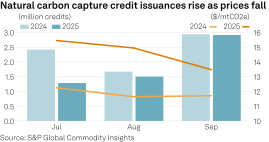
Carbon credit issuances happen once a project is registered and verified by a carbon registry, making its credits available for trade in the VCM.
"We are trying to sell from the bottom," the developer said about prioritizing the selling of IFM credits under the 1.3 methodology version versus credits from the newer ACR V2.1 version. Credits under the new version were heard offered at a premium to the V1.3 methodology of $25-$30/mtCO2e.
Platts heard an offer price for improved forest management on Non-Federal US Forestlands, removal credits, with project ID 422 for 77,000 and vintage 2023, at $12/mtCO2e.
Platts also heard an earlier trade for ACR IFM Removals traded at $22/mtCO2e for 15,000 mt.
Meanwhile, credits in Mexico for CAR-certified IFM removal credits were last traded at $12/mtCO2e for 4,000 credits.

Editor: