LNG, Natural Gas
October 08, 2025
Ukraine gas injection rate sinks after Russian strikes: GIE
By Matt Hoisch and Roudy Dirani
HIGHLIGHTS
7-day rolling average lowest since April
Similar Feb attacks saw output fall
Traders see limited change in European fundamentals
Ukraine's gas injection rate has plummeted in the days after several major Russian strikes, data published Oct. 8 by Gas Infrastructure Europe showed.
Injections on a seven-day rolling average basis are at their lowest level since April, when the country began restocking.
GIE data showed the rolling average sinking to about 200 GWh/day (18.9 million cu m/day) on Oct. 6. This is almost 50% lower than the seven-day rolling average of some 383 GWh/ day on Oct. 2, the day before Russia commenced its latest wave of attacks on Ukraine's gas system.
Daily injection rates have recovered slightly since the attacks, reaching some 219 GWh Oct. 6 compared with about 126 GWh on Oct. 4.
GIE data is published with a two-day lag.
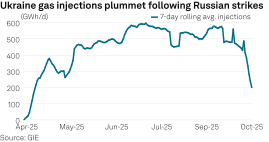
Recent attacks
The injection data offers the clearest indication yet of the potential impact of recent Russian strikes on Ukraine's gas system as the country prepares for winter.
State-owned oil and gas company Naftogaz said a drone and missile assault early Oct. 3 represented the "biggest attack yet" on its gas production facilities since the start of Russia's full-scale invasion.
Those strikes, which targeted gas sites in the country's Kharkiv and Poltava regions in eastern Ukraine, caused damage to a "significant portion" of Naftogaz's facilities, some of it "critical," CEO Serhiy Koretsky said Oct. 3.
Russian strikes on Oct. 5 targeting gas supply facilities also caused "significant damage," the company said the same day.
While Naftogaz and Ukraine's Ministry of Energy have offered general descriptions of the recent attacks, neither has provided exact data on the extent of damage to the gas system.
"After similar Russian attacks on Feb. 11, 2025 -- which were characterized by official sources in a similar way -- total Ukrainian gas output appears to have been cut by 50% for a short initial period, after which it took months to recover fully," S&P Global Energy analysts Laurent Ruseckas and Anna Galtsova said in a First Take note Oct. 7.
"If the Oct. 3 incident has a similar impact, all other things being equal, it would drive Ukraine to import an additional 1.5 Bcm from Europe over the course of the winter and summer-26, putting upward pressure on European prices on margins, affecting the Austrian and Slovakian VTP prices most directly but feeding through to TTF and the NWE LNG benchmark."
Prices surge, but sources discount longer-term impact
European gas prices have spiked in the days since the early October attacks. Since Oct. 2, the Dutch TTF month-ahead index has gained some 6.6%, rising to Eur33.355/MWh on Oct. 7. A 5.4% jump Oct. 6 was the largest single-day TTF increase since the Israel-Iran conflict in June sparked fears of a closure at the Strait of Hormuz, a vital waterway for international LNG trade.
Despite the recent surge, however, market participants do not anticipate a prolonged bullish impact from the strikes.
"You are in a market that is still anticipating a glut by next spring," a Germany-based trader said. "And the Ukrainians are quite good at repairing their infrastructure quickly. So that doesn't change the picture. It makes it a little less bearish, but still bearish."
A second Morocco-based trader similarly saw the attack as having a limited effect on fundamentals. Prices "will jump once people start hearing Naftogaz looking for tenders," the trader said. "Otherwise, [supply and demand] in Europe is unchanged."
The relative separation between the Ukrainian and EU gas systems is also expected to minimize the strikes' effects on the wider European market. Ukraine's storage sites mainly serve domestic needs, and the country is not a major transit route for EU gas supplies, according to Tatiana Mitrova, a fellow at Columbia University's Center on Global Energy Policy.
"The [injection] data show a visible and probably significant operational impact for Ukraine itself, but the systemic consequences for Europe remain limited," she told Platts, part of S&P Global Energy, in an emailed statement. "At most, the Ukrainian issues might slightly constrain regional flexibility or temporarily tighten prices in localized markets, but they are unlikely to threaten winter security of supply."
'An obvious target'
Still, Mitrova cautioned that further damage remained a possibility.
"This is probably only the beginning of a broader campaign of winter attacks on Ukraine's energy infrastructure -- and the gas system is an obvious target, especially now that Moscow no longer needs to preserve transit flows to Europe," she said.
Ruseckas and Galtsova agreed that major Russian attacks targeting Ukraine's energy infrastructure were "very likely to continue" over the coming months.
Total Ukrainian gas stocks reached about 12.6 Bcm as of Oct. 6, up from 5.3 Bcm on April 20 when the injection season began, according to data compiled by S&P Global Energy.
However, some 4 Bcm-5 Bcm of gas held in Ukrainian storage is cushion gas required for the technical operation of the country's storage sites.
Storage data published by GIE showed working Ukrainian gas stocks at 87.7 TWh (8.3 Bcm) as of Oct. 6, or 27.3% of capacity.
EU-wide storage was 82.9% full as of Oct. 6, according to GIE.

Editor: