Electric Power, Energy Transition, Renewables
October 01, 2025
US RENEWABLES TRACKER: 8.753 GW of clean energy capacity added in Q2
By Kassia Micek and Susan Dlin
HIGHLIGHTS
Arizona added the most capacity at 2.1 GW
Battery storage surpasses 35 GW nationwide
The US added 8.753 GW of wind, solar and battery storage capacity in the second quarter, with Arizona dominating additions, while Texas continues to lead the US in total clean power capacity.
US wind, solar and battery storage capacity increased by 16.7% year over year to total 333.968 GW by the end of Q2 2025, up 2.7% from Q1, according to data from S&P Global Market Intelligence. Solar accounted for most of the additions at 52.1%, adding 4.561 GW. Battery storage added 3.559 GW or 40.7% of Q2 additions, while there was 633 MW wind added.
"This is in line with our expectations," said Sam Huntington, director on the North American power team with S&P Global Energy.
One thing Energy will be watching is how many projects commence construction in the coming months, he added.
"Tax credit eligibility is contingent on getting projects started over the next nine months, so we'll be following that closely," Huntington said.
'Concerning signs for the industry'
The American Clean Power Association said the smaller amount of clean energy added in Q2 came "amidst concerning signs for the industry."
The clean power development pipeline showed "virtually no growth," ACP said in its Q2 report about declining solar installations and plummeting Power Purchase Agreements, which it said were "early indicators of federal policy attacks and fluctuating trade policy undermining American energy security and economic growth."
"America's clean energy industry continues to add much needed power to the grid. Unfortunately, federal policy obstacles and restrictive mandates are threatening hundreds of billions in planned energy investment," ACP CEO Jason Grumet said in a statement. "The uncertainty created by new bureaucratic delays and unclear demands is having a chilling effect on the pipeline for future energy projects, stalling growth precisely when our nation needs more energy to power a growing economy."
There is nearly 39.2 GW of clean generation capacity under construction or in advanced development that is slated to come online by the end of the year. The majority of that is in solar projects at about 19.6 GW, followed by storage at 14 GW and wind with 5.5 GW.
| Top 20 states ranked by installed capacity Q2 2025 (MW) | ||||||
| Wind | Solar | Storage | ||||
| Ranking | State | Installed | State | Installed | State | Installed |
| 1 | TX | 43,920 | TX | 28,804 | CA | 13,609 |
| 2 | IA | 12,929 | CA | 23,409 | TX | 9,840 |
| 3 | OK | 12,751 | FL | 11,883 | AZ | 3,531 |
| 4 | KS | 9,487 | NC | 6,853 | NV | 1,785 |
| 5 | IL | 8,237 | AZ | 6,551 | NM | 740 |
| 6 | CA | 6,964 | NV | 5,532 | FL | 656 |
| 7 | CO | 5,343 | GA | 5,467 | ID | 514 |
| 8 | MN | 4,962 | VA | 5,075 | HI | 510 |
| 9 | ND | 4,525 | OH | 4,164 | MA | 467 |
| 10 | NM | 4,419 | IL | 3,256 | CO | 443 |
| 11 | OR | 4,098 | IN | 3,163 | IN | 338 |
| 12 | WY | 4,083 | NY | 2,796 | OR | 322 |
| 13 | MI | 3,806 | CO | 2,441 | CT | 302 |
| 14 | IN | 3,743 | NM | 2,428 | NY | 283 |
| 15 | SD | 3,655 | WI | 2,373 | AK | 206 |
| 16 | NE | 3,559 | UT | 2,218 | NC | 149 |
| 17 | WA | 3,375 | AR | 2,198 | GA | 146 |
| 18 | NY | 2,915 | MN | 1,767 | OK | 140 |
| 19 | MO | 2,416 | SC | 1,743 | WI | 136 |
| 20 | MT | 1,907 | MA | 1,620 | MI | 115 |
| Source: S&P Global Market Intelligence | ||||||
Clean energy additions
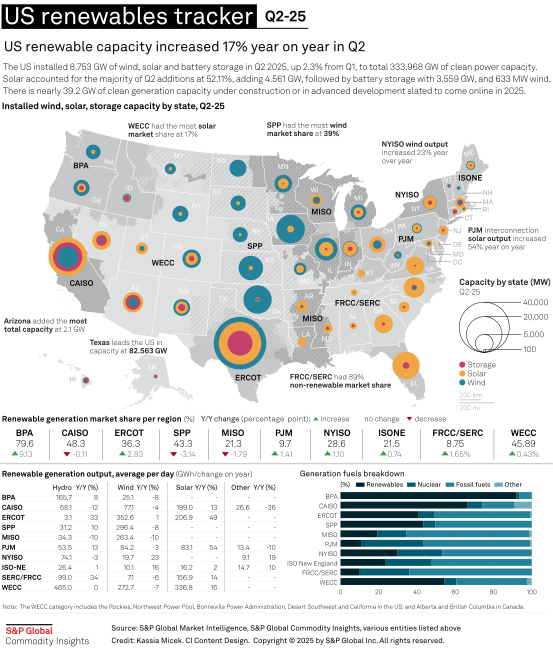
Texas leads the US in clean energy capacity with 82.563 GW, adding 1.4 GW in Q2, accounting for 16% of all US additions, according to Market Intelligence data. California followed with 43.982 GW, adding 552 MW in Q2, or 6.3% of the US total.
However, Arizona led the US in Q2 additions with 2.114 GW or 24.2% of all clean capacity added between April-June, according to Market Intelligence data
Only three states added wind capacity in Q2: Texas, Kansas and Maine, according to the Market Intelligence data. There were 22 states that added solar capacity in Q2, while 22 states added energy storage capacity.
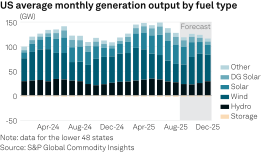
Solar output across the Lower 48 states is forecast to average 38.68 GW in Q3, up 2.5% from Q2, according to Energy data. Wind output is forecast to drop 26.6% to average 39.78 GW.
Texas leads the US in wind capacity with 43.92 GW, adding 243 MW or 56% of all Q2 wind additions, according to Market Intelligence data. The state has 27.9% of the nation's 157.520 GW of installed wind capacity.
Texas also leads the US in solar capacity at 28.804 GW, adding 875 MW or 18% all Q2 solar additions, according to Market Intelligence data. Arizona added the most solar capacity in Q2 with 1.04 GW or 21% of all wind installations. The US has 141.343 GW of installed solar capacity.
California leads the US in storage capacity at 13.609 GW, adding 610 MW or 17% of all Q2 storage additions, according to Market Intelligence data. The state has 39% of US energy storage capacity. However, Arizona added the most storage capacity in Q2 at 1.074 GW or 30% of the total.
The US has 35.135 GW of installed energy storage capacity, according to Market Intelligence data.
Renewable output breakdown
The Electric Reliability Council of Texas continues to be the grid operator regions that leads the US in total renewable generation output, averaging 541.623 GWh/d in Q2, an increase of 12.8% year over year, according to ERCOT data. The California Independent System Operator followed with 370.839 GWh/d, up 2.4% year over year, according to CAISO data.
The Florida Reliability Coordinating Council and SERC had a combined 63.3% of fossil fuels in the fuel mix for Q2, according to Energy data. The SERC Reliability Corp. was formerly known as the Southeast Electric Reliability Council.
Outside of the Southeast, the Midcontinent Independent System Operator had the largest amount of fossil fuels in its fuel mix, averaging 64.3% in Q2, an increase of less than 1 percentage point year over year, according to MISO data.
Combined, SERC and FRCC averaged the least amount of renewable market share at 10% for Q2, up 1.7 points year over year, while the PJM Interconnection with 10.7%, an increase of 1.4 points year over year.

Editor: