Electric Power, Energy Transition, Renewables
September 17, 2025
US BATTERY STORAGE: ERCOT surpasses CAISO in Q2 for most operating battery storage capacity in US
By Kassia Micek and Susan Dlin
HIGHLIGHTS
ERCOT leads the US capacity with 14.173 GW
There is 5.6 GW planned to be added in Q3
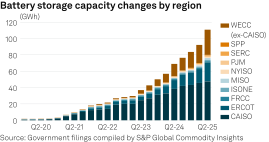
The Electric Reliability Council of Texas took over as the US region with the most operating battery storage capacity, adding 51.5% of the 6.239 GW installed across the US in second-quarter 2025.
US capacity increased 20% quarter over quarter and jumped 63% from a year ago to total 38.126 GW by the end of Q2. The capacity installed during Q2 is the largest quarterly addition to date, dwarfing the previous record of 3.954 GW in Q2 2024, according to an S&P Global Energy compilation of various government filings. The data includes facilities that either began commercial operation or were synchronized to the grid.
With the addition of 3.213 GW in Q2, ERCOT surpassed the California Independent System Operator to lead the US in battery storage capacity. CAISO added 563 GW, or 9% of Q2 additions, while the Western Electricity Coordinating Council region added 2.013, 32.3% of all Q2 additions in the US.
"The ERCOT market moves incredibly fast which is part of what has facilitated the rapid growth of batteries there," said Annie Gutierrez, S&P Global Energy senior research analyst.
In general, the faster a battery project can start participating in the market the more profitable, as adding more storage to the grid eventually saturates the market and depresses revenue, she added.
"In California, the ancillary service market has essentially become saturated, and most Battery Energy Storage Systems have moved to energy arbitrage" Gutierrez said. "In ERCOT, most BESS projects are still able to profit in the ancillary service market. The California market will still remain relatively steady as it's bolstered by strong policy, the continued growth of solar and the inability to build gas."
"The recent One Big Beautiful Bill Act preserves the investment tax credit for battery storage through 2034, but the new foreign entities of concern restrictions will be very difficult to comply with in the near term as the supply chain is currently situated in China," Gutierrez said. "Domestic manufacturing for battery storage is expected to ramp up in 2027-2028 which will allow developers to comply with FEOC. Chinese battery costs have come down significantly over the past three years, so even without the ITC many projects will still be built, especially those backed by policy. We expect a downtick in additions in 2027 as a result of FEOC restrictions, but additions will likely slowly rebound after that as domestic manufacturing ramps up."
Q3 expectations
If all 5.502 GW of planned Q3 additions are added to the grid, the US total would reach nearly 43.63 GW, a 14% quarter-over-quarter increase, according to the data.
The majority of planned Q3 additions are focused in the West, with CAISO accounting for 36% of expected capacity growth and WECC making up 31%. Outside of those two footprints, an additional 1.8 GW is slated to come online.
The top five largest projects proposed to be completed in Q3 are:
- AES Clean Energy Development's 500-MW 50LW 8me in California
- Nextera Energy Resources' 400-MW Kola Energy Storage in California
- Transgrid Energy's 300-MW Atlas VII in Arizona
- EDF Renewables' 250-MW Beehive Energy Storage in Arizona
- ENGIE North America's 205-MW BRP Castor BESS in Texas
AES Clean Energy Development's 50LW 8me facility was previously slated to come online in Q2, but has been pushed back to Q3.
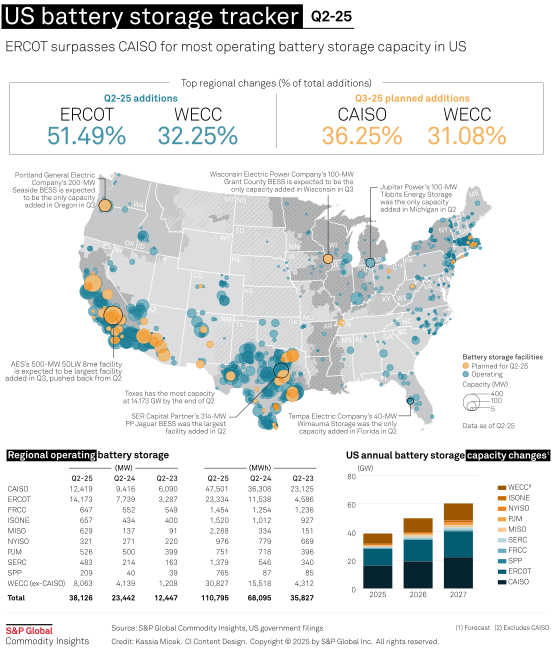
Leading Q2 additions, ERCOT capacity now totals 14.173 GW, or 37%, of total US capacity, followed by CAISO with 12.419, or 33%, and WECC with 8.063 GW, or 21%, according to the data. Within WECC, Arizona added the most capacity at 903.5 MW, followed by Nevada with 479 MW, Idaho with 230 MW and Colorado with 100 MW.
The top five largest projects to come online in Q2 were:
- SER Capital Partners' 314-MW PP Jaguar BESS in Texas
- ENGIE North America's 309.5-MW Platinum Energy Storage in Texas
- Copia Power's 300-MW Harquahala Sun 2 in Arizona
- Recurrent Energy's 300-MW RE Papago in Arizona
- Transgrid Energy's 279-MW Silver Peak Solar in Nevada
PP Jaguar BESS is now the fifth largest battery storage facility operating in the US and Platinum Energy Storage ranks seventh. In addition, Harquahala Sun 2 ranks 11th, RE Papago ranks 13th and Silver Peak Solar ranks 15th. The largest facility continues to be Florida Power and Light's 409-MW Manatee Energy Storage Center, which started operations in Q4 2021.
Company, state rankings
NextEra Energy Resources, which added 473 MW in Q2, remained the company with the most operating battery storage capacity in the US at 4.141 GW, according to the data. ENGIE North America, which added 833 MW in Q2, has the second most capacity, totaling 3.251 GW, followed by AES Clean Energy Development with 1.484 GW after adding 305 MW in Q2. Rounding out the top five were Enel Green Power North America with 1.253 GW and Plus Power with 1.219.
NextEra Energy Resources, ENGIE North America and AES Clean Energy Development are expected to install a combined 1.2 GW in Q3, according to the data.
At the state level, Texas leads US battery storage capacity with about 14.173 GW, followed by California with 13.066 GW, Arizona with 3.853 MW, Nevada with 1.604 GW and New Mexico with 701 MW, according to the data. In addition, 15 states have between 100 and 700 MW, five states have between 50 MW and 100 MW, while 15 states have less than 50 MW, leaving 10 states with no battery storage capacity
