Electric Power, Energy Transition, Renewables
September 15, 2025
Data center growth in Texas often comes with generation: experts

HIGHLIGHTS
‘Kind of bonkers’ project under construction
Some utility execs ‘just terrified’ by challenges
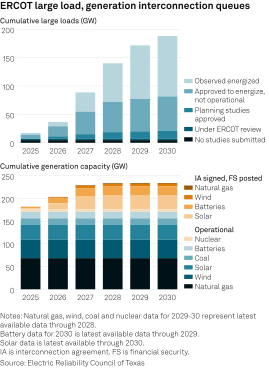
The Electric Reliability Council of Texas faces the challenge of integrating by 2030 as much as 188 GW of new large loads, much of it possibly inflexible data center load, which is prompting data centers to develop alongside new generation, experts say.
That 188 GW is more than double ERCOT's current official peakload of 85.5 GW set during a 15-day period in July-August 2023 in which CustomWeather reports the system's population-weighted high temperatures averaged more than 100 degrees F.
During a panel discussion entitled, "Powering the Digital Age: Data Centers and Energy Supply," at The University of Texas at Austin's Kay Bailey Hutchison Energy Center 2025 Energy Symposium, Michael McNamara, CEO and co-founder of Lancium, a data center developer, described the Stargate 1 project at its Lancium Clean Campus in Abilene, Texas, as "kind of bonkers."
The first 1.2-GW data center project is "fully under construction ... and then we will also build probably the country's largest solar project and the country's largest battery to accommodate the power needs," McNamara said during the Sept. 12 event.
Since that first data center began construction, Lancium has plans to add more capacity, which prompted Lancium to work with a local utility to build new ultra-high-voltage transmission connecting to a 765-kV system being built to serve the Permian Basin.
"The absolute key is if you build enough generation, enough wires and interconnect in the right way, you can accommodate projects of that scale, and that would take the Stargate campus to 10 square miles of data centers, 6 GW of peak demand, which is equivalent to two Austins."
Challenges, opportunities seen
Lisa Martin, Austin Energy deputy general manager and chief operating officer, said the data center growth situation "creates a lot of challenges and a lot of opportunities."
"When I talk to my utility colleagues across the country, some people love the idea and some people are just terrified, because the challenges are very real," Martin said during the Sept. 12 event. "What we're talking about is making sure there's enough space on the transmission and distribution system to serve that type of load. Is there a sufficient generation? And frankly, in many places, there's not enough at the times you need it, so then how can you control the load as appropriate? And so, in order to build out those things, it takes sufficient supply chains, and the tariffs are added complications."
But peakload is only part of the issue ERCOT must address, said Doug Lewin, associate professor of practice at The Univerrsity of Texas at Austin's LBJ School of Public Affairs.
Lewin noted that ERCOT has not set a new annual peakload record since 2023, but total energy consumption, in terawatt-hours, has climbed nearly 15%.
"Every single month this year, we've used more than last year, but peak demand is not higher," Lewin said. "For the last three months, all summer long, the minimum usage in Texas is way up 5%, 6%, 7%, 8% year-over-year. Our maximum use is not. That is a good thing. That is a sign that data centers are starting to come on and do things that are flexible, moving away from peak and filling in the valleys using more power when there's enough of it."
Competition is key factor
Lewin said he thinks Texas will lead the nation – possibly the world – in data center development "because of the competitive market."
"The next frontier, as far as I'm concerned, is the demand side, the distribution side," Lewin said. "How do we actually set up markets there that actually pay entrepreneurs to -- they can then monetize the reduction that happens at peak?"
ERCOT's competitive market was "key" for Lancium's decision to develop in Texas, McNamara said. Another nearby state's governor asked its local investor-owned utility how it could accommodate a certain number of additional gigawatts of data centers, McNamara said.
"The investor-owned utility came back and say, 'We can do it. It will take the rate base from $9 billion to $90 billion,'" McNamara said. "And the governor said, 'If the data centers don't come, then retail rates go up ten times.'"
In ERCOT, Lancium can submit interconnection requests for load and generation to complete technical and planning studies, McNamara said.
"We'll go do it ourselves, and the wires get built, and they all get interconnected, and you can do it much faster, and if the volumetric use shows up from the data center, it causes ad net reduction on the cost of service to every customer," McNamara said.

Editor: