Electric Power, Energy Transition, Renewables
July 09, 2025
Price cannibalization hits German solar in Q2, over $6 bil needed to balance EEG account

HIGHLIGHTS
Q2 solar capture price sinks below Eur23/MWh, down 41% on year
Record 29 TWh generated deflates Q2 capture rate to 33%
Number of zero and negative hourly prices at record high
Price cannibalization in the German solar market deflated values for the technology this spring, with the government having to pay out a record Eur5.2 billion ($6.2 billion) in state aid to balance the green energy EEG account in the second quarter alone, system data showed July 9.
The June capture price for solar plunged 61% year-on-year to Eur18.43/MWh, the lowest since May 2020, when power prices crashed due to coronavirus lockdowns, EEG system data showed.
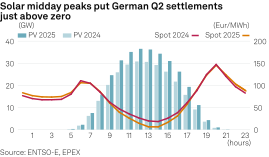
German solar energy generated a record 29 TWh of electricity in Q2, with output exceeding 52 GW for the first time in June. But that barely reduced the overall average wholesale power price.
Cannibalization, a phenomenon where increased solar generation leads to lower electricity prices during periods of high output, depressed the so-called capture rate for solar to under 33% in Q2, the lowest quarterly average on record, with the Q2 average falling below Eur23/MWh.
Platts, part of S&P Global Energy, assessed daily capture prices for German solar in a range from minus Eur64.31/MWh to Eur102.56/MWh during the quarter.
The number of negative hours rose by around 50% to over 300 in Q2, while the number of zero hours also increased.
Negative hourly prices trigger various payment halts under the EEG regulation.
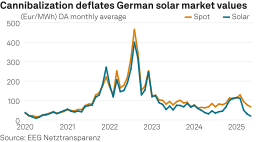
German Solar, Wind Market Values (Eur/MWh)
| Q2-2025 | Q2-2024 | Jun-25 | Jun-24 | |
| Spot Average | 69.76 | 71.31 | 63.99 | 84.45 |
| Solar | 22.94 | 38.64 | 18.43 | 46.35 |
| Onshore Wind | 62.09 | 55.88 | 51.41 | 63.56 |
| Offshore Wind | 64.93 | 58.01 | 58.23 | 65.33 |
Source: EEG Netztransparenz.de
Reality check ahead
Germany's new government plans to reform the EEG system and adjust expansion targets following a "reality check" or monitoring report on energy transition milestones.
Energy Minister Katherina Reiche indicated that overall system cost will be the focus of the report by external consultancies to measure success rates, rather than the previous administration's focus on installed GW capacity.
Solar association BSW warned in a July 4 statement that installed solar capacity only reached half of the 215 GW target set for 2030 under the EEG law and that capacity growth showed signs of a slowdown following an unprecedented boom that doubled installed capacity in just over four years.
Payouts to renewable assets owners from the EEG account rose to Eur2.43 billion in June alone amid a widening gap between market prices and contract values under various EEG schemes.
Solar, especially legacy feed-in tariffs for rooftops, accounts for the lion's share of the payouts.
The government had to inject another Eur2.40 billion in June from the federal budget to balance the EEG account, bringing federal subsidies for 2025 to date to Eur7.3 billion.
Higher market values in Q1 reduced the payments by 43% to under Eur2 billion amid a lull in wind and higher gas prices.
The EEG account balances guaranteed payments to green energy producers with monthly market income and was until 2022 financed via the EEG levy on consumer bills.
Some 87 GW of large-scale solar and wind assets were registered to receive the EEG market premium for July, while some 25.6 GW of large-scale solar and wind assets opted out, the latest monthly EEG data showed.
In total, Germany's installed wind and solar capacity is to hit 200 GW next year, forecast to generate around 255 TWh or just over half of German power demand, assuming average weather conditions.

Editor: