Crude Oil
November 25, 2025
Russia, China deepen energy ties as Western sanctions bite
HIGHLIGHTS
Russia seeks more long-term energy contracts with China
Sechin cites $20 billion savings from Russian oil imports
Chinese crude imports from Russia fall 7.7% on year
Senior Russian energy officials met their Chinese counterparts in Beijing Nov. 25 to bolster ties in the face of Western sanctions, as China's refineries have increasingly pivoted to importing more discounted Iranian crude.
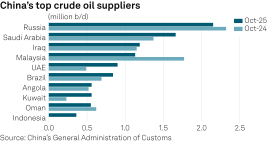
Russia has remained China's largest crude supplier, but those flows fell to 2 million b/d (83.15 million metric tons) in the first 10 months of 2025, down 7.7% year over year, according to data from China's General Administration of Customs.
The decline came as Iranian crude became more competitive for China's independent refineries over barrels from Russia, while tightening sanctions have discouraged China's state-run companies from taking seaborne Russian crude for the remainder of 2025, Platts, part of S&P Global Energy, has reported.
The value of China's Russian crude imports also fell to $42.06 billion in January-October from $52.84 billion in the same period a year earlier, the GAC data showed.
Amid these dynamics, Moscow dispatched Deputy Prime Minister Alexander Novak and Rosneft CEO Igor Sechin, among other officials, to the seventh Russia-China Energy Business Forum in Beijing.
In a statement, Novak said Russia was seeking to expand long-term hydrocarbon supply contracts. He added that technological cooperation, implementing joint gas transportation projects, and developing cross-border infrastructure and logistics also play a role in joint energy security cooperation, the statement said.
"Russia is committed to the closest possible partnership with China in the energy sector across all areas of cooperation. I am confident that integrating the efforts of the two countries in traditional and new energy sectors will ensure the sustainable development of our economies and create a technologically balanced energy landscape for the long term," Novak said.
Sechin said Russia could be a secure supplier for Europe and Asia.
"Let me remind you that, like China, Russia has been under increasing external pressure for many years. The primary goal of this pressure is to push our country out of the global market. The experience of the last 10 years has shown that these attempts are doomed to failure," Sechin said during the opening of the forum, according to a Rosneft statement.
As Russia has reoriented its trade and security relations toward the East, it has become China's top oil supplier with a share of about 20% of its imports, Sechin said.
"Owing to higher efficiency of purchasing Russian oil versus an alternative from the Middle East, the cumulative economic effect for China from the year 2022 in our estimates is about $20 billion," Sechin said.
Chinese President Xi Jinping sent a congratulatory letter to the forum, emphasizing that China is willing to work together with Russia to continuously consolidate their comprehensive energy partnership, jointly maintain the stability and smooth operation of the global energy industrial and supply chains, and promote the establishment of a more fair, just, balanced and inclusive global energy governance system, state-backed Xinhua agency reported Nov. 25.
Challenges amid sanctions
Chinese oil companies have not yet released statements from the forum, but Beijing-based sources with knowledge of the China-Russia energy relationship said representatives from the entities attended the event.
The forum was held following the latest round of intensive sanctions on Russian energy, including US sanctions targeting Russia's two largest oil producers, Rosneft and Lukoil, as well as the EU's 19th Russian sanctions package, which for the first time targeted a Chinese state-run trading company, Chinaoil (Hong Kong) Co. Ltd, a state-owned refinery, Liaoyang Petrochemical, and the private mega refinery Yulong Petrochemical.
China's small independent refineries, which have minimal exposure to the global market, are the main buyers of Russian seaborne crude as their state-run peers stepped away.
China's independent refineries imported 761,000 b/d (3.22 million mt) of Russian crude in October, surging 42.9% from 533,000 b/d in September, Platts data showed. Among the October arrivals, 1.03 million mt went to Yulong Petrochemical, more than double from 500,000 mt in September.
Chinese refiners are awaiting the government's release of crude import quotas for the remainder of 2025.
"Once they gain additional crude import quotas, they may bring more cheap feedstocks into China -- not only Russian, but also Iranian barrels," a Shandong-based trader said.

Editor: