Crude Oil, Refined Products, Maritime & Shipping
November 05, 2025
COP30 platform to discuss climate costs of conflict, as Ukraine invasion continues

HIGHLIGHTS
Some states prioritizing energy security over energy transition
Legal, ethical challenges in military emissions attribution
Russian refineries, Ukrainian power assets under attack
Some of the world's leaders, scientists and activists will be pushing for better reporting on militaries' climate impact, as well as energy security strategies that center around greener energy, during the 30th UN Climate Change Conference in Brazil over Nov. 6-21.
COP30 is taking place as Russia's invasion of Ukraine continues, causing widescale damage to Russian refineries and Ukrainian power assets, and generating significant greenhouse gas emissions. The conflict has triggered major supply concerns and price volatility, as active fighting and sanctions led to supply disruptions in one of the world's key commodities production and supply regions. This has recalibrated how many European countries view their energy transition targets and led to increases in military spending.
For others, the conflict is a sign that governments should be prioritizing green projects as part of their energy security plans.
Maxim Timchenko, CEO of Ukraine's largest private energy company DTEK, said that the war has accelerated the company's shift into decentralized energy assets like renewables, as a way to strengthen Ukraine's energy security.
"Renewables are no longer just about sustainability -- they are about resilience. Decentralized energy assets like wind turbines, solar panels and battery storage are not only harder to destroy, but also faster to fix," he said.
Russia has targeted many of DTEK and other Ukrainian energy companies' assets since it launched its full-scale invasion of Ukraine in February 2022.
Jens Wenzel Kristoffersen, a defense analyst working as Commander in Danish Defense Command - Navy Projects, said that discussions on the climate impact of military operations went on hold when Russia invaded Ukraine.
"And for at least the Danish defense side, everything has been focused on re-establishing combat power... Then climate change simply just faded out into something which is just an appendix in the policy programs," he said.
Kristoffersen added that countries need to make clear statements with concrete targets and timeframes on mitigating the climate impact of militaries. He sees using greener fuel in shipping and road transport as one of the most promising ways to reduce the climate impact of military operations.
Denmark is a member of NATO, which in June 2025 agreed that member countries will invest 5% of gross domestic product annually on core defense requirements and defense- and security-related spending by 2035.
Luiz Inacio Lula da Silva, the president of COP30 host Brazil, has criticized this approach.
"It is easier to allocate 5% of GDP to military spending than to commit the 0.7% promised for Official Development Assistance. This shows that the resources to implement the 2030 Agenda do exist -- they are simply not made available due to a lack of political will," he said, according to a statement from the BRICS group of countries.
NATO declined to comment for this article. It said previously that it has committed to integrating climate change considerations across its core tasks, as well as establishing a Centre of Excellence for Climate Change and Security.
A major challenge is creating accurate assessments of the climate impact of militaries and conflict. Researchers may include factors such as arms production, explosions and fires, military and civilian transportation, and the cost of post-war reconstruction, but there is no consensus on methodology, or obligation for states to report military emissions to the UN.
In a report published in 2022, Scientists for Global Responsibility and the Conflict and Environment Observatory said that their best estimate of the militaries' operational greenhouse gas emissions was 500 million mtCO2e, or around 5.5% of the global total, and that is just in peacetime.
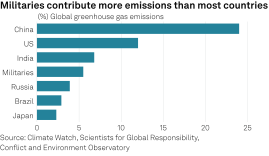
Executive director of SGR Dr Stuart Parkinson said that the increase in NATO's military spending over the five years 2019-24 has led to an increase in its military carbon footprint of about 64 million mtCO2e, in a report analyzing research into the relationship between military spending rises and greenhouse gas emissions.
More planned increases are likely to lead to an additional rise of about 132 million mtCO2e, he said, noting that the uncertainty in these figures is high.
A further problem is that emissions are reported to the UN on a national basis, raising questions about how to attribute emissions linked to wars waged abroad and countries' military bases on foreign soil.
Ellie Kinney, Advocacy Climate Coordinator at the Conflict and Environment Observatory, who will be attending COP30, said that there needs to be a standardized approach, and these emissions need to be included in reporting under the United Nations Framework Convention on Climate Change.
"We need an internationally agreed framework for conflict emissions tracking and accounting, and figuring out where this accountability lies," she said.
Kinney said that the estimates have huge variability because they are based on patchy data that is hard to rely on.
She attributes this partly to military emissions being excluded from the Kyoto Protocol, and the subsequent Paris Agreement only allowing for voluntary reporting. This differentiates the military from other branches of trade and industry, which have had to collect and report some emissions data for many years.
There have also been some attempts to address the legal responsibility of states for emissions linked to military activity.
These emissions were not included in a landmark opinion issued by the International Court of Justice on July 23, which said that countries must address the threat of climate change.
The court did hear some evidence about the climate impact of military activity, including from a delegation representing Palestine. A presiding judge, Sarah Cleveland, said in an independent declaration released alongside the ruling that states are obliged to assess, report on, and mitigate harms to the climate resulting from armed conflict and other military activities.
"Failing to take such harms into account underreports and distorts our understanding of global warming and undermines the ability of the international community to tackle its causes," she said.
Energy targets
Research into the impact of Russia's full-scale invasion of Ukraine could provide a framework for future accounting.
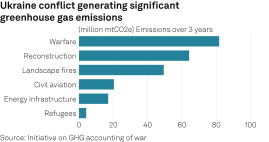
The Initiative on GHG Accounting of War estimates that greenhouse gas emissions attributable to the conflict in its first three years totaled almost 237 million mt of CO2 equivalent, it said in a report published Oct. 8.
The report said that warfare was the largest source of emissions, adding up to 81.7 million mtCO2e in the first three years of the war, with fossil fuels used by tanks and fighter jets making up the brunt of warfare emissions.
Ukraine is also targeting Russian refineries, as it attempts to cripple Russia's ability to meet fuel demand and secure revenues to finance its invasion of Ukraine.
S&P Global Energy said that as of the end of October, about 1.5 million b/d, or around 20% of Russia's total capacity was offline due to the attacks. It estimates that Russian crude runs fell to 4.8 million b/d in October.
Rebeka Foley, Senior Principal Analyst at S&P Global Energy, focusing on refined products, said that outages have been at around this level since August, reflecting that Russia has managed to bring capacity back online.
"However, if we see a prolonged period, which we're already starting to see a little bit of, strikes that could have a greater impact both on Russian refining, Russian domestic product supply and global markets," Foley said.
Ukrainian attacks have caused significant disruption to Russian oil refining and products supply in recent months. S&P Global Commodities at Sea data shows that Russia exported 1.165 million b/d of oil products by sea in October, down from 1.339 million b/d in July. Russia has redirected some crude volumes from refineries to export. Its seaborne crude exports were 4.11 million b/d in October, up from 3.46 million b/d in July. Discounts on Russian crude have grown, with Platts assessing Urals crude at a $12.4/b discount to Dated Brent on Oct. 31.
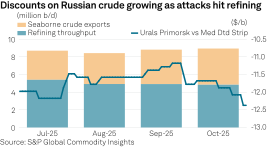
Foley said that diesel cracks have been inching up seasonally, but are not spiking, which could be a sign that the market is adjusting.
"Supply risks and risk premiums surge prices when there's a shock, but we're kind of in a sustained shock now, which means that there's less of a boost there," she said.
Platts has also recorded attacks on agriculture, chemicals and nuclear facilities, which have intermittently hit markets since the conflict broke out in Ukraine.
The future of peace talks between Russia and Ukraine, as well as the success of a Gaza peace plan agreed in early October could play a significant role in attacks on commodities infrastructure, as well as global emissions levels in the coming years.

Editor: