Crude Oil, Maritime & Shipping, Refined Products
October 23, 2025
FACTBOX: US, EU sanctions on Russian energy giants target Asian crude flows
HIGHLIGHTS
Crude prices surge on supply disruption risks
New sanctions target major Russian oil exporters
Asian buyers scramble to replace Russian crude
Global crude prices surged Oct. 23 after the US and EU ratcheted up sanctions on some of Russia's largest energy companies, targeting major oil flows to India and China.
The US imposed sanctions on Rosneft and Lukoil late Oct. 22, while the EU on Oct. 23 issued full transaction bans on Rosneft and Gazprom Neft, as well as sanctions on Lukoil subsidiary Litasco and the trading arm of China's largest energy company, PetroChina.
The sanctions, which follow similar measures from the UK on Oct. 15, mark a significant escalation in Western efforts to degrade Russia's ability to fund its war in Ukraine, with US Treasury Secretary Scott Bessent stating the moves respond to Putin's "refusal to end this senseless war."
S&P Global Energy analysts expect a gradual but meaningful shift in crude trade flows as Asian buyers seek alternative supplies. Middle East crude differentials have surged on the news.
"This is expected to be bullish for crude oil, particularly for Middle Eastern and American grades, which India and China will increasingly purchase to replace Russian crude. The resulting ripple effect may tighten diesel supply and available bunker ships," Commodities Insights analysts said in a note.
The following are key facts about the sanctions' impact on global crude markets:
Trade flows
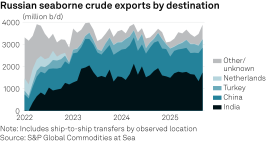
Asian buyers are already scrambling to secure alternative crude supplies as Russian barrels face increased sanctions risk. Rosneft and Lukoil export 3.1 million b/d of oil, according to the UK government. Rosneft alone accounts for nearly half of all Russian oil production and approximately 6% of global output.
- India, which sources roughly one-third of its crude from Russia, has told the US it will halt Russian oil purchases gradually, according to US President Donald Trump.
- China's crude imports from Russia averaged 2.02 million b/d in September, up 7.8% from August's seven-month low, according to Chinese customs data.
- Indian refiners diversified import baskets in Q3, increasing volumes from Colombia, Canada and the Middle East, but still took 1.68 million b/d from Russia, according to tracking data from S&P Global Commodities at Sea.
- India's state refiners may scale back Russian barrels to avoid secondary sanctions on shipping and banking.
- OPEC+ supply increases may help fill the gap as Asian buyers substitute Russian crude with Middle East grades, traders said.
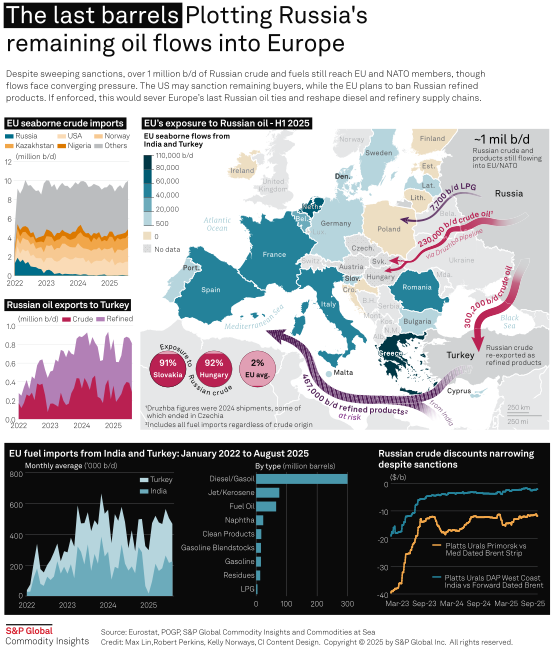
- Diesel restocking ahead of winter and the EU's 18th sanctions package may tighten available supply from India.
Prices
Crude futures and Middle East crude differentials surged following the sanctions announcement as markets priced in supply disruption risks.
- ICE December Brent futures were up $3.18/b (5.08%) to $65.77/b as of 1312 GMT on Oct. 23.
- The November-December Dubai futures time spread widened to 90 cents/b, more than double Oct. 22's 32 cents/b close.
- The cash Murban premium against Dubai futures jumped from $2.20/b on Oct. 22 to more than $3.47/b.
- Middle East crude differentials had hit near three-year lows before the latest sanctions announcements, with Dubai at a premium of 48 cents/b on Oct. 17.
- Indian refiners face a potential reduction in gross refining margins previously boosted by discounted Russian crude.
- Physical Russian crude discounts may remain attractive enough for some buyers willing to risk sanctions exposure.
Infrastructure
The sanctions target companies controlling significant portions of Russia's oil production and export infrastructure.
- The EU's sanctions also included two Chinese state-owned refineries: Yulong Petrochemical Co. and Liaoyang.
- The 400,000 b/d Yulong, which was also recently sanctioned by the UK, sources millions of barrels of Russia's Urals crude through the Eastern Siberia-Pacific Ocean oil pipeline, while PetroChina's Liaoyang is the only Chinese refinery running exclusively on Russian oil, according to the EU.
- Rosneft accounts for nearly half of all Russian oil production and approximately 6% of global output.
- Combined, Rosneft and Lukoil operations represent 3.1 million b/d of oil exports according to the UK government.
- Gazprom, Gazprom Neft and Rosneft own 20 Russian refineries in total with a combined crude processing capacity of close to 3 million b/d.
- Rosneft's German subsidiary, Rosneft Deutschland, also still holds stakes in three refineries, currently held under government trusteeship. The company was last instructed to sell the assets before a deadline of March 10, 2026.
- The European Commission also designated 117 new shadow tankers used to sell Russian oil above its price cap threshold, adding to a current blacklist of 442 vessels.
- The UK previously sanctioned 44 oil tankers alongside Rosneft and Lukoil on Oct. 15.
- The US secondary sanctions risk extends to shipping, banking and insurance sectors facilitating Russian crude trade.
- Pipeline infrastructure from Russia to China remains operational but faces increased scrutiny.
