


Agriculture, Energy Transition, Biofuel, Renewables
September 23, 2025
WORLD HYDROGEN: India aims for key hydrogen market role on global stage
HIGHLIGHTS
Investing in infrastructure, executing projects key challenges
Aims for hydrogen export hub, meeting domestic demand
Pushes for adoption across all sectors, industry collaboration
India is pushing ahead with ambitions to become a key participant in the global hydrogen market via new investments and policies, while the sector looks to overcome project costs, access to infrastructure and production at scale through effective public-private sector collaboration.
Delegates scheduled to attend World Hydrogen India Sept. 25-26 in New Delhi said the country is uniquely placed to develop an effective renewable hydrogen trading hub and help discover a market price that would eventually create efficiencies and help bring down costs.
"What is required at this point is to cut through the mysticism and get onto the exciting part -- that is, how to invest the capital in hydrogen and put in place the mechanisms and the infrastructure to support that market space. That alignment around size, investment and capital is what really is required at this launch pad to get this market going," said Dave Ernsberger, co-president at S&P Global Energy.
The conference, organized by Energy, will bring together India's decision-makers and industry experts to examine regulatory frameworks, investment opportunities and technological innovations shaping the country's hydrogen economy.
"India is building one of the world's largest green hydrogen ecosystems under Prime Minister Narendra Modi. Green hydrogen will be India's fuel of the future, and we have a target to produce 5 million mt of green hydrogen annually by 2030," said Petroleum Minister Hardeep Singh Puri.
Pragmatic approach
The government is keen to accelerate progress toward renewable hydrogen, though industry officials note that India should adopt a more pragmatic approach and aim to look at all categories of hydrogen. By the time green hydrogen costs come down, India will have its supply and distribution infrastructure in place.
"There are so many routes available, but ultimately we have to all move to green hydrogen. My view is that since green hydrogen is expensive and is not available in larger quantities, let's not wait for that to happen," said RK Malhotra, president of the Hydrogen Association of India.
According to Anri Nakamura, principal analyst for hydrogen at Energy, India has already laid a solid foundation for green hydrogen through the National Green Hydrogen Mission and Strategic Interventions for Green Hydrogen Transition program. Federal and state-level incentives -- like fee waivers and energy banking -- have driven down costs, as seen in recent low-priced "green ammonia" auctions. The next step is turning domestic successes into exports.
"India's green hydrogen future is promising but complex. Domestically, it must balance higher costs with development goals -- yet this challenge also opens doors for job creation, renewable expansion, and water access. Globally, slower European market growth expectations in the near-term means India will need to build internal demand if they are to reach their target production level," she added.
Early mover advantage
India's potential to become a low-cost hydrogen supplier depends on sustaining its early momentum against strong competitors and securing offtake agreements. China is already ahead in the renewable hydrogen sector, having built a robust electrolyzer supply chain and generated significant demand through state-owned enterprises, according to Energy.
"The next 5-10 years are crucial for India to establish itself as a preferred global supplier and to maintain that lead over time," Nakamura said.
India's National Green Hydrogen Mission targets an annual production of 5 million metric tons of renewable hydrogen by 2030 and also sets a goal of capturing 10% of the global trade. Indian developers are hoping to gain a low-cost advantage, which, in addition to its geographical location, can enable exports to the EU, Japan and South Korea.
Platts, part of Energy, assessed Saudi Arabia hydrogen produced using alkaline electrolysis (including capital expenditures) at $4.10/kg on Sept. 22, nearly the same as a month ago. South Australia hydrogen produced using alkaline electrolysis (including capex) was assessed at $1.57/kg Sept. 19, down 79% from a month ago.
Encouraging signs
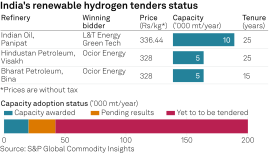
India recently concluded 13 auctions for supplying 724,000 metric tons per year of renewable ammonia to fertilizer companies at lower-than-expected prices, a move that could help kick-start a domestic trade for renewable fuels. In addition, two refineries awarded their own tenders for building renewable hydrogen plants for captive use.
"We are not only pushing the usage of hydrogen for mobility, but we want a hydrogen economy to be developed and let hydrogen be used in various sectors of the economy. India has the potential to produce green hydrogen at a lower cost as compared to the rest of the world. And with Indian electrolyzer manufacturing, the government has been providing a lot of support. If that also starts happening, we will see prices gradually coming down," Malhotra said.
