Refined Products, Gasoline, Diesel-Gasoil, Fuel Oil
September 10, 2025
FUJAIRAH DATA: Oil product stockpiles rebound as fuel oil imports climb
By Claudia Carpenter and Nicholson Lim
HIGHLIGHTS
Fuel oil imports from Kuwait, Russia, Iraq
More gasoline heading for Pakistan
Total inventories up 3.1% for the year
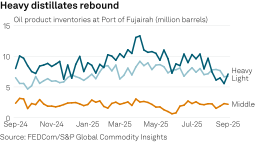
Oil product inventories at the UAE's Port of Fujairah rebounded 10% in the week ended Sept. 8, led by a 28% rise in fuel oils, according to Fujairah Oil Industry Zone data published Sept. 10.
The total rose to 16.024 million barrels after falling to the lowest since November 2024 a week earlier. Stockpiles are up 3.1% since the end of 2024.
Heavy distillates used as fuel oils for shipping and power generation increased to 7.095 million barrels after dropping to the lowest since February 2018 a week earlier. They are down 5.4% so far this year.
Stockpiles of middle distillates, including jet fuel and diesel, fell 5% to 2.188 million barrels, the first drop in three weeks. They are up 11% since the end of 2024.
Light distillates such as gasoline and naphtha rose 1.3% to 6.741 million barrels, the first increase in three weeks, after falling to a six-month low a week earlier. They are also 11% higher this year.
The jump in fuel oil stockpiles followed more imports from several countries, led by Kuwait. Preliminary refined product exports are averaging more than 1 million b/d in September, compared with 669,000 b/d in August, according to S&P Global Commodities at Sea.
Fuel oil imports to Fujairah are averaging 53,000 b/d from Kuwait this month, the most since June, while Russia is sending 51,000 b/d, Iraq 33,000 b/d, Georgia 19,000 b/d and Saudi Arabia 15,000 b/d, according to the shipping data.
Pakistan is set to get 103,000 b/d of gasoline from Fujairah, while another 68,000 b/d of gasoline and a record-high 74,000 b/d of gasoil are headed for Saudi Arabia, according to the ship tracking data.
Bunker demand mixed
Downstream demand for low sulfur fuel oil recently slowed amid strengthened valuations at Fujairah, which eroded its price competitiveness versus prices around the Singapore hub, thus plateauing the overall flow of inquiries.
Straight-run low sulfur fuel oil cargoes are reportedly swung towards Fujairah to replenish components for the marine fuel blending pool owing to a recent supply crunch for Dar blend crude arising from recent diplomatic frictions.
Thus, traders mostly expect LSFO delivered premiums to soften gradually in the upcoming trading days, though forward barging schedules are still slightly extended in the week of Sept. 8-12.
Platts assessed the Fujairah-delivered LSFO marine fuel premium over FOB Singapore cargo values at an average of $14.46/mt over Sept. 1-9, almost double the $7.68/mt for all of August.
On the other hand, the mostly brisk high sulfur fuel oil demand managed to balance demand and supply, though shipment inflows are also keeping stocks mostly ample in the near term.
Still, traders noted fewer inflows of regional barrels recently to also slow any potential HSFO stock build, keeping viable profit margins with reasonable delivered versus ex-wharf cargo price spreads.
Platts assessed the Fujairah-delivered 380 CST HSFO bunker premium to the 380 CST 3.5%S FOB Arab Gulf fuel oil cargoes at an average of $15.14/mt so far in September, up from $112.50/mt in August.
Platts is part of S&P Global Energy.
