Crude Oil, Refined Products, Gasoline
September 09, 2025
'Significant' inventory builds to fuel crude price declines, US EIA projects

HIGHLIGHTS
STEO sees Brent falling to $51/b in 2026, WTI at $48/b
Inventory growth to average 2.1 million b/d in H2 2025
US drivers' 2026 gasoline costs projected lowest since 2005
Crude prices will continue to "significantly" decline in late 2025 and throughout 2026, the US Energy Information Administration projected, as the summer driving season wanes and global oil inventories and overall supplies experience parallel growth in the months to come.
Brent crude spot prices fell from an average of $71/b in July to $68/b in August, the EIA said Sept. 9 in its September Short Term Energy Outlook. It projected an average Brent price of $59/b in the fourth quarter of 2025 and a decline to $49/b by March 2026. The agency expects 2026 Brent crude prices to average $51/b, while WTI would average $48/b.
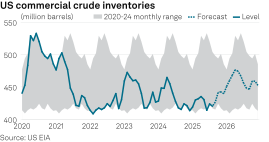
Expected average inventory builds of 2.1 million b/d in the second half of 2025, with expectations for elevated inventories throughout 2026, will put "significant downward pressure on oil prices," EIA wrote. Subsequently lowered prices should "lead to a reduction in supply by both OPEC+ and some non-OPEC producers, moderating inventory builds later in 2026."
The forecast was finalized before OPEC+ announced Sept. 7 that it would raise production by an additional 137,000 b/d beginning in October.
Declines in crude prices should dovetail with a drop in US gasoline prices, the September STEO said, with the US average retail price for regular-grade gasoline declining to an average of $3.10 in 2025 -- about 20 cents/gal lower than in 2024 -- followed by a further fall to $2.90/gal in 2026. US drivers' gasoline expenditures as a share of total disposable personal income could be the lowest since 2005 (excluding during the COVID-19 pandemic in 2020), even as drivers are expected to slightly increase overall consumption in 2026, EIA said.
"The good news for consumers is that we are generally seeing lower prices at the pump, and we expect gasoline prices to keep trending lower through next year," EIA acting Administrator Steve Nalley said in a statement.
Excess supply
EIA said it observed some lag between current global inventory builds and declines in oil prices in recent months. Inventory builds averaged an estimated 1.6 million b/d between May and August, but "global prices have not fallen significantly" in that period.
"This disconnect is likely the result of some of the excess production ending up in observable strategic reserves, particularly China, or other stockpiles used by countries for domestic consumption," the forecast said.
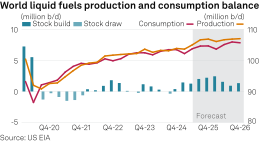
Still, EIA noted that OECD inventories have recently moved above their previous seasonal average range (from 2018-2024), and recent growth in OECD inventories "suggest some excess supply is beginning to show up." After a spike in inventory builds in the remainder of 2025 and the first quarter of 2026, global supply is expected to outstrip demand by an average of 1.6 million b/d across 2026.
"We forecast that inventory builds will moderate in 2026 due to a combination of higher global oil demand and slightly lower oil production growth, both in response to lower oil prices," EIA said.
EIA also noted continued "significant uncertainty" in its forecast, including ongoing Middle East tensions, negotiations in the Russia-Ukraine war, the potential for OPEC+ to revise its production plans, and trade disputes -- including domestic legal challenges to US President Donald Trump's tariffs on trade partners.
US policy
EIA largely maintained its August projections for US production -- when it forecast a peak of 13.6 million b/d of US production in late 2025, largely thanks to improvements in well efficiency -- in its September update. Still, it foresaw US production declining from an average of 13.4 million b/d in 2025 to 13.3 million b/d in 2026.
Lower prices are expected to further reduce US rig counts and capital expenditures. Many US companies advising reduced spending programs in their Q1 and Q2 2025 earnings reports, reductions EIA has said could see production decline to 13.1 million b/d by the end of 2026.
Under US President Donald Trump, federal agencies and congressional Republicans have introduced a variety of deregulatory measures on the fossil fuel industry, including more lease sales on federal lands and waters, a return to pre-Inflation Reduction Act royalty rates, and changes to commingling rules.
Still, increased input costs on tubular goods and other supplies -- the result of sweeping sectoral tariffs on steel and aluminum -- and the weakening price environment have spurred contractions and pessimism in the US oil patch.
The Dallas Federal Reserve Bank's Q2 survey of executives from 136 firms, published July 2, showed broadly negative sentiment, with many anonymous respondents criticizing the administration for pursuing $50/b WTI as a policy goal.
"There is constant noise coming from the administration saying $50-per-barrel oil is the target," one anonymous executive wrote in the survey's comments section. "Everyone should understand that $50 is not a sustainable price for oil. It needs to be mid-$60s."
Jarrod Agen, executive director of the National Energy Dominance Council, said Sept. 4 that the administration was speaking to companies in the Permian "on a daily basis" -- but that the industry's interests would not always align with the President's goals.
"We 100% believe 'drill, baby drill' can happen this year," Agen said at an event at the Center for Strategic and International Studies in Washington. "At the end of the day, the President wants the price at the pump to be low. That doesn't always coordinate with what industry wants. But we work for the President, and so we're going to do what the President wants."
