Crude Oil, Refined Products, Chemicals, Diesel-Gasoil, Gasoline
September 09, 2025
APPEC: Chinese refiners urged to streamline, with domestic fuel demand at risk
HIGHLIGHTS
New energy vehicles eroding traditional fuel consumption
2 mil b/d refining capacity may close in 3-5 years: Rongsheng
Greater focus on fuel exports, petrochemicals urged
China's refining sector must pursue structural reforms, including plant closures, increased fuel exports and a shift toward petrochemical production, as domestic oil demand faces a looming peak, industry experts said at APPEC 2025 in Singapore over Sept. 8-9.
One senior official from a state-owned oil company said on Sept. 8 during the event, hosted by S&P Global Energy, that China's demand for transportation fuels has already peaked, while overall demand for petroleum liquids, including feedstocks for petrochemical production, is expected to begin declining in 2027.
The official, who asked not to be identified to discuss market-sensitive matters, said the Chinese refining sector -- the world's largest -- faces severe pressure as the rapid adoption of new energy vehicles erodes traditional fuel demand, and it would not be surprising if penetration reaches 100% in the future. Advancements in technology are driving NEV penetration.
"For instance, Dalian, a city in northeast China where temperatures often drop to minus 20-30 C, has seen a remarkable 48% penetration rate," the official said. "With the latest electric vehicles capable of traveling approximately 600 km on a single charge, concerns about mileage are becoming obsolete."
According to a report by Sinopec Economics & Development Research Institute, China's gasoline consumption is projected to fall 4.8% year over year to 163 million mt in 2025, following a 1.1% decline in 2024. NEV sales are forecast to reach 15.84 million units next year, capturing 52% of all new passenger car sales.
Han Guangzhong, vice president of CNOOC Energy Economics Institute, highlighted a rapid transition in the heavy truck sector during the panel discussion. He projected that by 2030, LNG heavy trucks could replace demand for 38 million metric tons/year of gasoil, up from the current replacement level of 10-20 million mt/year.
"The economics of using LNG heavy trucks will be better than that of gasoil heavy trucks when the price of LNG is about 20% lower than that of gasoil," Han said, emphasizing the economic incentive for the switch, on top of being cleaner than gasoil.
Sinopec's EDTI estimated China's gasoil consumption to fall by 5.2% year over year to 186 million mt/year in 2025.
Capacity cuts
To address overcapacity amid demand peaks, "the first way is to close some refineries, the second is to increase exports of clean oil products, and the third will be to transform from oil products to petrochemicals," the first senior official from a state-owned oil company said.
Li Xinhua, global head of trading at Rongsheng Petrochemical Co., said during a panel Sept. 9 that about 100 million mt/year (2 million b/d) of refining capacity would be phased out within three to five years.
China's refining capacity is nearing 1 billion mt/year (20 million b/d), according to industry sources, while crude throughput averaged 14.68 million b/d in the first seven months of 2025, data from the National Bureau of Statistics showed.
Chinese delegates told Platts, part of Energy, that small independent refineries without crude import permissions are likely to be the first eliminated due to fierce market competition for oil products.
Nationwide regulations, including tighter tax controls, stricter environmental requirements, and carbon emission standards, are expected to further reduce capacity.
In early August, the 5.8 million mt/year Wonfull Petrochemical in Shandong became the latest to declare bankruptcy, according to the Intermediate People's Court of Zibo in Shandong province. The refiner, once a leader in the independent refining sector, struggled after losing crude import quotas in June 2021, when it was removed from the crude import quotas allocation list.
Higher quotas urged
"We have called on the government to grant more export quotas, but it's still very challenging this year," the senior official said.
Sinopec's EDTI estimated China's demand for clean oil products to fall by 10 million mt in 2025, while supplies are expected to decline by 5 million mt, which would cause the surplus to rise by 5 million mt.
During APPEC, Chinese delegates estimated that the government would release about 9 million mt for clean oil products in the coming allocation, down from about 10 million mt in the previous estimation. This would bring the 2025 quotas to 41.375 million mt, nearly unchanged from 41 million mt in 2024.
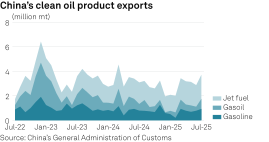
Beijing has discouraged oil product exports in recent years by limiting export quota allocations and cutting the value-added tax rebate. The government was unwilling to subsidize the outflows amid a worsening international trading environment. Moreover, pollution and avoiding importing more for exports are always the government's concerns, Platts reported.
As a result, gasoline, gasoil and jet fuel exports dropped by 11.3% year over year to 20.37 million mt in the first seven months of 2025, Chinese customs data showed.
Shift to petrochemicals
Both state-run and independent refineries have been shifting toward petrochemical production for about five years, with new chemical units coming online.
However, APPEC delegates cautioned that such an emphasis on petrochemicals is not a panacea. Hengli Petrochemical International CEO Janet Kong said Sep. 9 on a panel that chemical products tend to have a longer consumption lifespan compared to oil products, which are consumed almost instantaneously.
CNOOC's Han noted that while petrochemical demand remains a key growth driver for China's oil consumption, "incremental demand driven by petrochemicals will only compensate for the consumption fall in gasoline and cannot cover the drop in gasoil, so China's oil demand will still fall."
China's chemical industry is facing a prolonged downturn, with most plants operating at a loss due to overcapacity, APPEC delegates said.
Sinopec, the leading producer by capacity, reported a loss of Yuan 4.1 billion ($575.7 million) in EBIT for chemicals amid oversupply, deepening from a Yuan 2.14 billion loss in H1 2024. This came despite domestic ethylene equivalent consumption rising 10.1% year over year.
