Refined Products, Crude Oil
September 08, 2025
APPEC: Asia's oil demand seen strong amid tariff jitters and ample arbitrage trades
HIGHLIGHTS
US tariff hikes have minimal impact on consumer demand
China's stockpiling strategy aims for long-term energy security
Asian refiners capitalize on competitive US, Brazilian crude prices
Asia's oil demand has outperformed expectations in 2025, positioning the region as a key consumption center, driven by China's robust stockpiling and abundant arbitrage trading opportunities, according to industry executives at APPEC 2025 in Singapore on Sept. 8. Meanwhile, US tariff hikes have had little effect on consumers so far.
Oil consumption in Asia has exceeded forecasts, driven by factors including China's strategic stockpiling initiatives and India's burgeoning economy. These developments have placed the region at the forefront of the global energy market, despite looming external pressures such as US tariffs, according to Saad Rahim, chief economist at Trafigura, and Frederic Lasserre, global head of research and analysis at Gunvor Group, during a panel discussion at APPEC, hosted by S&P Global Energy.
Rahim said the impact of tariffs on demand is yet to materialize. While US companies have absorbed most of the tariff burden, the anticipated rise in consumer prices has not occurred.
Consequently, oil demand has remained stable, with consumers continuing to engage in purchasing patterns that support overall consumption, according to Rahim.
Lasserre agreed, noting that the full impact of tariffs may take time to become evident. "The data indicates that the majority of the tariff impact has been absorbed by US companies, with consumers only beginning to feel the pinch... This delay in consumer response could mean that oil demand remains resilient," Lasserre said.
China's stockpiling
China's approach to oil procurement has shifted significantly in recent months, as the country has actively engaged in stockpiling crude oil, supporting broader Asian demand fundamentals.
This strategy has been especially evident during periods of price declines, when the nation has taken advantage of opportunities to strengthen its strategic reserves. Rahim and Lasserre indicated that this stockpiling is not simply a response to market fluctuations, but a deliberate strategy to secure long-term energy supplies amid an increasingly volatile geopolitical landscape.
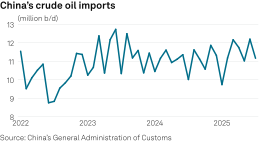
As the world's largest crude importer, China's demand plays a significant role in influencing global oil prices. Recent industry discussions suggest that the country's stockpiling activities have helped sustain elevated price levels, despite potential oversupply in other regions, according to Rahim.
Rahim said China's crude imports are expected to continue rising, particularly as the nation seeks to replenish its reserves to levels that align with its strategic goals.
Moreover, China's stockpiling coincides with relatively lower prices in the global oil market. This downtrend in benchmark oil prices has allowed Chinese refiners to optimize their operations while benefiting from favorable pricing conditions, according to a refining and feedstock analyst at a state-run Chinese refiner on the sidelines of APPEC.
Lasserre said the recent trends indicate that this stockpiling initiative will likely continue, further solidifying China's role as a key participant in the oil market.
Arbitrage window
Another key factor driving Asia's robust oil demand is the favorable arbitrage trade for crude from the Americas, according to Rahim and Lasserre during the panel discussion, as well as refining and trading operation managers at Japanese, South Korean and Indonesian downstream companies attending APPEC.
As US and Brazilian crude oil prices remain competitive, Asian refiners have seized the opportunity to enhance their refining margins. This increased influx of crude from the Americas has diversified supply sources, providing refiners with the flexibility to optimize their operations in response to fluctuating global prices.
The arbitrage trade has bolstered Asian refiners' profitability, allowing them to mitigate risks associated with supply disruptions from traditional sources. By tapping into North American crude supplies, Asian buyers have strengthened their negotiating positions and ensured a more stable supply chain, according to APPEC participants.
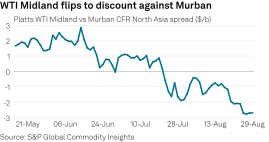
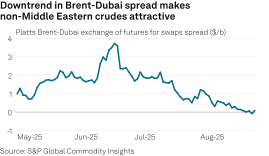
For Asian refiners, trading economics are increasingly favoring the intake of light sweet US crude, with WTI Midland priced lower than some Middle Eastern grades. Additionally, low-sulfur sweet crudes from Latin America, Oceania and Southeast Asia have become attractive options, as the Brent-Dubai price spread recently turned negative, according to South Korean and Japanese delegates attending APPEC.
Platts, part of Energy, assessed the Brent-Dubai exchange of futures for swaps spread -- a key indicator of Brent's premium or discount to the Middle Eastern benchmark -- at minus 8 cents/b on Aug. 27, marking its lowest level since minus 11 cents/b on March 21. The EFS spread was assessed at 57 cents/b on Sept. 5.
Furthermore, rising demand for refined products in Asia has encouraged refiners to explore new markets and expand their operations. By sourcing crude from multiple regions, Asian refiners are better equipped to respond to shifting market dynamics and evolving consumer preferences, according to Rahim and Lasserre.
